Descendant of two rulers, student of Ioan Slavici, wife of two Romanian prime ministers. The history of Elisa Brătianu
By Bucharest Team
- Articles
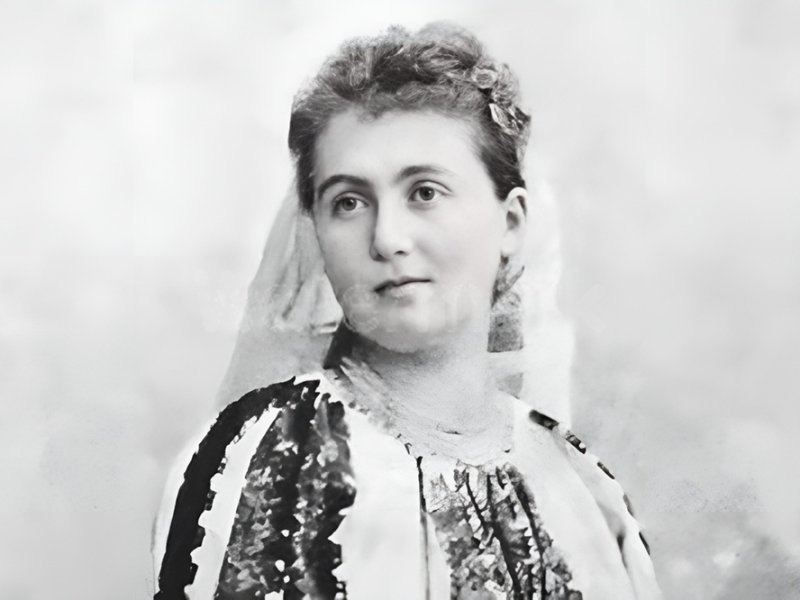
Elisa Brătianu, descendant of ruling families and a remarkable personality in Romanian cultural and political life, lived a life that seems taken from a novel. Born in a palace, educated in the spirit of culture and art, wife of two of Romania’s most influential politicians, and actively involved in the social and cultural life of the country, Elisa left behind a legacy that goes beyond mere aristocratic lineage. Intelligent, elegant, and talented, she spoke fluent French, English, and German, and her passion for culture and art remained even during the most difficult moments of her life. After the establishment of the communist regime in 1948, almost all of Elisa Brătianu’s wealth was expropriated, and the house in which she had lived for years was taken from her. This loss did not erase the memory of a life full of achievements and contributions to Romanian culture and civic life.
Childhood and noble origins
Elisa Brătianu was born on May 2, 1870, at the Știrbei Palace in Buftea, being the first child of Alexandru B. Știrbei (1837–1895) and Maria Știrbei, born Ghica (1851–1885). Her family stood out for its connection to Romanian history: among her most notable ancestors were Gheorghe Bibescu, ruler of Wallachia between 1842 and 1848, and Barbu Știrbei, his brother, who ruled between 1849–1853 and 1854–1856, the latter being Elisa’s grandfather.
From childhood, Elisa was educated at home, together with her brother Barbu and sister Elena. Although she did not attend formal high school, she became an extremely cultured woman. In her memoirs, titled “Involuntary Memories,” Elisa mentioned the decisive influence of Ioan Slavici, who introduced her to the poetry of Mihai Eminescu and contributed significantly to her intellectual and spiritual development.
Elisa’s childhood was happy, but marked by early tragedies. In 1885, her mother died at only 34 years old during the birth of the eighth child, leaving the family in grief and suffering. Ten years later, in March 1895, her father, Alexandru Știrbei, passed away, leaving eight children behind. These losses shaped Elisa, making her develop a strong character and remarkable adaptability.
Education and multiple talents
Elisa Brătianu was a polyglot, fluent in French, English, and German, and during World War I, she dedicated herself to learning Russian. She had multiple talents: she narrated stories with flair, wrote easily, had a penetrating mind, and a curiosity that made her quickly move from one domain to another. Her memoirs reflect her passion for culture as well as her ability to observe and analyze the world around her.
Marriages and family life
At 20, in 1890, Elisa married Alexandru Marghiloman, the future prime minister and a prominent figure of the Conservative Party, who was sixteen years older than her. Although Marghiloman was a doctor in law and political sciences in Paris and served multiple times as minister, their marriage did not last long, and the couple divorced after a few years.
At the beginning of 1907, Elisa married Ion I.C. Brătianu, known as Ionel Brătianu, a liberal leader and prime minister multiple times. The religious wedding took place at the Știrbei Palace in Bucharest, preserving her connection to her family of origin. This marriage brought her new responsibilities and consolidated her influence in Romanian society.
Relationships with the Brătianu family and social involvement
The memoirs of Sabina Cantacuzino, Ionel Brătianu’s sister, reveal the challenges Elisa faced in her relationship with her husband’s family: although initially feeling hostility toward certain habits and places, she tried to integrate and contribute to managing the estates and gardens. However, at times, her desire to make changes and take control created tensions.
Elisa’s civic spirit manifested concretely during the Bulgarian campaign of 1913, when she organized an ambulance service for cholera patients, financially supported by the Știrbei family and other prominent families. Her humanitarian work continued in Bucharest, in the salon of the Știrbei Palace and at the house on Amzei Street.
On the eve of World War I, Elisa established the workshop and shop “Albina,” dedicated to promoting Romanian folk embroidery, contributing to the preservation and promotion of cultural heritage.
Promoting Romanian art and traditions
Elisa Brătianu personally drew designs for traditional blouses (ii), coats, and other folk clothing items, publishing an album with the most successful works. At Florica, she founded a school of folk embroidery, training women and children and promoting traditional crafts.
During the interwar period, she also devoted herself to managing the Ion I.C. Brătianu Foundation and Library, supporting Romanian education and culture.
The Ion I.C. Brătianu Library and cultural legacy
One year after Ionel Brătianu’s death, Elisa, together with her brothers, sisters, and her husband’s collaborators, established the Ion I.C. Brătianu Library, an institution meant to preserve his memory and values.
The cornerstone was laid on June 5, 1929, and within a few months, Elisa donated her properties on Biserica Amzei Street, while the Brătianu brothers contributed nearly 6,000 volumes from the Florica library. This initiative became a symbol of Romanian culture and education.
Later years and passing
Elisa Brătianu passed away on May 13, 1957, at the age of 87, following a traumatic shock caused by a third fracture to the same knee. She was buried two days later in the Rosetti family vault in Bellu Cemetery, Bucharest, leaving behind an undeniable cultural and social legacy.
Elisa Brătianu’s life was marked by nobility, culture, courage, and civic engagement. Descendant of ruling families, student of Ioan Slavici, wife of two prime ministers, and promoter of Romanian arts and traditions, Elisa demonstrated that the influence of a person is measured not only by social rank but also by real contributions to culture and community life.
The library and her efforts to promote Romanian traditions remain a living testament to her dedication to the country’s cultural and spiritual heritage.
We also recommend: Ionel Brătianu, “the good fortune of Romania,” right hand of King Ferdinand I. Introduced universal suffrage and “made” the Great Union