Why women were not allowed to walk unaccompanied on Podul Mogoșoaiei in past centuries’ Bucharest
- Articles
- 14 JAN 26
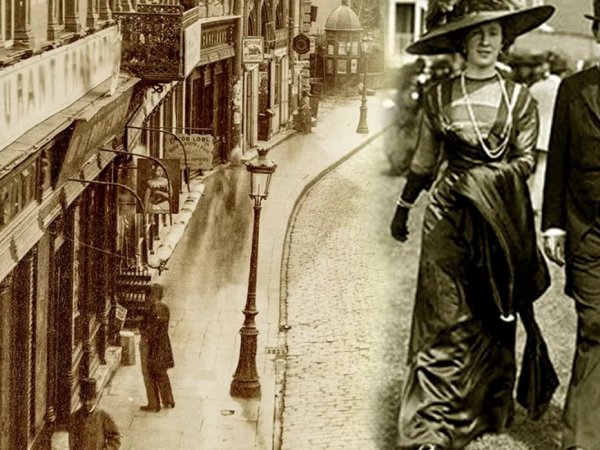
Bucharest, a city with a history of more than six centuries, hides numerous stories that today may seem hard to imagine. Beyond modern buildings, crowded boulevards, and the fast pace of urban life, the Capital was for a long time a space governed by strict rules, rigid social conventions, and mentalities that deeply reflected the values of past eras. One of the most surprising customs of old Bucharest is linked to Podul Mogoșoaiei, today’s Calea Victoriei, a place where women were not allowed to walk alone, without being accompanied.
This unwritten rule, respected strictly for generations, says a great deal about the status of women, about public morality, and about the way social life was organized in the city that would later become “Little Paris”.
Podul Mogoșoaiei, the first major artery of Bucharest
Before becoming one of the best-known and most elegant arteries of Eastern Europe, Calea Victoriei bore the name Podul Mogoșoaiei. The name was neither accidental nor metaphorical. In the 17th–18th centuries, the city’s roads were difficult to use, especially during rainy periods, when mud made movement almost impossible. The solution was paving important arteries with thick wooden beams laid transversely, which gave the impression of a continuous bridge.
Podul Mogoșoaiei was built in 1692, by order of Prince Constantin Brâncoveanu, to link the Princely Court with his estate at Mogoșoaia, where he would build the famous palace a few years later. The road thus became not only an access route, but also a symbolic axis of power, luxury, and aristocratic life.
Bucharest between tradition and modernization
Over the centuries, Bucharest went through extremely difficult periods: Ottoman, Russian, and German invasions, devastating epidemics, fires, and earthquakes. Nevertheless, the city also experienced moments of spectacular development. With the arrival of the 19th century, and especially after the establishment of the Royal House, the Capital entered an accelerated process of modernization.
The first streets illuminated with petroleum appeared, followed later by electric lighting, the horse-drawn tram was introduced, and commerce and cultural life diversified. Podul Mogoșoaiei became the main promenade artery, the place where “high society” met, where elegant shops, select cafés, and luxury stores opened.
In this context, strict rules of public behavior also emerged, especially regarding the presence of women in the urban space.
The unwritten rules of the female promenade
In Bucharest of past centuries, the presence of a woman alone on Podul Mogoșoaiei was viewed with suspicion. According to tradition and historical accounts, respectable ladies were not allowed to stroll unaccompanied along this important artery. They had to be accompanied either by their husband, a family member, a close friend, or even a servant.
This rule was not imposed by law, but functioned as an extremely powerful social norm. Respecting it was a matter of honor, reputation, and social status. A woman who ignored this custom risked being harshly judged by the community and losing her good name.
Morality, appearances, and social control
The main reason for this prohibition lay in the mentality of the time, which associated an unaccompanied female presence in public space with a lack of morality. In a deeply patriarchal society, women were perceived as needing protection, but also supervision. Freedom of movement was interpreted as a sign of excessive independence, incompatible with the feminine ideal of the era.
Thus, a woman walking alone on Podul Mogoșoaiei could be mistaken for a lady of the night or a “kept woman”, an extremely serious label in a society where reputation was social capital. Control was exercised not only by men, but also by other women, who contributed to maintaining these norms through judgment and marginalization.
Luxury establishments and the conditional access of women
The same rules applied to restaurants, cafés, and elegant venues of the city. In many of these spaces, women were not allowed to enter alone. Their presence was accepted only if they were accompanied by a man or by a respectable group.
A woman who dared to enter a fashionable establishment by herself risked being thrown out or, at best, looked upon with hostility. The staff could refuse service precisely to avoid association with scandal or immorality. Thus, public space became deeply segregated from a gender perspective.
From Podul Mogoșoaiei to Calea Victoriei
The change of name from Podul Mogoșoaiei to Calea Victoriei took place only in 1878, after the War of Independence. The new name reflected national aspirations and Bucharest’s status as a modern capital. Although the configuration of the road changed over time, the spirit of the place remained linked to elegance, prestige, and intense social life.
As the city modernized, the rigid rules regarding women’s presence in public space gradually began to fade. The first women appeared who went out alone for walks, shopping, or to cafés, a sign of profound changes in the mentality of society.
A rule that tells a larger story
The prohibition against women walking unaccompanied on Podul Mogoșoaiei is not merely a historical curiosity, but a window into how Bucharest society functioned in the past. It reflects power relations, gender roles, and the importance of appearances in a city situated at the crossroads between East and West.
Today, when Calea Victoriei is a space of freedom, relaxed strolls, and diversity, it is hard to imagine that, once upon a time, the same street imposed such strict rules. Precisely for this reason, such stories help us understand how much Bucharest has changed and how long the road toward freedom of expression and movement has been, especially for women.
We also recommend: Bucharest’s Calea Victoriei “breathes” history: the old Mogoșoaia Bridge was paved by Constantin Brâncoveanu with tree trunks