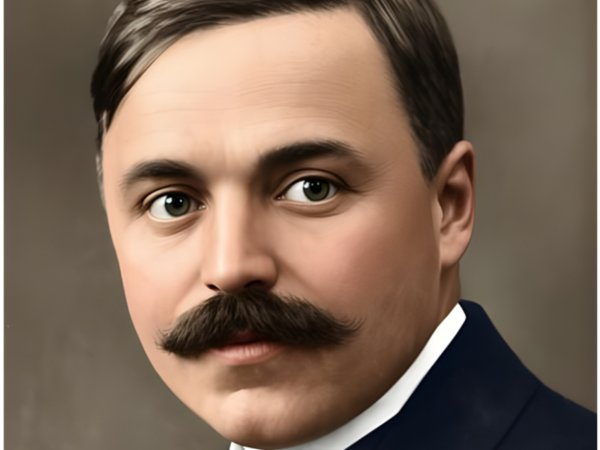
Who was Panait Cerna and why does he have a street named after him in Bucharest
- Articles
- 19 MAR 26
In the cultural landscape of Bucharest, the names of certain streets keep alive the memory of personalities who profoundly marked Romanian literature and culture. Among them is Panait Cerna, a poet of great sensitivity and depth, whose short but intense life left a strong imprint on his contemporaries. Although he did not have time to build a vast body of work, the value of his creations and the promise of an exceptional literary destiny were enough to secure him a place of honor in the history of Romanian literature. The fact that a street in Bucharest bears his name is not accidental. It is a form of recognition of his remarkable talent, but also of the impact he had on his generation and on the literary critics of his time. The story of Panait Cerna is, at the same time, one about ambition, vast culture, and a destiny cut short too early.
Modest origins and promising beginnings
Panait Cerna was born on September 25, 1881, being the son of a teacher from the locality of Cerna. He attended his primary school in his native village, in a modest environment, but one favorable to his intellectual formation. From childhood, he stood out through remarkable intelligence and a thirst for knowledge that would accompany him throughout his life.
Later, he continued his studies at high school in Brăila, and then reached the University of Bucharest, where he was initially attracted to philology, later turning toward philosophy. During this period, an essential role in his formation was played by Titu Maiorescu, whose vast culture and intellectual influence fascinated and guided him.
Described by George Călinescu as “a picturesque figure of the society of students in letters”, Cerna was a charismatic young man, admired in academic circles. This strong presence in the student environment already announced the emergence of a distinct literary personality.
Literary debut and the affirmation of poetic talent
At only 18 years old, Panait Cerna made his literary debut in the magazine “Revista modernă”, with the poem “Tristețea Leonorei”. It was the first step in a promising career, which would quickly take shape through appearances in important publications of the time.
Collaborations followed with magazines such as “Semănătorul”, where he published the poems “Cătră pace” and “În peșteră”, texts that drew attention to his sensitivity and poetic depth. At the age of 20, he appeared in “Convorbiri literare” with translations after François Coppée and Charles Baudelaire, demonstrating not only poetic talent, but also a solid literary culture.
The first important appreciations came from Mihail Dragomirescu, who noted his value in “Convorbiri critice”. In turn, Ion A. Rădulescu-Pogoneanu presented him to the Bucharest public as “a new poet”, emphasizing the important place he occupies in Romanian literature.
Poems such as “10 Mai”, “Spre Bucovina” or “Zile de durere” confirm Cerna’s artistic maturity and his ability to approach profound, social, and national themes.
Relationship with major critics and literary recognition
Panait Cerna’s talent did not go unnoticed by Eugen Lovinescu either, who dedicated an extensive study to him in the work “Critice”. This attention from such a caliber critic confirms the literary value of the young poet.
In the press of the time, his name frequently appeared in the context of conferences and cultural events. For example, in Curtea de Argeș, a conference dedicated to his work drew public attention to his exceptional potential.
Cerna stood out not only through talent, but also through his dignified attitude in the face of criticism. He was known for the balance and “Olympian bearing” with which he received both praise and criticism, without being excessively influenced by them.
Journalistic activity and numerous collaborations
Throughout his life, Panait Cerna collaborated with numerous magazines and publications, becoming a constant presence in the literary press of the time. His texts appeared in important journals such as “Convorbiri literare”, “Flacăra”, “Luptătorul” or “Rampa nouă ilustrată”.
His work continued to be published even after his death, a sign of the constant interest in his creation. Even translations made by him, such as that of the poem “Prometeu” by Johann Wolfgang von Goethe, were appreciated and republished. This intense activity demonstrates not only his talent, but also his active involvement in the cultural life of the era.
Studies in Germany and intellectual formation
A defining moment in Cerna’s evolution was obtaining a study scholarship in Germany, thanks to the interventions of Titu Maiorescu and Simion Mehedinți.
Arriving in Heidelberg, he attended the courses of the philosopher Wilhelm Windelband, and later continued his studies in Berlin and Leipzig. There he studied under the guidance of prestigious professors such as Alois Brandl, Erich Schmidt, and Alois Riehl.
In Leipzig, he completed his doctoral thesis entitled “Die philosophische Gedankendichtung”, under the coordination of Johannes Volkelt, a work appreciated for its depth. The defense of the doctorate, in 1913, ended with an excellent result. This period of formation transformed him into a complete intellectual, with vast culture and profound thinking.
Literary friendships and major influences
During his time in Germany, Panait Cerna developed a close relationship with Ion Luca Caragiale, who lived in Berlin in his last years. Between the two a sincere friendship was formed, based on mutual respect and intellectual affinities.
Cerna was attracted to the works of great authors such as Mihai Eminescu, Percy Bysshe Shelley, Lord Byron, or Lev Tolstoi. Also, critic Horia Petra-Petrescu observed similarities between Cerna’s writings and those of Giacomo Leopardi. These influences contributed to shaping a deep poetic style, marked by philosophical reflection and sensitivity.
A destiny cut short too early
Although his future seemed promising, Panait Cerna’s life was abruptly ended in 1913, at only 32 years old. His death, caused by acute pneumonia on the background of heart problems, shocked the literary world.
In his last days, aware of the seriousness of his condition, he sent a telegram to his friend Romulus Cândea, the message being simple and moving: “Sick pneumonia, Cerna”.
The news of his death caused a wave of sadness among contemporaries. The press of the time recorded the loss as the disappearance of one of the most promising poets of his generation.
Legacy and the significance of his name in Bucharest
Although his work is not very extensive, Panait Cerna’s impact on Romanian literature is significant. His volume of poems from 1912 was awarded by the Romanian Academy, following the proposal of Duiliu Zamfirescu, confirming his artistic value.
The Latin motto “Non multa, sed multum” suits him perfectly: he did not write much, but what he left behind is valuable. The poet Demostene Botez described him suggestively as “a giant in a world of dwarfs”, emphasizing his uniqueness.
Today, the fact that a street in Bucharest bears his name is proof of the recognition of his cultural contribution. It is a way through which the city keeps alive the memory of a poet who, although he lived little, managed to leave a lasting legacy.
Panait Cerna thus remains the symbol of authentic talent, of an impressive intellectual ambition, and of a literary promise that, although prematurely interrupted, continues to inspire generations.
We also recommend: The military doctor who became one of the most avant-garde writers of Bucharest. The story of the rebel Sașa Pană