Who was Constantin Noica and why does a street in Bucharest bear his name
- Articles
- 08 JAN 26
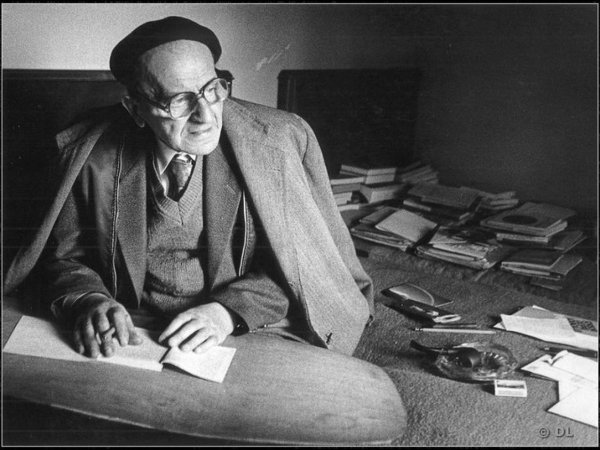
Constantin Noica was one of the most complex and influential personalities of Romanian culture in the 20th century: philosopher, essayist, poet, publicist, and writer, a thinker who decisively marked the way entire generations understood the relationship between culture, identity, and spirit.
Origins and formation of an exceptional mind
He was born on July 12, 1909, in the town of Vitănești, Teleorman County, in an Aromanian family, his parents being Grigore and Clemența Noica. This family heritage, combined with a solid education, would shape his profound interest in roots, tradition, and cultural belonging.
He spent most of his childhood and adolescence in Bucharest, where he attended middle school at "Dimitrie Cantemir," living in the family home. Later, between 1924 and 1928, he was a student at the prestigious "Spiru Haret" high school, where he stood out as an exceptional student, particularly attracted to issues related to the "world of the spirit."
Here, he had the poet Ion Barbu, known by his real name Dan Barbilian, as his mathematics teacher, an intellectual encounter that would influence his path.
Intellectual debut and university studies
Even during high school, Constantin Noica made his public debut. In 1927, he published his first essays in the school magazine "Vlăstarul," texts that would later be collected in his debut volume, "Mathesis sau bucuriile simple," published in 1934. These early writings already revealed a mature thought, concerned with the deeper meanings of existence and knowledge.
After obtaining his baccalaureate in 1928, Noica was admitted to the Faculty of Philosophy and Letters in Bucharest. Here he had philosopher Nae Ionescu as a professor, one of the central figures of interwar intellectual life. Under his guidance, Noica defended in 1931 his undergraduate thesis titled "The Problem of the Thing in Itself in Kant," demonstrating a particular affinity for classical German philosophy.
Searches, hesitations, and personal choices
Between 1931 and 1932, Constantin Noica completed his military service at the Mountain Hunters Battalion in Sinaia, after which he worked as a librarian. Between 1932 and 1934, he attended the cultural society "Criterion," a space for intense debates, where intellectuals such as Mircea Eliade, Emil Cioran, and Eugène Ionesco, friends and peers, were active.
Although some of them later expressed sympathies for the Legionary Movement, Noica initially held that Romania's revival had to be cultural rather than political. In 1933, he briefly attended the Faculty of Mathematics, but later abandoned it at the suggestion of Ion Barbu, who told him that his true vocation lay elsewhere.
Noica's personal life also had unexpected moments. In 1934, he married Wendy Muston, an Englishwoman he met by chance, upsetting his family's plans. He moved to Sinaia, where he began translating detective novels by Edgar Wallace to support himself.
Philosophical maturation and historical turmoil
The following years were marked by health issues and intellectual affirmation. In 1935, Noica became seriously ill with tuberculosis, underwent surgery, and remained with a single kidney. Nevertheless, his intellectual activity continued intensively: in 1936, he published "Open Concepts in the History of Philosophy in Descartes, Leibniz, and Kant," and in 1937, "De caelo."
Between 1938 and 1939, he received a scholarship in Paris. Under the impact of political events, Noica briefly showed sympathy for the Legionary Movement, a stance he quickly renounced, especially after the assassination of Nicolae Iorga. In 1940, he obtained his PhD in philosophy with the thesis "Outline for the History of 'How Something New is Possible?'"
Inner exile, imprisonment, and refusal to leave the country
During World War II, Constantin Noica was in Berlin as a philosophy referent at the Romanian-German Institute, attending several times the philosophy seminar of Professor Martin Heidegger. After August 23, 1944, he was offered the opportunity to leave for the United States, but he refused, choosing to remain in Romania, convinced that spiritual fulfillment is only possible close to one's own origins.
This choice would cost him dearly. After losing much of his family’s land due to the agrarian reform, Noica was placed under compulsory residence in Câmpulung-Muscel between 1949 and 1958. There, he developed the philosophical principles that would form the foundation of his later work.
Trial, conviction, and return to cultural life
On December 11, 1958, Constantin Noica was arrested by the communist regime, along with other intellectuals, accused of conspiring against state order. In reality, his "crime" consisted of organizing private seminars on philosophy.
He was sentenced to 25 years of forced labor, 10 years of civil degradation, and confiscation of property. All participants in his Câmpulung seminars were arrested and labeled the "Noica-Pillat group."
In 1962, his volume "The Phenomenology of the Spirit by G.W.F. Hegel narrated by Constantin Noica" was published. Noica served six of the 25 years in Jilava Prison and was released on August 8, 1964.
After his release, he settled in Bucharest in a two-room apartment. He worked as a researcher at the Logic Center of the Romanian Academy, and in his free time, he conducted seminars on Hegelian, Platonic, and Kantian philosophy, attended by, among others, Sorin Vieru, Gabriel Liiceanu, and Andrei Pleșu.
The Păltiniș School and cultural legacy
In the 1970s, Noica moved to Păltiniș, founding what became known as the "Păltiniș School." Here, philosophical dialogue, reading major works, and intellectual rigor were essential. Access to these meetings required knowledge of multiple modern and classical languages, as well as reading from a list of "100 mandatory books."
This experience was immortalized by Gabriel Liiceanu in the volume "The Păltiniș Diary," published in 1983. Noica’s final years were extremely productive in terms of publications, including works such as "Becoming into Being" and "The Romanian Sentiment of Being."
Constantin Noica passed away on December 4, 1987, in Păltiniș. The street in Bucharest that bears his name today is not just an urban tribute but a recognition of his decisive contribution to Romanian culture, his fidelity to the spirit, and his courage to remain, even when leaving would have been the easier path.
We also recommend: The passions of the nearsighted teenager of Bucharest: Mircea Eliade rowed on the Danube, climbed mountains, and played oina in the neighborhood