Where to get an ID card in Bucharest in 2026: Required documents, appointments, fees and offices in every sector

- Articles
- 09 OCT 26
In 2026, Bucharest residents can apply for an electronic identity card at any population records office in Romania, regardless of their registered home address. This means that someone living in Sector 3 can book an appointment in Sector 1, Sector 6 or even another city if an earlier appointment is available there.
The rule applies to the electronic identity card (CEI), not to every type of identity document. Applications for the simple identity card, which does not contain a chip, remain subject to territorial rules based on the applicant's registered address.
The new electronic identity card was introduced in Bucharest in April 2025. In 2026, it is available to both adults and children, including those under 14. However, fees, required documents and application procedures vary depending on the applicant's circumstances.
What types of identity cards are available in Romania in 2026?
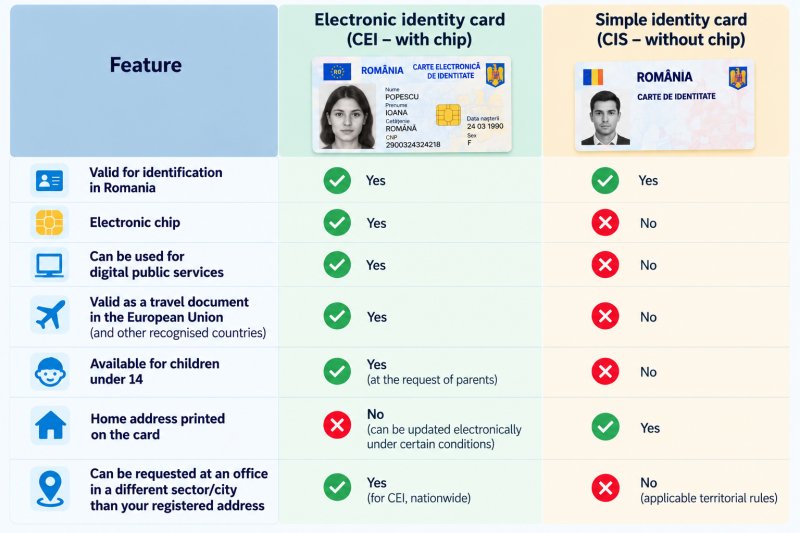
Romanian citizens can choose between two main types of identity documents: the electronic identity card (Carte Electronică de Identitate, or CEI) and the simple identity card (Carte de Identitate Simplă, or CIS).
The electronic identity card is approximately the size of a bank card and contains a chip that securely stores identification data. It can be used to access compatible digital public services and as a travel document within the European Union and other countries that recognise it.
One important difference compared with the traditional Romanian ID card is that the holder's registered home address is no longer printed on the card. Under certain conditions, this information can be updated electronically without issuing a replacement card.
The simple identity card has the same compact format but does not contain a chip. It can be used for identification within Romania but is not valid as an international travel document.
Children under 14 can only obtain the electronic version.
Table 1 – Electronic identity card (CEI) vs simple identity card (CIS): Key differences
How much does an identity card cost in 2026?
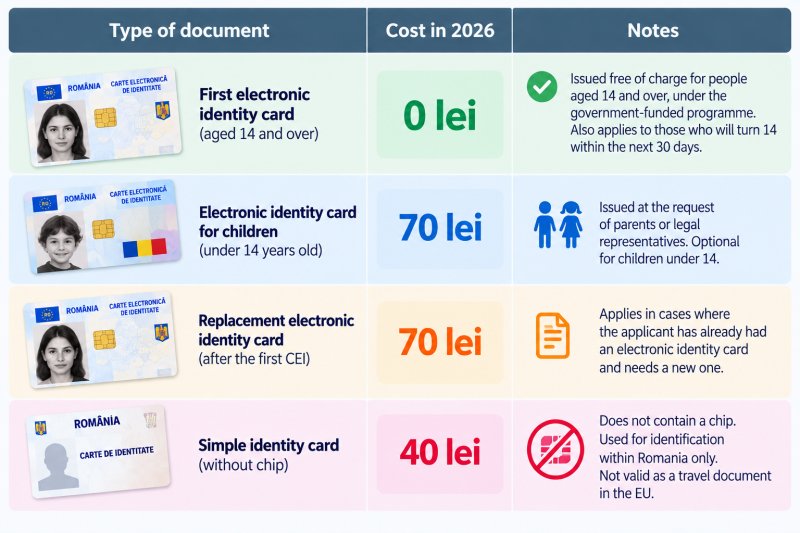
The first electronic identity card is free for Romanian citizens aged 14 and over, subject to the conditions of the government-funded programme. The same benefit applies to children who will turn 14 within the next 30 days.
Free issuance applies to the first CEI and depends on the funding available under the programme. If someone has already received an electronic identity card and needs another one, the applicable replacement fee must be paid.
For children under 14, obtaining an electronic identity card is optional and costs 70 lei. The simple identity card, without a chip, costs 40 lei. A replacement electronic identity card generally costs 70 lei when the fee applies.
Payments can be made through CEC Bank branches or SelfPay payment terminals. Where a fee applies, proof of payment must be presented when submitting the application.
Table 2 – Identity card fees in Romania in 2026
Where can you get an identity card in Bucharest?
All six sectors of Bucharest have population records offices, and some operate from more than one location.
For an electronic identity card, applicants are not required to use the office in the sector where they live. They can look for the earliest available appointment anywhere in Bucharest or elsewhere in Romania.
It is important to check the exact office address before travelling. In some sectors, population records services operate inside shopping centres or buildings separate from the local city hall.
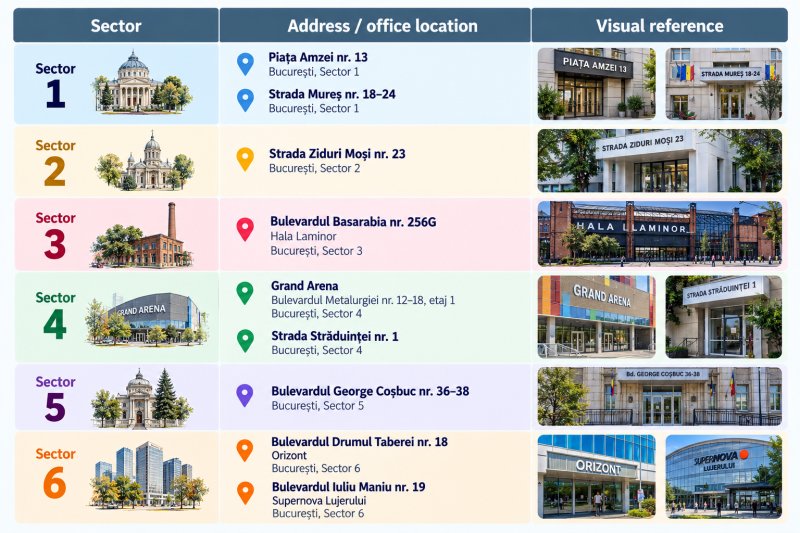
In Sector 1, offices are located in Piața Amzei and on Strada Mureș. Sector 2 has an office on Strada Ziduri Moși, while Sector 3 processes applications at Hala Laminor on Bulevardul Basarabia.
Sector 4 has offices at Grand Arena and on Strada Străduinței. In Sector 5, the population records service is located on Bulevardul George Coșbuc, while Sector 6 has offices at Orizont and Supernova Lujerului.
Not every office necessarily follows the same opening hours or processes every type of application. For electronic identity cards, the Ministry of Internal Affairs' appointment platform shows the available locations and time slots.
Table 3 – Population records offices in Bucharest: Addresses by sector
How to book an appointment for an electronic identity card
Appointments are made through the official Romanian Ministry of Internal Affairs online platform.
After opening the website, select Bucharest or the county where you want to submit your application, choose an office and check the appointment calendar. If appointments are available, select a date and time and enter the requested personal information.
An important detail is that the appointment must be confirmed within 30 minutes by clicking the link sent to your email address. Otherwise, the reservation is automatically cancelled.
Simply completing the online form is therefore not enough. If the confirmation message does not arrive immediately, check your spam folder.
If you cannot find a convenient appointment, you can check other offices. Being able to apply for a CEI regardless of your registered home address is one of the main advantages of the new system.
What documents do you need if your ID card has expired?
To replace an expired identity card, applicants must provide documents confirming their identity, civil status and registered home address.
Generally, these include the previous identity card and the birth certificate, both in their original form. Depending on the applicant's circumstances, a marriage certificate, divorce certificate or final court decision may also be required.
In some cases, the authorities can verify proof of residence electronically through their information systems. Nevertheless, it is advisable to bring the document establishing your right to live at the declared address, as electronic verification may not always be sufficient.
If you live in a property that you do not own, the owner's consent or a declaration from the person accommodating you may be required.
What happens if your identity card is lost or stolen?
Losing an identity card, having it stolen or damaging it are circumstances in which a new document must be requested.
For an electronic identity card, the applicant must attend the appointment in person and provide the documents required to verify identity, civil status and residence.
The cost depends on whether the applicant has previously received an electronic identity card.
If you already had a CEI and lost it, obtaining another card is generally subject to a fee. If you lost an older-style Romanian ID card and are applying for your first CEI, you may still qualify for free issuance under the programme's conditions.
What documents do you need after marriage or divorce?
If your surname changes following marriage or divorce, your identity document must be updated.
After marriage, the marriage certificate is the main document proving the name change. Following a divorce, a divorce certificate or final court judgment is required, depending on the circumstances.
Other relevant documents must also be presented, including the birth certificate, previous identity card and any necessary proof of residence.
If the applicant has already received an electronic identity card and a new card must be issued because of a name change, the replacement fee applies.
How to obtain a child's first identity card at 14
Romanian citizens are required to obtain an identity document when they turn 14.
A minor must attend the appointment accompanied by a parent or legal representative. The documents normally include the child's birth certificate, the accompanying parent's identity document and any relevant documents concerning the family's legal circumstances.
If the parents are divorced, additional documents may be required regarding parental responsibility and the child's registered residence.
The first electronic identity card can also be requested during the 30 days before the child's 14th birthday.
Can children under 14 get an identity card?
Yes. Parents or legal representatives can apply for an electronic identity card for a child under 14.
The document is optional for this age group and costs 70 lei.
The application requires the child's birth certificate, the parents' identity documents and, where relevant, documents establishing the family's legal circumstances. Parental consent must be provided in accordance with the applicable legal requirements.
Fingerprints are not collected from children under 12. From the age of 12, fingerprints are collected under the rules governing electronic identity cards.
What if you do not have all the required documents?
Some applicants may be unable to provide every document required for a standard identity card. For example, they may not have a birth certificate or may be unable to prove their registered home address.
In certain circumstances, a temporary identity card (carte de identitate provizorie) may be issued.
This is different from the simple identity card and is subject to a separate legal procedure. Applicants should check the requirements with the population records office responsible for their case.
How long does it take to receive a new identity card?
Processing times vary depending on the type of document, the checks required and the number of applications being handled.
For electronic identity cards, applicants who provide a valid email address may receive notifications about the progress of their application.
When collecting a CEI, the holder sets the PIN codes required to use its electronic functions. Personal attendance is generally necessary, subject to the exceptions provided by the applicable procedures.
You do not have to wait until your current identity card expires before applying for an electronic identity card. You can request a replacement earlier.
Required documents at a glance
The documents needed depend on why you are applying. Replacing an expired card, reporting a lost document, changing your surname and applying for a child's first identity card each involve different requirements.
Table 4 – Required documents for each application: Expired ID, lost or stolen ID, name change, first ID at 14, children under 14 and change of address
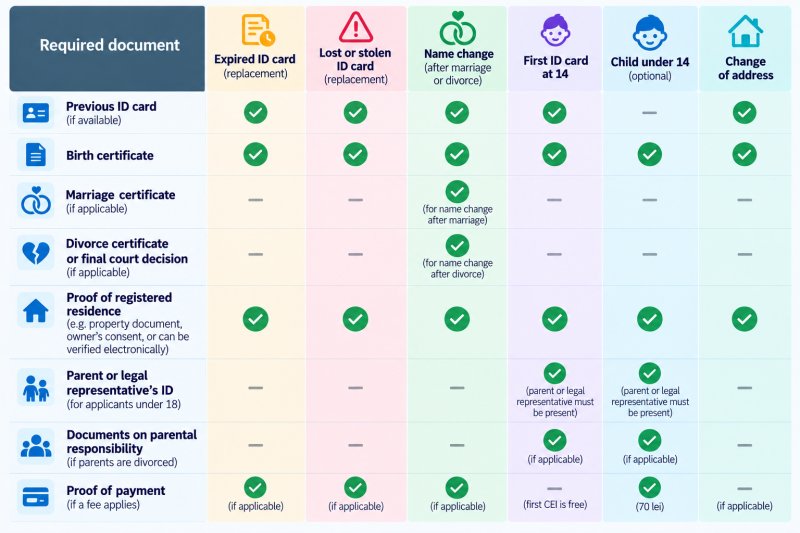
The documents must generally be presented in their original form. Additional requirements may apply depending on the applicant's personal and legal circumstances.
For electronic identity card appointments, use the official platform: https://hub.mai.gov.ro/cei/programari/harta.
Office availability, appointment slots and administrative procedures may change, so it is advisable to check the current information before visiting a population records office.