What is the quietest neighborhood in Bucharest? The capital’s intellectual elite once lived here
By Raluca Ogaru
- Articles
- 20 AUG 26
Cotroceni is one of the answers that comes up most often when Bucharest residents are asked where they can find a quiet neighborhood close to the city center and suitable for leisurely walks. However, there is no official ranking that names it “the quietest neighborhood in Bucharest.” Perceptions vary from one street to another and even from one apartment building to the next.
In a discussion on social media, a Bucharest resident looking for a suitable area for his family received numerous recommendations. Drumul Taberei, Titan, Tineretului, Bucureștii Noi, Domenii, Vatra Luminoasă and Piața Muncii were all mentioned. Cotroceni stood out because it offers a combination found in few other parts of the city: quiet residential streets, historic architecture, mature trees and easy access to central Bucharest.
“Vatra Luminoasă–Maior Coravu is paradise, and my top choices are Cotroceni or Primăverii. I almost shed a tear when I walk there on Sundays because the streets are so quiet and the cats around the houses are so beautiful,” one person wrote.
Cotroceni is quiet, but not on every street
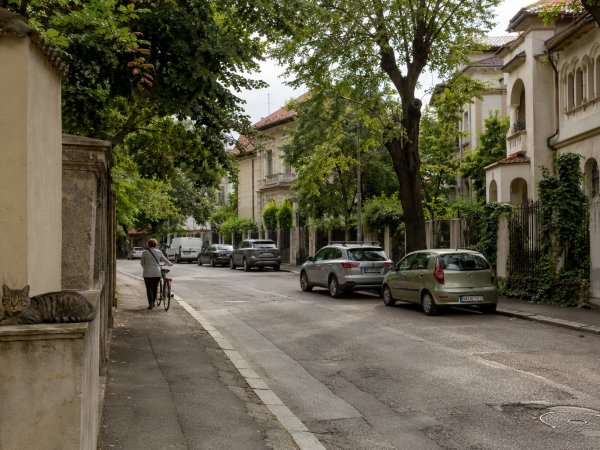
A walk through the inner part of the neighborhood can make it feel as though busy Bucharest has been left several dozen kilometers behind. Houses are set back from the road, many have gardens, and through traffic is lighter than on the city’s major boulevards. Streets such as Doctor Joseph Lister, Doctor Louis Pasteur, Doctor Nicolae Turnescu, Doctor Carol Davila and Doctor Grigore Romniceanu retain a predominantly residential atmosphere.
This description does not apply equally to the entire area. Homes close to Șoseaua Cotroceni, Bulevardul Eroilor, Splaiul Independenței or major intersections may be exposed to heavy traffic. Ambulances travelling to nearby hospitals, events organized in the area and weekday traffic can occasionally disrupt the neighborhood’s apparently peaceful rhythm.
The strategic noise maps published by Bucharest City Hall do not identify a winner among the city’s neighborhoods either. They assess exposure to noise generated by road traffic, trams, railways and industrial activities. The maps help explain why one address on a side street may be considerably quieter than another only a few hundred meters away but facing a major boulevard.
Cotroceni can therefore be considered one of the quietest central areas of Bucharest, but that does not automatically make every address here the quietest in the entire city.
READ ALSO:
A date in old Bucharest: A romantic walk through Cotroceni’s hidden corners and secret tea houses
Why the neighborhood has a different rhythm from the rest of the city
Cotroceni’s tranquility is not simply the result of lighter traffic on its inner streets. Much of the neighborhood was developed on a human scale, with detached homes, generous plots and buildings that do not form continuous walls of high-rise apartment blocks.
Vegetation also plays a visible role. Mature trees, private gardens and the Botanical Garden create a landscape different from neighborhoods dominated by concrete and parking spaces. The streets are not deserted, but neither do they experience the constant flow of pedestrians, delivery couriers, buses and cars associated with busy commercial areas.
Cotroceni also retains numerous Neo-Romanian, eclectic, modernist and Art Deco villas built between the late 19th century and the first half of the 20th century. Architecture alone cannot guarantee peace and quiet, but the way the area was divided into residential plots limits through traffic on many streets.
The neighborhood is nevertheless very active during the day. The “Carol Davila” University of Medicine and Pharmacy, the Cantacuzino Institute, several hospitals, educational institutions and Cotroceni Palace are all located nearby. Residents may find an exceptionally quiet street while still having to contend with congestion around the area’s major institutions.
From the Cotroceni estate to the neighborhood of professors and doctors
The earliest documentary references to the Cotroceni estate date from the beginning of the 17th century. A decisive moment came in 1679, when Wallachian ruler Șerban Cantacuzino began building a monastery on Cotroceni Hill. The complex later became a princely residence and, following transformations during the 19th century, a royal residence.
The development of Cotroceni Palace, the Faculty of Medicine and military institutions gradually attracted senior officers, professors, doctors, lawyers, artists and prominent civil servants. After the First World War, residential streets and housing plots continued to develop, according to research published by the Bucharest Municipality Museum.
Among the prominent figures associated with the neighborhood are writer Ion Minulescu, sculptor Oscar Han, biologist Emil Racoviță and literary critic Eugen Lovinescu. Poet and doctor Vasile Voiculescu worked at the neighborhood dispensary, while numerous streets were named after important physicians.
“The intellectual elite” is an appropriate description for some of Cotroceni’s former residents, but the neighborhood was not reserved exclusively for the wealthiest families in the capital. Teachers, affluent pensioners, military officers and public servants also lived here. Some of Bucharest’s most opulent residences were found in areas such as Kiseleff and Aviatorilor or along the streets surrounding Șoseaua Kiseleff.
During the communist period, some houses were nationalized and divided between several families. The neighborhood nevertheless retained much of its historic urban fabric, unlike central areas heavily affected by the demolitions of the 1980s.
READ ALSO:
Cotroceni: From Șerban Cantacuzino’s monastery to the capital’s elite neighborhood
What other quiet neighborhoods do Bucharest residents recommend?
Cotroceni was not the only option suggested in the social media discussion. Drumul Taberei received several recommendations because of its green spaces, metro access and distance from the busiest parts of central Bucharest.
“Drumul Taberei is a quiet neighborhood. The only downside, in my opinion, is the terrible traffic at certain times, but that can be solved by taking the metro. There are also parks in the area,” one resident explained. Another added: “It still remains one of the most beautiful and peaceful neighborhoods in Bucharest.”
Titan, particularly the area surrounding IOR Park and Liviu Rebreanu Boulevard, was appreciated for its vegetation, public transport and nearby shops. Bucureștii Noi and Domenii were recommended for their quieter side streets, while Vatra Luminoasă and Maior Coravu were praised for their residential atmosphere.
One observation from the discussion sums up the issue particularly well: “The apartment building you choose matters a great deal, regardless of the neighborhood.” A quiet street cannot always compensate for poor sound insulation, noisy neighbors or a home facing a busy intersection.
How to find out whether an address is genuinely quiet
If you are considering moving, the name of the neighborhood is only the beginning of your research. Visit the address on a weekday morning, then return in the evening and during the weekend. Listen to the traffic with the windows open and check whether there are schools, hospitals, bars, construction sites or routes frequently used by ambulances nearby.
You should also test the journey to work. “The most important criterion is how efficiently and quickly you can get wherever you need to go every day,” one Bucharest resident remarked. An exceptionally quiet home may become difficult to enjoy if it requires a two-hour daily commute.
Cotroceni remains a strong recommendation for people seeking peace and quiet close to the city center who can afford the cost of living in an area with a limited housing supply. It does not officially hold the title of Bucharest’s quietest neighborhood. However, it has more than enough streets where the noise of the capital can barely be heard.