Văcărești Monastery, Symbol of Bucharest Destroyed by Ceaușescu: From the Famous Place of Worship to Political Prison
- Articles
- 26 FEB 26
The history of Bucharest preserves numerous dramatic episodes, but few monuments symbolize the destruction of heritage better than Văcărești Monastery. Once considered one of the most impressive religious constructions in Eastern Orthodox Christianity, this monastery was, over time, both a spiritual and cultural center and a political prison. Its destiny reflected the political and social changes of Romania, from the Phanariot era to the communist regime.The demolition of Văcărești Monastery in the 1980s represented one of the most painful cultural losses suffered by Bucharest. Today, the place where the monastic complex once stood is occupied by modern constructions, and the memory of the monument survives only in documents, photographs, and saved fragments.
The Phanariot Foundation and a Great Cultural Center
The history of Văcărești Monastery begins in 1716, during a period marked by major political changes. After the execution of Constantin Brâncoveanu and the end of the reign of Ștefan Cantacuzino, Wallachia entered under the rule of the Phanariot princes. The first of them was Nicolae Mavrocordat, who initiated the construction of the monastery on Văcărești Hill, at the southeastern edge of Bucharest, in an area then covered with vineyards and orchards.
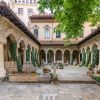
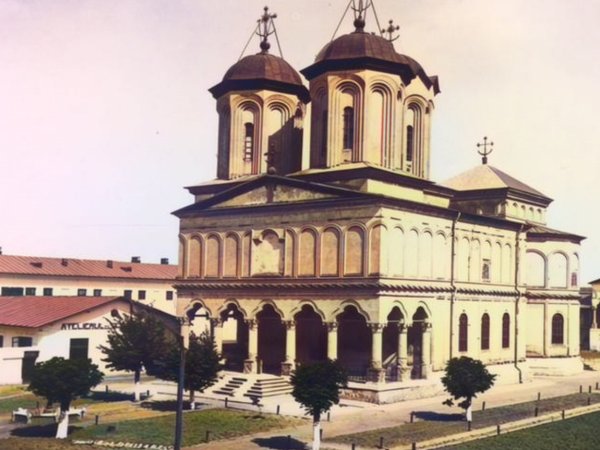
The monastic complex was impressive both through its size and through its artistic value. Extending over approximately 18,000 square meters, the complex was surrounded by strong defensive walls that gave it the appearance of a true fortress. Construction was completed in 1722, and two years later the main church, dedicated to the Holy Trinity, was consecrated.
The church was one of the largest in the country at that time and impressed through mural paintings executed in the Brâncovenesc style. After the death of Nicolae Mavrocordat, the works were continued by his son, Constantin Mavrocordat, who added in the eastern part of the complex a chapel decorated with frescoes representing saints and biblical scenes.
The monastery was not only a place of prayer, but also a true princely residence. Inside the walls there were a princely palace, a printing house, a Greek school, and an extremely rich library that housed numerous manuscripts and rare books gathered by Nicolae Mavrocordat during his reigns in Moldavia and Wallachia.
Through these institutions, Văcărești Monastery had been conceived as a major cultural center of Wallachia and of the entire region.
Transformation into a Prison
The destiny of the monastery changed radically in the nineteenth century. During that period, the authorities began to use certain monasteries as places of detention for political prisoners.
The Organic Regulation of 1831 provided for the construction of special prison buildings, but the lack of financial resources caused these plans to be delayed. As a result, existing spaces were transformed into detention places.
During the Revolution of 1848, numerous revolutionary leaders were imprisoned within the walls of Văcărești Monastery. Among them were important personalities of Romanian political and cultural life, such as Ion Heliade-Rădulescu, C.A. Rosetti, Ion Ghica, Gheorghe Magheru, and I.C. Brătianu.
The decisive moment came in 1864, when, after the secularization of monastic estates and in the context of the social tensions generated by the peasant uprisings, the complex was officially transformed into a prison. The basements of the former princely palace became cells, and the monastery gradually lost its spiritual and cultural role.
The church and the chapel were neglected, and the beauty of the complex began to deteriorate. The monument that had once been a symbol of Brâncovenesc art gradually became a place associated with suffering and imprisonment.
Famous Prisoners and Controversial Stories
In the interwar period, Văcărești Monastery continued to function as a political prison. Numerous intellectuals and political figures were incarcerated here.
Among those who passed through the cells of Văcărești were important writers such as Tudor Arghezi, Ioan Slavici, and Liviu Rebreanu. The prison thus became associated not only with political repression but also with the destinies of major cultural personalities.
Corneliu Zelea Codreanu, the leader of the Legionary Movement, was also imprisoned here. He later stated that the name of his organization, the Legion of the Archangel Michael, had been inspired by the icon of the Archangel Michael located on one of the altar doors of the monastery church.
During the period between the two world wars, communist militants such as Ion Costache Frimu and Gheorghe Cristescu were also imprisoned at Văcărești.
A frequently mentioned story says that Nicolae Ceaușescu himself was detained here in his youth, a fact that would have influenced his later decision to destroy the monument. However, there is no clear evidence to confirm this hypothesis.
Restorations and Decline During the Communist Period
In the years 1936–1937 restoration works were carried out on the church and the chapel, temporarily stopping the degradation of the monument. These interventions allowed the complex to be preserved in relatively good condition until the outbreak of the Second World War.
After the war, the priorities of the communist state changed. Funds were directed toward the functioning of the prison, and restoration works were abandoned.
Until the beginning of the 1970s, Văcărești functioned as a screening prison for political detainees of the communist regime. Thousands of people passed through this place before being transferred to other penitentiaries.
Between 1973 and 1974 the decision was made to evacuate the prison and begin restoration works. The plan provided for transforming the former monastery into a museum of architecture and traditional art.
The earthquake of 1977 caused damage to the complex, but this damage was not irreparable. The monument could have been restored without major difficulty.
Demolition and Disappearance of the Monument
Although the monument could have been saved, the earthquake provided the communist authorities with a pretext for demolition. The regime led by Nicolae Ceaușescu decided to destroy the complex as part of the urban systematization program.
Initially various projects were proposed for the cleared land. The construction of a Palace of Justice was discussed, followed by plans for a multipurpose hall with a capacity of 12,000 seats.
Finally, in 1988 works began for a building intended to house the National Council of Working People's Democracy.
Between 1986 and 1987 Văcărești Monastery was completely demolished. The protests of architects, historians, and cultural organizations from the country and from abroad failed to stop the destruction of the monument.
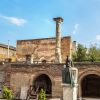
A small part of the architectural elements was saved. Stone columns, capitals, and decorative fragments were transported to Mogoșoaia Palace and to Cernica Monastery.
Out of approximately 2,500 square meters of mural painting, about 1,000 square meters were prepared for transport, but in the end only about 140 square meters were saved. Some of these fragments are today preserved in the collections of the National Museum of Art of Romania.
The Legacy and Memory of Văcărești Monastery
After 1989 there were discussions about rebuilding Văcărești Monastery. The projects were not completed, mainly because of the high costs.
Eventually, between 2007 and 2008, a modern commercial complex was built on the site of the former monastery and prison.
The disappearance of Văcărești Monastery remains one of the most dramatic episodes in the history of Bucharest’s heritage. The monument had been a witness to more than two centuries of history, passing through different political eras and radical transformations.
From a Phanariot foundation dedicated to culture and spirituality, to a political prison and finally to ruins destroyed by the communist regime, Văcărești Monastery reflected the dramatic evolution of the city.
Today, its memory represents a warning about the fragility of cultural heritage and about the irreversible losses caused by political decisions. In the consciousness of Bucharest’s inhabitants, Văcărești Monastery remains the symbol of a vanished Bucharest, sacrificed in the name of forced modernization.
We also recommend: Calea Văcărești, the story of one of the oldest arteries in Bucharest. The princely road connected the center of the Capital to the famous monastery