Top 10 the longest streets in Bucharest. Which are the most extensive roads of the Capital
- Articles
- 04 MAY 26
Bucharest is a vast city, with an impressive road network that reflects both historical development and the accelerated urban expansion of recent decades. The capital of Romania has no fewer than 5,340 streets, which total a length of approximately 1,820 kilometers and cover a total surface of nearly 20,000 square meters. Even if these figures may seem difficult to imagine, they become easier to understand when we think that crossing the city from east to west or from north to south can mean a distance of about 25 kilometers, depending on the chosen route. However, the longest arteries of Bucharest do not reach this distance. The most extensive streets of the Capital have lengths that stop around the value of 10 kilometers, but their importance does not consist only in size, but also in the role they play in urban mobility. Each of these arteries connects neighborhoods, facilitates access to important areas and contributes to the daily dynamics of the city. Below, we present the ranking of the 10 longest streets in Bucharest, in a detailed analysis.
A complex urban network and the role of the main arteries
Bucharest developed radially, around a central nucleus, and this structure is reflected in the way the streets are organized. There are several traffic rings and radial arteries that connect the periphery with the center. The longest streets are, as a rule, those that cross the city or make the connection with surrounding areas.
These boulevards and roads are essential for daily traffic. They take over large flows of cars, public transport and even commercial routes. Also, many of them have a strategic importance, being the main ways of entering and exiting the city.
Besides the functional role, these arteries also have a symbolic value. They define neighborhoods, influence urban development and become landmarks for residents. From modern boulevards to historical roads, each of them tells a part of the story of the Capital.
Places 10–6: important streets that connect the neighborhoods of the Capital
On place 10 in the ranking is Drumul Taberei, with a length of 5.2 kilometers. This artery gives the name to one of the most well-known neighborhoods in the west of Bucharest and connects the Răzoare area to other important streets such as Brașov or Valea Argeșului. It is an essential street for the residents of the area, having a major role in daily traffic.
Place 9 is occupied by Calea Griviței, which measures 5.3 kilometers. It connects Gara Basarab with Gara de Nord and ends in Calea Victoriei. It is one of the arteries with an important historical load, but also with an essential role in connecting the railway areas of the city.
On position 8 is Șoseaua Mihai Bravu, with 5.4 kilometers, one of the most circulated arteries in Bucharest. Part of the main ring, this road crosses extremely crowded areas such as Dristor, Iancului or Obor, being a key point for urban traffic.
Place 7 is occupied by Șoseaua Olteniței, which has a length of 5.6 kilometers within the city. It connects the Tineretului area with the city of Popești-Leordeni, passing near important landmarks such as Tineretului Park and Văcărești Lake.
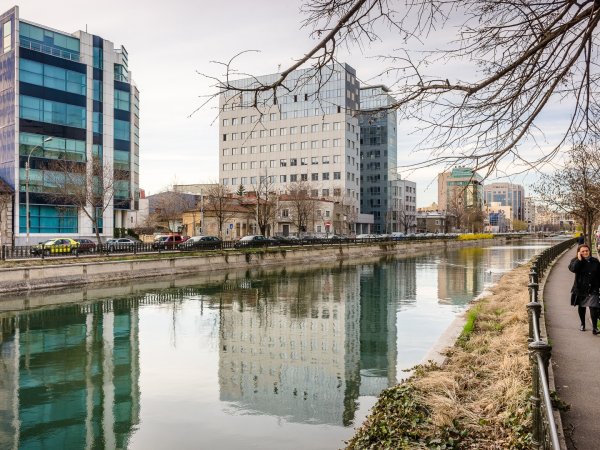
On place 6 is Splaiul Independenței, with 5.7 kilometers. This artery starts from Piața Unirii and follows the course of the Dâmbovița River to the west of the city, reaching the area of Lacul Morii. It is one of the most picturesque and important roads in the Capital.
Places 5–2: major arteries of entering and exiting the city
On place 5 is Șoseaua București-Ploiești, with a length of 6.5 kilometers within the Capital. It starts from Piața Presei Libere and represents one of the main access ways from the north of the city. It is an intensely circulated road, especially by those who come or leave towards the Ploiești area.
Place 4 is occupied by Bulevardul Ghencea together with Prelungirea Ghencea, which total 6.8 kilometers. They connect the central-western area with the Ring Road and are essential for the residents of the western neighborhoods.
On place 3 is Bulevardul Iuliu Maniu, with 7.3 kilometers. It is the main access artery from the west of the Capital and connects the Bucharest Ring Road with the central area, near Piața Leul. It is one of the most important and crowded streets in the city.
Place 2 is occupied by Bulevardul Timișoara, which measures approximately 7.5 kilometers. This artery connects the Răzoare area with CET Vest and represents an important link between the periphery and the central ring of the city.
Place 1: the longest street in Bucharest
On the first place in the ranking is Splaiul Unirii, the longest artery in Bucharest, with a total length of 10.8 kilometers. It starts from Piața Unirii and extends up to the exit from the city, near the Ring Road, continuing afterwards in Ilfov County.
Within the Capital, the actual length of Splaiul Unirii is approximately 9.3 kilometers, the rest being outside the administrative limits. An interesting aspect is the fact that this artery can be traveled entirely only from the center towards the exterior. On the opposite direction, from the periphery towards the center, the traffic is interrupted in the area of the Mărășești Passage.
Splaiul Unirii has an essential role in Bucharest traffic, being one of the main routes that follow the course of the Dâmbovița River. Along it there are industrial, commercial and residential areas, which turns it into a vital artery for the city.
The importance of these arteries in everyday life
The longest streets in Bucharest are not just simple traffic axes, but true backbones of the city. They facilitate mobility, connect neighborhoods and support economic and social activities.
At the same time, these arteries reflect the urban evolution of the Capital. From historical roads to modern boulevards, each of them has been shaped by the needs of the city and by its transformations. Heavy traffic, real estate development and infrastructure modernization are just some of the aspects that define them.
As Bucharest continues to develop, the role of these streets will become even more important. Investments in infrastructure and adaptation to new mobility requirements will influence how these arteries will look and function in the future.
A city defined by its roads
The ranking of the longest streets in Bucharest offers an interesting perspective on how the Capital is organized. Even if none of these arteries crosses the city completely, each of them plays an essential role in urban connectivity.
Whether we are talking about Splaiul Unirii, Bulevardul Iuliu Maniu or Șoseaua Mihai Bravu, these roads are an integral part of the daily life of Bucharest residents. They are not just travel routes, but also urban landmarks that define the identity of the city.
In the end, Bucharest can be better understood not only through its buildings or through history, but also through the roads that cross it. And these long arteries are clear proof that infrastructure plays an essential role in the development and functioning of a metropolis.
We also recommend: Iuliu Maniu Boulevard in Bucharest, the third-longest thoroughfare of the Capital. Where its name comes from and how it became so important