Top 10 Strangest Google Searches About Bucharest: What People Ask When Nobody’s Watching
- Articles
- 20 MAR 26
If you could read someone's mind in the exact moment they type something into Google, you'd learn more about them than any psychological test ever could. And Bucharest — with all its complexity, ugliness, charm and contradictions — inspires some of the most amusing, surprising and occasionally baffling questions that people can type about a city.
Some come from genuine ignorance. Others from deeply rooted prejudice. Some are simply funny. Here is a portrait of Bucharest seen through the eyes of a cursor blinking in a search box.
1. "Is Bucharest safe?"
This is, according to real data from the Visit Bucharest Today platform, the second most frequently asked question by foreign tourists about the capital. Not "where should I eat", not "how do I get to the Palace" — but whether they will survive the visit.
European statistics show that Romania's major cities have crime rates comparable to, or lower than, many Western European cities. Bucharest, Cluj-Napoca, Timișoara and Brașov are all frequently visited without serious incidents.
Where does this fear come from? From a cocktail of 1990s films, corruption headlines, the confusion between "Romanian" and "Roma", and probably something in the chaotic energy Bucharest emits in the first hours after landing. Henri Coandă Airport, the apocalyptic traffic, the taxi drivers outside arrivals — they make a spectacular first impression.
Ironically, the probability of a tourist actually having something bad happen to them in nighttime Bucharest — even at 3am, surrounded by 10,000 people on the street on a Tuesday — is extremely low.
Also recommended Exploring Bucharest by night: essential tips for a safe stroll
2. "Is tap water in Bucharest safe to drink?"
Among the most searched questions by foreign tourists about Bucharest, this one is both perfectly legitimate and deeply revealing about the image Romania projects abroad.
The official answer is yes — Bucharest's water is treated and declared safe to drink. The unofficial answer, which every Bucharest resident knows, is that nobody in the apartment blocks drinks tap water. The taste of chlorine, old pipes, generalised distrust — all of these contribute to a parallel reality in which people buy water in 6-litre bottles from the supermarket, even though theoretically they don't need to.
That a tourist from Berlin or London searches this before visiting is, at its core, a symptom of Romania's image gap with Western Europe.
3. "Why did Ceaușescu build such a massive palace?"
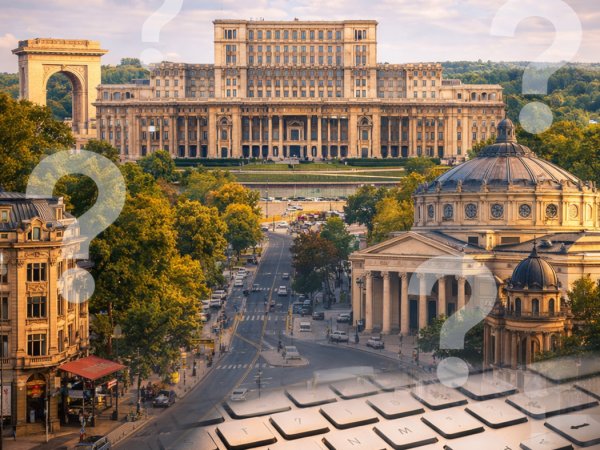
The Palace of the Parliament is, by far, the strangest tourist landmark in Europe — and one of the most searched buildings on the internet in any possible combination of words. The reason is simple: there is nothing else like it on the planet.
The building reaches a height of 84 metres, extends 92 metres underground, covers a floor area of 365,000 square metres and has a volume of 2,550,000 cubic metres. It is the heaviest building in the world, weighing approximately 4 million tonnes, and the largest civilian administrative building on Earth. The Independent once described it as "hideous, but also kind of impressive" — a better summary than any travel guide has managed.
It sinks by 6 millimetres every year under its own weight. It has 12 floors above ground and eight underground levels, the last of which is a nuclear bunker. Ceaușescu, fearing a nuclear war, connected it to the main state institutions via 20 kilometres of tunnels.
The idea took shape after Ceaușescu's visit to North Korea in 1971, where he was struck by the monumental scale of Pyongyang's architecture. The Palace was conceived as the heart of a new Civic Centre — a complex meant to represent the strength and unity of the Romanian people under his rule.
No tourist who searches "why is Bucharest parliament so big" is prepared for what they find.
4. "Did Michael Jackson shout 'Hello Budapest' in Bucharest?"
This is, without doubt, one of the most searched stories about Bucharest in international context — and it is completely true.
In July 1992, Michael Jackson performed a concert in Bucharest. He stepped onto the stage in front of over 70,000 people and shouted into the microphone: "Hello, Budapest!"
The mistake has lived on in pop history ever since. Romanian fans reacted with a mixture of disbelief, humour and deep resignation. The story still circulates today on music forums in the form of passionate debates about whether MJ knew where he was or had simply confused the capitals of the former Eastern Bloc.
The most likely answer is that he genuinely didn't know. Which, much like the tap water question, says something about Bucharest's place on the world's mental map in 1992.
5. "Why is Piața Obor a tourist attraction?"
This is perhaps the most disorienting tourist phenomenon in Bucharest in recent years: Piața Obor — a vast, chaotic, wonderfully unglamorous covered market — consistently appears among the sights that foreign visitors want to see in the capital. And they have noticed that locals don't share their enthusiasm, which they find genuinely difficult to understand, given that it has fresh vegetables, good produce and, crucially, mici.
A journalist from the Financial Times once wrote a feature about Obor. Tourists describe it on TripAdvisor and Google as an unrepeatable authentic experience. "This is a total contrast to tourist Bucharest. Here you see real people living a normal life. The market is enormous, probably the largest I've ever been in," wrote one visitor.
Meanwhile, Bucharest residents continue to treat Obor as a Saturday morning chore. Nobody said tourism follows local logic.
6. "Romania and Dracula — is Bucharest in Transylvania?"
The confusion between "Romanian" and "Roma" is one of the most widespread mistakes tourists make. But there is an even more persistent myth: that all of Romania is Transylvania, that Transylvania is all of Romania, and that Dracula is lurking somewhere between the airport and the old town.
Tens of thousands of tourists arrive in Bucharest every year asking where Bran Castle is. The answer — 170 kilometres away, in an entirely different geographical and administrative region — genuinely surprises them. Sinaia is another place many tourists believe to be in Transylvania, despite being in Muntenia.
Questions along the lines of "where can I find vampires in Bucharest?" are not metaphorical — they exist in TripAdvisor reviews and in the inboxes of local tour guides.
7. "What on earth is Caru' cu Bere?"
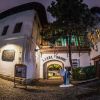
Caru' cu Bere is among the most searched destinations by tourists in Bucharest. It appears in every restaurant ranking, every travel guide, every blog. And the question "what is Caru' cu Bere?" keeps coming back, precisely because the name means nothing to a non-Romanian speaker.
The answer — an Art Nouveau beer hall opened in 1879, with original stained glass windows and a painted ceiling that would make any Viennese restaurant envious — invariably produces the reaction: "how did I not know about this?" Caru' cu Bere is probably the most photographed interior in Bucharest, and yet it remains unknown outside travel lists.
8. What Romanians search about their own city
It's not only foreigners who have strange questions. Romanians' searches about Bucharest tell their own story.
The searches that recur specifically about Bucharest include: "where to park for free", "earthquake Bucharest", "buildings with red dot" (the seismic risk label), "things to do in Bucharest this weekend" and — with depressing regularity — "how to escape Bucharest traffic". The city is experienced by those who live in it as a series of daily practical problems to be solved, not as a destination to be explored.
9. "Bucharest or Budapest?" — the eternal confusion
Perhaps the most persistent search involving Bucharest isn't really about Bucharest at all: it's the comparison — or outright confusion — with Budapest. The two cities are mixed up so frequently, by tourists, international journalists and concert organisers alike, that Bucharest residents have arrived at a kind of amused resignation about it.
Google autocomplete suggestions in many languages include variations of "Bucharest or Budapest?", "difference between Bucharest and Budapest", "which is better". On Reddit, there are long threads in which people from around the world recount having booked flights to Budapest and landed in Bucharest, or the reverse, not realising the mistake until the airport.
Both cities benefit from the confusion — each receives tourists who came for the other and leave pleasantly surprised.
10. "Why is Bucharest so underrated?"
This search — in various forms — has been coming up more and more frequently in recent years, as Bucharest appears in international city break rankings and as prices in Prague, Vienna and Amsterdam have climbed steeply. People are looking for confirmation of a feeling: that they've discovered something others have missed.
Tour guides often ask visitors why they chose Bucharest, and the answer is frequently that the flight was cheapest. One British tourist celebrated his birthday with 20 friends in the city, spending less on the entire trip — flights and accommodation included — than a single evening at a pub in London would have cost.
Accidentally or not, Bucharest has come to be discovered through Google Flights rather than through tourism marketing. Which is, in its own way, a strange kind of success.
Conclusion: Google as a mirror
Searches about a city are, at heart, an X-ray of the fears, prejudices and curiosities of the people looking at it from the outside. In this X-ray, Bucharest appears as a place that produces confusion, anxiety, pleasant surprise and fascination in roughly equal proportions.
That the first question millions of tourists ask is "is it safe?" and the second is "can I drink the water?" says something about Romania's image gap. That the same people go home writing that it's "underrated" and "authentic" says something about the real Bucharest.
Somewhere between those two searches is a city that Google cannot fully describe. Which is, probably, the best thing that could have happened to it.
Also recommended 10 fun questions about Bucharest that will help you better understand what it's like to live in this capital