The stars of interwar Bucharest: Silly Vasiliu, the Alhambra star whom her parents wanted to force into marriage at 14
- Articles
- 22 DEC 25
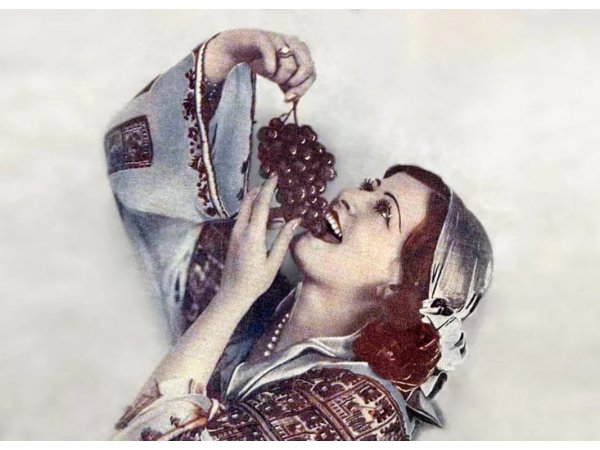
Interwar Bucharest was a city of contrasts, elegance, and artistic effervescence, a true magnet for the talents of the time. In this vibrant cultural context, Silly Vasiliu established herself as one of the brightest stars of revue theatre and Romanian light music.
A diva of the Romanian stage in a golden age
A theatre and film actress, singer, and dancer, Silly Vasiliu quickly became an emblematic presence on the stage of the “Alhambra” Operetta Theatre, winning over audiences with her talent, beauty, and unmistakable charisma.
Beyond her artistic success, her life story is an impressive one, marked by radical choices and a constant struggle for freedom and independence. The road to glory was by no means easy, and her destiny was built through courage, ambition, and the refusal to submit to the rigid norms of society.
Childhood in Galați and the confrontation with conservative traditions
Silly Vasiliu was born in Galați, into a modest family, at a time when a woman’s role was strictly defined by social conventions. Her parents, although well intentioned, envisioned their daughter’s future through the lens of material security, not personal fulfillment. In a society dominated by conservative mentalities, a young girl’s dream of becoming an artist was viewed with suspicion and disapproval.
Silly’s talent and desire for self-expression quickly came into conflict with her family’s plans. The decisive moment came when she was only 14 years old, when her parents tried to force her to accept an arranged marriage to a wealthy man whom she did not love. For the teenager she was at the time, this prospect was unacceptable and triggered one of the bravest decisions of her life.
The flight to Bucharest, an act of revolt and freedom
Refusing to sacrifice her future and aspirations, Silly Vasiliu chose to run away from home and leave for Bucharest. Her gesture was extremely risky for such a young girl, but it also represented a declaration of independence rarely encountered at that time. Leaving behind her family, her hometown, and the security she knew, Silly chose the unknown and the fight for her dream.
Once she arrived in the capital, she was taken in by an aunt, but the beginnings were difficult. Bucharest offered opportunities, but also numerous challenges, especially for a teenage girl without solid financial support. Even so, Silly Vasiliu demonstrated from the very beginning an extraordinary determination.
Artistic training and early disappointments
Determined to build a career, Silly Vasiliu attended the ballet school run by Mrs. Battagi, where she took her first serious steps into the artistic world. Later, she enrolled at the Bucharest Conservatory, studying singing under the guidance of renowned teachers such as Mrs. Anghel and Mrs. Assan. At the same time, she began working in ballet choreography at the Romanian Opera.
The road was not free of obstacles. At one point, one of the teachers at the Opera told her that she did not have enough talent, criticizing her appearance and her lack of “sex appeal.” The young woman’s impulsive reaction, which led to her being expelled, was a painful but revealing moment. Instead of giving up, Silly turned this failure into additional motivation to prove the opposite.
The discovery of her talent and her affirmation on stage
Luck smiled on her when she was noticed by the tenor Santarelli, who appreciated her voice and recommended her to Maestro Egizio Masini. Her hiring into the chorus of the Romanian Opera marked the beginning of a spectacular rise. From there, the path toward revue theatre was a natural one.
The “Alhambra” Operetta Theatre in Bucharest became the place where Silly Vasiliu built her true artistic identity. Here, her talent flourished, and her stage personality definitively conquered the public. Alhambra was one of the most important centers of entertainment in the interwar period, and Silly integrated perfectly into this world full of energy and creativity.
Alhambra and the consecration of a star
On the Alhambra stage, Silly Vasiliu performed alongside some of the greatest names of the era, such as Maria Tănase, Marilena Bodescu, Virginica Popescu, Mia Apostolescu, Lulu Nicolau, Lisette Verea, and Titi Botez. Together, they brought to life memorable productions that marked the history of Romanian revue theatre.
Among the performances in which Silly Vasiliu shone are “Saboți,” “Barcă,” “Vulpea albă,” “Ți-amintești,” “Haimanale,” “Bonsoir Alhambra,” and “Sinaia petrece,” from 1931. The public adored her, and the press of the time called her “the darling of the revue audience,” a title that reflected her popularity and special charm.
National and international recognition
Silly Vasiliu’s success went beyond the country’s borders. Prestigious magazines such as “Realitatea Ilustrată” and “Ilustrațiunea română” dedicated extensive articles to her, confirming her status as a star of the Romanian stage. Moreover, the famous Parisian magazine “Comoedia” called her “the star of Romanian musical theatre,” appreciating her performances on the stages of Alhambra, Scala, and Femina.
This international recognition was rare for Romanian artists of the time and demonstrates the impact Silly Vasiliu had on the European artistic world.
Film, music, and artistic maturity
In 1935, Silly Vasiliu entered the history of Romanian cinema through her participation in the first Romanian sound film, “Bing-Bang.” The film’s premiere, held at the ARPA Cinema within the National Military Circle, was a major event, consolidating her image as a diva of Romanian light music.
Her career continued after the interwar period as well. In 1960, she performed in the production “Bădăranii” by Carlo Goldoni, staged at the National Theatre in Bucharest, demonstrating remarkable artistic versatility. At the same time, she performed highly successful songs composed by Ion Vasiliu, such as “Suflet candriu de papugiu,” “Te-am înșelat și-mi pare rău,” and “Nu-ți pare rău că vezi că plâng.”
The legacy of a courageous woman
Silly Vasiliu was not only a great artist, but also a woman who had the courage to follow her dream in an era hostile to female independence. Her flight from home at just 14 years old remains a symbol of rebellion against social constraints and of the desire for freedom.
Through talent, perseverance, and inner strength, Silly Vasiliu left an indelible mark on the history of Romanian theatre and light music. Her name remains inseparably linked to Alhambra and to the golden age of interwar Bucharest, a period in which art and passion gave birth to exceptional destinies.
We also recommend: The stars of interwar Bucharest: The actress Nora Piacentini, a student of the great Nottara, ended her life at the age of 40