The Patriarchate Palace, from the beginnings of Romanian politics to the vineyards of the monks in Bucharest. Here they elected Cuza as ruler of the United Principalities
- Articles
- 03 MAR 26
What we today call the Patriarchate Palace in Bucharest is more than an imposing building, placed on one of the symbolic hills of the Capital. It is a space charged with history, a place where, for centuries, religious and political power, tradition and modernity, faith and the destiny of a nation intersected. Before becoming the official residence of the Romanian Orthodox Church, this place was the witness of events that shaped the Romanian state.
From the princely vineyards to the center of religious and political power
Its history goes back to around the year 1650, in an era in which the concept of a secular state was nonexistent, and religious leaders had an essential role in the life of the city. The hill on which the palace stands today then bore the name of the Hill of the Metropolis and was occupied by princely vineyards and by vineyards of the monks. The landscape was dominated by nature and modest constructions, yet the importance of the place was already outlined by the presence of the Metropolis, a fundamental institution in the organization of Wallachia.
In that period, the physical proximity between lay and church institutions was not a simple urban coincidence, but a natural necessity. The Metropolitan had an active role in political decisions, and the Assembly of the Country, the forum that decided the major directions of public life, functioned in close connection with ecclesiastical authority. Thus, from the vineyards and the monks’ cells there would gradually arise a center of Romanian political power.
The monks’ cells and their transformation into the Princely Divan
As the political life of Wallachia intensified, the modest spaces of the monastery began to acquire a new function. The monks’ cells were adapted and transformed in order to host political meetings. It was a natural step in a society in which church and state functioned almost organically, and the great decisions were taken in proximity to the altar.
The role of the Metropolitan in the second half of the 19th century was essential in the political dynamics of the time. In an era in which the modern structures of the Romanian state were in full formation, the collaboration between boyars and the church hierarchy made the Hill of the Metropolis become a space of debate and historic decisions. Thus, the old cells were rethought and transformed into a suitable place for sessions and deliberations.
In 1881, these spaces were substantially reorganized. An amphitheater was added to them, and the construction became known as the Princely Divan. The building was spacious, elegant, and conceived to respond to the needs of a legislative forum in full affirmation. The session hall was arranged in a semicircle, a modern formula for that time, meant to facilitate debate and dialogue between deputies.
Public access to the building was carefully regulated. According to the mentions in the Romanian Encyclopedia, Romanian citizens could take part in the deputies’ sessions only if one of the elected representatives signed them an entry ticket. It was a system that reflected both the desire for transparency and the necessity to maintain order in a space where the future of the country was decided.
January 24, 1859 – the day when the Union was made
The building that today bears the name of the Patriarchate Palace was the scene of one of the most important moments in the history of modern Romania. Here, the Ad-Hoc Assembly of Wallachia voted the draft resolutions that made possible the Union of the Principalities under the name of Romania. The decision was to permanently change the political destiny of the region.
The culminating moment took place on January 24, 1859, when, in the same space, the election of Alexandru Ioan Cuza as ruler both in Wallachia and in Moldavia was announced. The double election of Cuza represented the founding act of the United Principalities and the first decisive step toward the constitution of the modern Romanian state. The event was not only a diplomatic victory, but also the expression of the political will of the Romanian elites to overcome the borders imposed by the great powers.
The atmosphere of those days was marked by enthusiasm and tension. The election of the same ruler in both principalities was an ingenious solution through which the Romanians managed to force the recognition of a new political reality. The Hill of the Metropolis thus became not only a religious space, but also the place where modern Romania was born.
The monumental architecture inspired by the great European capitals
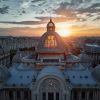
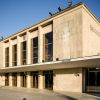
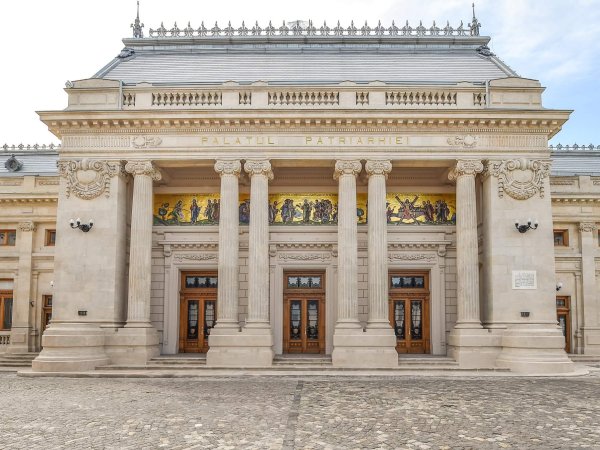
The current building of the Patriarchate Palace, initially known as the Palace of the Chamber of Deputies, was designed by the architect Dimitrie Maimarolu. The idea of the construction dates from 1890, when his project won an international competition. The main inspiration came from the architecture of the Reichstag in Berlin, a symbol of German parliamentarism.
Because of financial difficulties, the works began only in 1906, at the urging of Take Ionescu, and the completion of the construction took place in 1916. The building was conceived in neoclassical style with French influences, having an impressive façade of approximately 80 meters oriented toward the Patriarchate. The imposing ground floor is dominated by the central body of the entrance and by the dome of the session hall, similar to that of the Romanian Athenaeum.
The main façade is flanked by two corner volumes, subordinated to the central body, creating a harmonious architectural balance. The session hall, circular in shape, was provided with seats for deputies on the ground floor and galleries for the public on the upper level.
Until 1948, the vestibule and the hall were adorned with dozens of busts of the great political figures of the modern era – C.A. Rosetti, Dimitrie Sturdza, Barbu Catargiu, Alexandru Lahovary, Ionel Brătianu, Lascăr Catargiu, Titu Maiorescu, Take Ionescu and others – created by renowned sculptors such as Karl Storck, Ion Jalea, or Oscar Han. These works disappeared during the years of the communist regime.
The dome of the hall, at the top of which there is an eagle with spread wings, symbol of sovereignty, suffered serious damage following the earthquake of November 10, 1940, when it collapsed and had to be subsequently rebuilt. The building was, moreover, the first construction in Romania made of reinforced concrete, marking a moment of technical innovation in national architecture.
The Palace is surrounded by a park and connected through monumental stairs to the Patriarchate plateau, creating a solemn perspective over the entire ensemble. In 1996, by Government decision, at the request of the Romanian Orthodox Church, the building was given for its use, officially becoming the Patriarchate Palace.
Today, the edifice remains a symbol of historical continuity. From the vineyards of the monks and the modest cells of the monastery, to the proclamation of the Union and the parliamentary debates of modern Romania, the Patriarchate Palace reflects the evolution of a nation. It is the place where faith and politics met, where fundamental decisions were taken, and where history was written with solemnity and responsibility.
We also recommend: Mitropolia Hill in Bucharest, Between Legend and Truth. What Secrets Might the “Hill of Joy” Hide?