“The Misfortune” of the Great I.L. Caragiale: Unjustly Accused of Plagiarism, the Great Playwright Left Romania Permanently
- Articles
- 13 JAN 26
Ion Luca Caragiale is today considered, without reservation, one of the pillars of Romanian literature. His work, translated and performed on stages around the world, remains relevant through the strength of social observation and the merciless irony with which he captures human weaknesses. However, his destiny was not free of drama, and one of the most painful blows received by the great playwright came precisely from within the Romanian literary world. The accusation of plagiarism related to the drama “Năpasta” triggered a scandal of proportions that shook his confidence in Romanian society and led him to permanently leave the country.
An Essential Name in Modern Romanian Literature
Born on January 30, 1852, in the locality of Haimanale, Prahova County, Ion Luca Caragiale came from a family of Aromanian origin. His father, Luca Caragiale, and especially his uncle, Costache Caragiale, an actor and playwright, introduced him early to the world of theater. The studies he pursued in Ploiești and Bucharest opened the path toward journalism and dramatic criticism, fields in which Caragiale quickly distinguished himself.
The end of the 19th century and the beginning of the 20th century represented a period of remarkable effervescence for Romanian literature. Alongside Mihai Eminescu, Ioan Slavici, Alexandru Vlahuță, or Barbu Ștefănescu Delavrancea, Caragiale contributed decisively to the modernization of Romanian culture. His satirical writings, often uncomfortable, earned him both public admiration and the hostility of those disturbed by the critique of their own flaws.
Master of Comedy and the Lucidity of Social Satire
Caragiale’s consecration came through his comedies of manners, which captured with rare precision the defects of Romanian society. Plays such as “O noapte furtunoasă” (1879), “O scrisoare pierdută” (1884), or “D-ale carnavalului” (1885) became benchmarks of Romanian theater, performed continuously to this day.
His irony, memorable dialogues, and realistically drawn characters established him as an unflinching observer of political and social life. Yet this very lucidity attracted numerous detractors, offended by the way the playwright exposed imposture, corruption, and hypocrisy.
“Năpasta,” Caragiale’s Only Tragedy
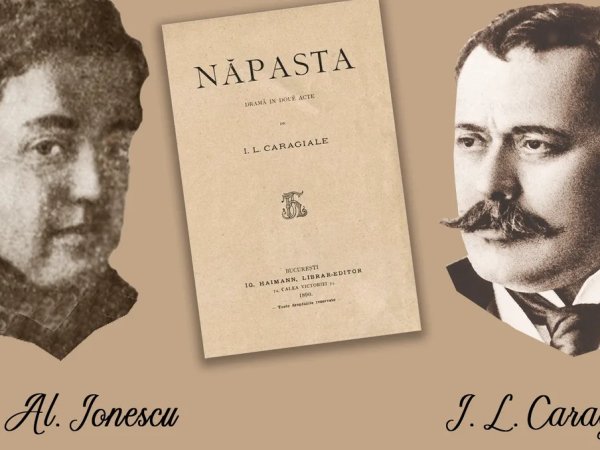
Beyond his famous comedies, Caragiale wrote the drama “Năpasta”, published in 1890. This is his only tragic play, marking a profound shift in tone. Năpasta is a meditation on guilt, suffering, and revenge, displaying remarkable psychological intensity.
The play was praised for the gravity of its themes and the construction of its characters, demonstrating that the author of comedies could approach the darkest corners of the human soul with equal force. Ironically, this work would become the source of the greatest scandal in his life.
The Plagiarism Accusation and Caion’s Article
On November 30, 1901, in Revista literară, journalist Constantin Alexandru Ionescu, known under the pseudonym Caion, published an article titled “Domnul Caragiale” (“Mr. Caragiale”). In it, he claimed that the drama “Năpasta” was plagiarized from a Hungarian play called “Nenorocul”, attributed to a supposed author named Istvan Kemeny.
According to Caion, the drama had been translated into Romanian and published in Brașov as early as 1848 by a certain Alexandru Bogdan. The article went beyond mere plagiarism accusations, containing disparaging statements suggesting that Caragiale’s success was due to lack of scruples and dubious talent.
The Literary World’s Reaction and the Scandal’s Impact
The accusations by Caion caused a true shock in the Romanian cultural sphere. Caragiale was already an established figure, and the idea that he had plagiarized a foreign play seemed inconceivable to many contemporaries. Nevertheless, the scandal was amplified by the press, and the playwright’s reputation was placed in serious jeopardy.
Profoundly affected, Caragiale tried to locate the drama “Nenorocul” to prove his innocence, but found no evidence of its existence. Realizing the accusation was entirely fabricated, he decided to sue Caion for defamation.
The Trial and Confrontation with Injustice
Convinced of his innocence, Caragiale brought Caion to court. His defense was handled by Barbu Ștefănescu Delavrancea, a distinguished writer and orator, who ensured a solid defense. The trial was intensely covered by the media and closely followed by the public.
During the hearings, Caion was forced to admit that Istvan Kemeny did not exist and that the entire accusation was invented. Consequently, the court initially sentenced him to three months of correctional imprisonment, a fine of 500 lei, and payment of 10,000 lei in civil damages to Caragiale.
Caion’s Acquittal and the Final Rupture
Dissatisfied with the verdict, Caion appealed. Surprisingly, at the appeal trial, he was acquitted. The court’s decision sparked controversy and seemed influenced by political pressure and certain cultural circles. For Caragiale, this acquittal was the final blow.
Profoundly disappointed by how he had been treated and by Caion’s acquittal, Caragiale decided to leave Romania permanently. In 1905, he settled in Berlin with his family, choosing exile as a moral and personal refuge.
Exile in Berlin and Disillusionment with the Homeland
In Berlin, Caragiale continued to write and publish, but his disappointment with Romania remained deep. In a letter to his friend Alexandru Vlahuță, he expressed with bitterness the reasons for his exile, speaking of the same faces, the same mentalities, and a society where flattery and theft were virtues, while labor and talent were despised.
This confession remains one of the harshest indictments of Romanian public life at the beginning of the 20th century and offers a clear picture of the internal suffering endured by the great playwright.
Death and Posthumous Recognition
Ion Luca Caragiale passed away on June 9, 1912, in Berlin, due to arteriosclerosis. His body was repatriated, and on November 22, 1912, he was buried with honors at Șerban Vodă Cemetery in Bucharest. Today, he is recognized as one of the greatest Romanian writers of all time.
His plays continue to be staged constantly in theaters in Romania and abroad, and his work remains a reference for lucidity and artistic intelligence. The trial with Caion, however, remains one of the saddest and most unjust episodes of Caragiale’s life, a “misfortune” that forced him from his own country, yet could not diminish his value or literary immortality.
We also recommend: How Ion Luca Caragiale “drove away” Aristizza Romanescu and Constantin Nottara from the National Theatre of Bucharest