The History of the Romanian Lottery: Who Founded It, the First Law, How It Took Place During the Two World Wars
- Articles
- 22 JUN 26
The history of the Romanian Lottery is closely linked to the modernization of Romanian society at the beginning of the 20th century and to the efforts of the state to support projects of public interest. Before the official establishment of a national state lottery, Romania had its first experience in this field in 1906, with the organization of the lottery dedicated to the Romanian General Exhibition.
The first initiatives and the appearance of the State Lottery in Romania
The event of 1906 had a special importance for the country's history, marking 40 years of the reign of King Carol I, 25 years since the proclamation of the Kingdom of Romania, and 1,800 years since the arrival of Emperor Trajan in Dacia. Inspired by the great European universal exhibitions, especially those organized in Paris, the Romanian General Exhibition presented the economic, cultural, and social progress achieved during the period of Carol I’s reign.
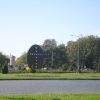
Following this extensive project, Bucharest gained new representative spaces, the best known of which is the current Carol Park. At the same time, the Roman Arenas were also built, a space intended for the shows and ceremonies organized during the duration of the exhibition.
Also in 1906, the legal foundation of the State Lottery in Romania was established through the adoption of the “Law for the establishment of a fund for the sanitary assistance of villagers,” promulgated on May 29. This is considered the birth certificate of the institution. The initiative was supported by several important personalities of the time, including King Carol I, the famous surgeon and professor Doctor Thoma Ionescu, who proposed the project, as well as Gheorghe Grigore Cantacuzino, President of the Council of Ministers and Minister of Internal Affairs.
The new permanent class lottery had an essential role: the funds obtained from its net revenues were directed towards improving sanitary conditions in rural areas. Thus, the State Lottery became, from its very beginning, an instrument of support for the construction and maintenance of rural hospitals, sanatoriums, asylums, medical districts and public baths, as well as for combating diseases affecting the population of Romanian villages.
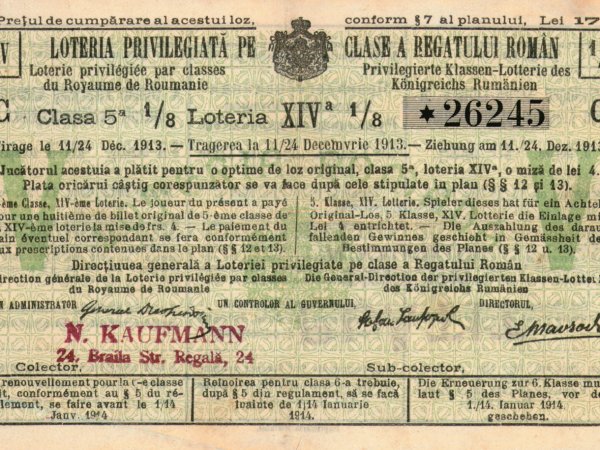
On July 12, 1906, the constitutive act of the State Lottery Society of Romania was published in the Official Gazette, and in less than one year, the first regulation concerning the drawings of the privileged class lottery of the Romanian Kingdom was elaborated.
The role of the Romanian Lottery during the period of the two World Wars and the development of the healthcare system
The first decades of the existence of the State Lottery coincided with some of the most difficult moments in Romania’s history, including the period of the First and the Second World Wars. Even in the context of the challenges generated by the armed conflicts, the institution maintained its social mission, contributing to the support of the healthcare system and of the people affected by the wars.
The funds resulting from the lottery’s activity were also used to support the war invalids of the War for National Unification. They benefited from pensions, specialized hospitals and homes intended for their care, during a period in which the Romanian state was trying to manage the dramatic consequences of the conflict.
An important moment in the evolution of the institution took place in 1934, when a new law was adopted through which the administration and operation of the State Class Lottery for public health and social protection were entrusted to the State Lottery Administration. The new structure had the right not only to organize traditional lottery games, but also auxiliary lotteries in collaboration with social assistance and cultural institutions.
The money obtained from the activity of the lottery continued to be distributed for the benefit of public health. The largest part of the funds was directed toward the fight against tuberculosis, one of the most severe diseases of that period. At the same time, programs for combating syphilis, malaria, pellagra, trachoma, and leprosy were financed.
Numerous medical institutions in Romania benefited from financial support. Among these were the hospitals administered by the Saint Spiridon Epitropy in Iași, such as Cantacuzino Hospital, the Central Hospital in Pașcani, and the Institute of Obstetrics and Gynecology. Also, the Eforia of Civil Hospitals in Bucharest received funds for the development of institutions such as Colțea Hospital, Filantropia Hospital, Colentina Maternity Hospital, and children's hospitals.
The State Lottery also contributed to the modernization of more than 40 healthcare units throughout the country by financing construction and renovation works, as well as the acquisition of furniture and medical equipment. Sanatoriums for tuberculosis, dispensaries, and care centers for chronic patients were among the main objectives that received support.
Supporting culture and the transformations after the Second World War
Besides the healthcare field, the State Lottery gradually expanded its activity towards supporting culture. In 1934, through an agreement approved by the Council of Ministers, the Lottery of the Union of Royal Cultural Foundations was created, an auxiliary lottery intended to finance the major cultural projects of the time.
Through the funds obtained, prestigious publications such as the “Review of the Royal Foundations,” important editorial projects, and the publication of fundamental works of Romanian literature were supported, including the famous edition of the works of Mihai Eminescu coordinated by Perpessicius.
After the end of the Second World War and the change of the political regime in Romania, the organization of the lottery underwent important transformations. Private lottery collections were eliminated, and the State Lottery Administration came under the authority of the Ministry of Finance.
In the years 1954 and 1958, the institution became the State Enterprise Loto-Pronosport, and a large part of the obtained revenues were directed towards the development of Romanian sports. During this period, new games appeared, such as Pronosport and Pronoexpress, as well as the extremely popular “Instant Lottery Ticket,” which achieved considerable success both in rural areas and in cities.
The modernization of the Romanian Lottery and its contribution to the development of society after 1989
In the following decades, the Lottery continued to be one of the main financiers of Romanian sports. It supported important competitions such as the Tour of Romania cycling race, organized special draws to help the victims of the devastating floods of 1970, and contributed to the participation of Romanian athletes in international competitions.
After the fall of the communist regime in December 1989, the Romanian Lottery entered an extensive process of modernization and adaptation to the market economy. In 1992, the automation of the lottery system began, and in August 1993, the first fully automated lottery games were organized.
The institution was reorganized in 1995 as the Autonomous Administration of the National Lottery, and in 1999 it received its current form as the National Company “Romanian Lottery” S.A. Although its organizational structure changed, its mission remained the same: attracting funds that would be used for projects of public interest and awarding prizes to participants.
During the 1990s and at the beginning of the new century, the Romanian Lottery was an important supporter of sports, especially football. It financed the participation of the national team in the 1994 World Cup held in the United States and contributed to the qualification for the final tournament of the 1998 Football World Cup in France. At the same time, numerous sports federations benefited from financial support.
The Lottery’s contribution was not limited only to sports. The institution supported important cultural projects, such as the “George Enescu” International Festival, the Sibiu International Theatre Festival, the UNITER Awards Gala, and the restoration of the Romanian Athenaeum. It also financed educational programs, social projects, medical institutions, people in difficult situations, and works for the preservation of historical monuments.
Thus, from the first law adopted in 1906 until the present day, the history of the Romanian Lottery reflects the evolution of Romanian society. For more than a century, the institution has played an important role in financing healthcare, culture, education, and sports, constantly adapting to the political, economic, and social changes through which Romania has passed.
We also recommend: The code of good manners in interwar Bucharest: How gentlemen and young ladies behaved when they went out in the city