The history of the grand Marmorosch Bucharest Hotel, the palace that once housed the most influential bank of 19th-century Romania
- Articles
- 29 NOV 25
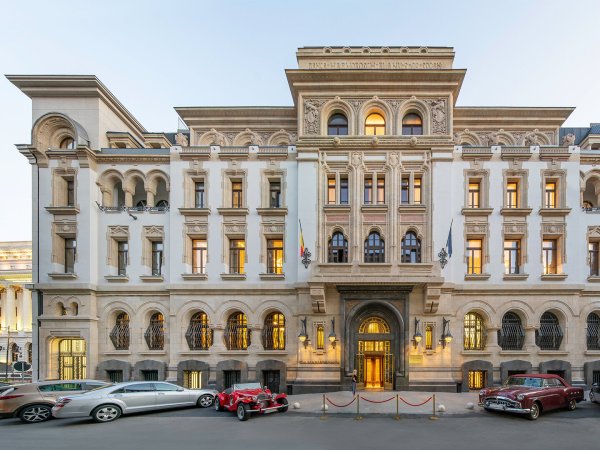
In the heart of Bucharest’s old town, on Doamnei Street, stands today the Marmorosch Bucharest Hotel, an elegant space that preserves an impressive history within its walls. The building that hosts this five-star hotel was not always a place dedicated to hospitality, but the headquarters of one of the most influential financial institutions of Romania at the end of the 19th century: the Marmorosch-Blank Bank. Its story is, in fact, the story of an era in which the Romanian economy was modernizing rapidly, and foreign capital was beginning to play a decisive role in the country’s development.
The roots of a symbol of Romanian finance
The Marmorosch Bank has its origins in the year 1848, when Iacob Marmorosch founded a banking house in one of Bucharest’s oldest neighborhoods. It was a period marked by political effervescence and national awakening, and financial institutions had started to gain an increasingly important role. Strategic partnerships strongly influenced the evolution of the bank.
While at first Iacob Marmorosch collaborated with the banker Loebel, in 1864 Mauriciu Blank joined the business, the man who would eventually transform the institution into a true financial giant.
The year 1905 represented a turning point. The bank was reorganized as a joint-stock company, starting with a capital of 8,000,000 lei, which later increased spectacularly to 125,000,000 lei.
Relationships with powerful banking groups from Germany, Austria, France, and the United States strengthened the institution’s status. Becoming the main channel through which Western capital entered the Romanian economy, the bank established itself as a central element of the country’s modernization and industrial development.
The rise and peak of the Marmorosch Blank Bank
In the 1920s, the Marmorosch Blank Bank had already become the strongest commercial bank in Romania. Its expansion was impressive: 25 branches in the country and four abroad—Paris, Istanbul, Vienna, and New York.
This success directly connected it to the major economies of the Allied camp in the First World War, such as Great Britain, the U.S., and France. At the same time, the bank maintained relationships with financial institutions from the opposing side, such as Pester Ungarische Kommerzial Bank or Darmstadter Bank, demonstrating the leadership’s ability to balance complex interests.
The impact on the Romanian economic environment was enormous. Through the approximately 115 companies it controlled, the bank influenced key sectors, from infrastructure and industry to trade and services. Bucharest was rapidly modernizing, and the prosperity of this financial institution contributed directly to transforming the city into a true regional metropolis.
However, the spectacular success was overshadowed by global economic events. The worldwide crisis that broke out in 1930 severely affected financial systems everywhere, and on October 21, 1931, the Marmorosch Blank Bank entered payment default.
Although formally declared in “preventive concordat,” the bank soon came under the strict supervision of the National Bank of Romania. The NBR attempted a rescue through the takeover of certain debts and by granting preferential loans, but the institution’s situation was already too fragile.
From political support to inevitable decline
The personality of Aristide Blank, the son of Mauriciu Blank, strongly influenced the bank’s trajectory during the turbulent years that followed. During the dictatorship of King Carol II, Aristide Blank became a central figure in the circles close to the monarch, being considered his main sponsor.
This connection brought the bank preferential treatment, and political interventions went as far as the dismissal of the NBR governor, Mihail Manoilescu, who opposed the unconventional methods applied to save the bank.
To cover the debts, the Carlist government granted Discom, a company controlled by Aristide Blank, highly profitable concessions for the sale of tobacco and salt, both previously state monopolies. At the same time, the City Hall of Bucharest was forced to buy, at inflated prices, land owned by Blank, such as the marsh on which today’s Bordei Park stands—a scandal long remembered by the public.
After the abdication of Carol II, the situation changed radically. The National Legionary State and later the Antonescu regime imposed a discriminatory treatment on Aristide Blank, accusing him of huge personal debts to the state. Although in 1944 the pro-Soviet government restored his personal fortune, the bank shares did not return to his possession, and the institution continued to accumulate losses.
In the end, on June 4, 1948, the Marmorosch Blank Bank entered insolvency again and was liquidated. Paradoxically, its end coincided with the centennial year of its founding, and the disappearance of the bank occurred even before the wave of communist nationalizations. A part of its buildings became the property of the National Bank of Romania, which later redistributed them to departments that would eventually become independent institutions, such as the Romanian Commercial Bank (BCR) and the Romanian Bank for Foreign Trade (BRCE, later Bancorex).
Aristide Blank, the bank’s last major director, also had a tragic fate. Convicted of treason in 1953, released in 1955, and emigrated to Paris in 1958, he remained until the end a controversial figure, caught between ambition, influence, and the political instability of his era.
The building’s transformation into a symbol of modern elegance
Throughout this time, the building constructed between 1915 and 1923 continued to fascinate with its spectacular architecture. Built in the Neo-Romanian style with Art Deco, Gothic, and Byzantine influences, it represented a refined blend of tradition and modernity. The interior, decorated in Art Nouveau, completed the image of a palace of Romanian finance, a space where luxury intertwined with economic power.
Today, this historic building has been reborn under the name The Marmorosch Bucharest by Autograph Collection, a five-star hotel that carries forward the legacy of the place. A meticulous restoration brought to light spectacular architectural details, and the old bank vault—with its original door preserved—was transformed into a unique bar open to visitors. It is a space where the atmosphere of the past can still be felt, and the grandeur of former times subtly blends with the comfort of the present.
The Marmorosch Hotel is not just a place of accommodation, but a cultural landmark, an invitation to step into a universe where Romania’s economic history comes to life. Here, among arches, stained glass, and noble materials, visitors sense the pulse of an era in which Bucharest was defining its modern identity. The legacy of the Marmorosch Blank Bank thus remains alive, integrated into an elegant place that continues to impress nearly a century after its construction.
We also recommend: Bucharest City Hall, the history of a grand palace: Maidanul lui Duca, the Ministry of Public Works, and the People’s Council