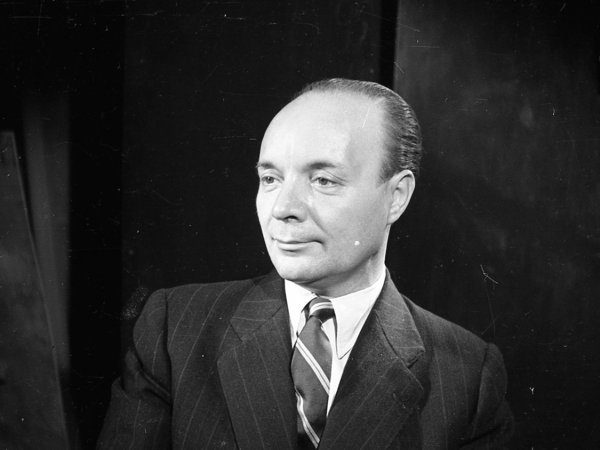
The greatest fan of Caragiale gave us “A Stormy Night” and became a pioneer of Romanian comedy in cinema. The story of the famous director Jean Georgescu
- Articles
- 16 JAN 26
The history of Romanian cinema cannot be told without mentioning Jean Georgescu, one of the most important comedy directors Romania has ever had. A lucid, ironic spirit, deeply attached to the work of I. L. Caragiale, Jean Georgescu managed to transfer to the screen the essence of Romanian comedy, in an era dominated by ideological constraints and often suffocating censorship. His life and career represent a combination of authentic talent, artistic courage, and personal suffering, within a historical context that was far from favorable to freedom of expression.
The formation of an artist drawn to theater and film
Jean Georgescu was born on February 12, 1904, in Bucharest, at a time when the performing arts were beginning to assert themselves more visibly in the Romanian space. He attended the Royal Conservatory of Dramatic Art, an institution that trained numerous important actors and directors of the era. After graduating, in the 1920s, he began his career as a theater actor, performing in various companies alongside well-known names of the Romanian stage.
The first years of activity offered him a profound understanding of theatrical mechanisms, of the relationship between actor and audience, as well as of the rhythm of comedy—elements that would later decisively help him in his cinematic career. Direct contact with the stage shaped his taste for dialogue, situation, and character construction, essential aspects of comedy inspired by Caragiale.
The first steps in cinema and the French experience
His debut in film took place in 1923, in the movie “Țigăncușa de la iatac” (“The Gypsy Girl from the Boudoir”), where he played the role of a “bonjourist.” Although still at the beginning, Jean Georgescu was quickly attracted by the expressive possibilities of cinema, an art that was then in full development in Romania as well. Fascinated by the new visual language, he began writing film scripts and gradually moved closer to directing.
Wishing to perfect himself and to come into contact with a more developed film industry, he left for France in 1929. There, he worked as a director and screenwriter, accumulating extremely valuable experience. Contact with Western cinema broadened his artistic horizon and offered him models of professionalism and creative freedom, which he would later try to apply in Romania.
The return home and the encounter with Caragiale on the big screen
Returning to Romania at the end of the 1930s, Jean Georgescu began to put his artistic vision into practice. The peak moment of his career is represented by the film “O noapte furtunoasă” (“A Stormy Night”, 1942), an adaptation of the famous comedy written by I. L. Caragiale. This production has remained to this day one of the most appreciated cinematic adaptations of Caragiale’s work.
The film benefited from an exceptional cast, bringing together leading actors such as Alexandru Giugaru, Radu Beligan, George Demetru, Ștefan Iordănescu-Bruno, Jean Moscopol, Florica Demion, Miluță Gheorghiu, Maria Maximilian, and George Ciprian. Under the guidance of Jean Georgescu, Caragiale’s characters came to life on screen, preserving their flavor, irony, and critical spirit.
Jean Georgescu, the quintessential Caragiale-inspired filmmaker
The work of I. L. Caragiale was a constant source of inspiration for Jean Georgescu. According to the “Dictionary of Cinema” (Univers Enciclopedic Publishing House, 1997), his adaptations, especially “A Stormy Night,” represent fundamental landmarks of Caragiale-inspired filmography. The director deeply understood the mechanisms of linguistic, situational, and character-based comedy, managing to adapt them to the cinematic language without diluting their force.
For Jean Georgescu, Caragiale was not merely a classical author, but an eternal contemporary, whose typologies and social habits could be found, in various forms, in modern society as well. This perspective allowed him to create films that remained relevant beyond the era in which they were made.
The confrontation with censorship and the film “Our Director”
The communist period represented a continuous struggle with censorship for Jean Georgescu. Although he continued to work, he was often marginalized, and his artistic freedom was severely limited. The peak of the conflict with the authorities was reached with the release of the film “Directorul nostru” (“Our Director”), which premiered on March 29, 1955.
This satirical comedy, which criticized bureaucracy, servility, and the lack of responsibility in certain institutions, was made in a special context, marked by a slight relaxation of censorship after the death of Iosif Vissarionovici Stalin on March 5, 1953. Today, the film is considered one of the most important productions in the history of Romanian cinema.
Behind the scenes of a courageous creation
Pavel Țugui, at that time head of the literature and arts sector within the Propaganda Section of the Central Committee of the Romanian Workers’ Party, later revealed that the appearance of the script for “Our Director” was the result of a “scheme” involving several decision-makers in the cultural field. Filming took place between June 18 and December 24, 1954, with exterior scenes shot in Bucharest and interior scenes on the Tomis and Floreasca studio stages.
Jean Georgescu explained before the premiere that he had been forced to expand the action and to make the story more dynamic in order to avoid the static, tiring character of the original short story. Through varied sets and constant movement, he succeeded in transforming the literary material into a fast-paced and incisive film.
Marginalization and years of suffering
The artistic success of the film did not protect the director. On the contrary, “Our Director” brought him a ban from working on film sets. Jean Georgescu was removed from projects such as “Două lozuri” (“Two Lottery Tickets”) and “Telegrame” (“Telegrams”), and in 1959 he was effectively expelled from the film industry altogether. A deeply difficult period followed, during which he was forced to live in miserable conditions, selling his belongings in order to survive.
His later testimonies speak of humiliation, but also of the discreet solidarity of several former students who secretly helped him. These years remained one of the most painful chapters in his life.
The last films and the reflections of a filmmaker
After eight years of forced silence, Jean Georgescu returned to cinema, making his last feature film, “Pantoful Cenușăresei” (“Cinderella’s Shoe”, 1969), which also marked the cinematic debut of actress Ioana Pavelescu. During this period, the director reflected lucidly on the art of film, which he described as a complex “cocktail” of talent, technique, and inspiration.
The last years of his life were spent away from the world of film, withdrawn and almost forgotten by the institutions that had marginalized him. Jean Georgescu died on April 8, 1994, leaving behind an essential body of work for Romanian comedy and an example of artistic dignity in a difficult era.
We also recommend: Veta had “A Stormy Night” that Truly Launched Her Career. The Story of Actress Maria Maximilian