The George and Agatha Bacovia Memorial House: Brief History, Schedule, Exhibition, Tickets
- Articles
- 24 MAR 26
The George and Agatha Bacovia Memorial House is one of those places in Bucharest that does not impress through monumentality, but through the emotional and cultural density it preserves within its walls. It is not a spectacular museum in the classical sense of the word, it does not rely on grandiosity or sophisticated scenography, but on authenticity. That is why, for those who want to understand not only George Bacovia's work but also the atmosphere in which the poet lived, wrote, and aged, this house has a special value.
Where did George Bacovia live in Bucharest
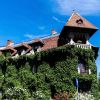
Here lived George Bacovia, one of the most important Romanian poets of the 20th century, between 1933 and 1957, together with his wife, Agatha Grigorescu Bacovia, and their son, Gabriel. The house, modest and discreet, does not tell only the story of a great writer, but also that of a family who built a refuge on the outskirts of the Bucharest of yesteryear.
Over time, this space became a place of memory, and the main credit for transforming it into a museum goes to Agatha Bacovia, who understood very early that the place needed to be preserved as a living witness to the life and work of the poet.
Today, the memorial house functions under the aegis of the National Museum of Romanian Literature and can be visited by the public according to a clearly established schedule. Besides the historical and literary dimension, the museum also offers an intimate, almost domestic experience, different from large museum institutions.
Visitors do not enter merely an exhibition, but a personal universe, where the furniture, documents, manuscripts, and the garden quietly continue the biography of an intellectual family. Additionally, for those interested in the practical side of visiting, the schedule, ticket prices, and access rules are well-defined and worth knowing beforehand. The visiting hours and prices officially posted by the National Museum of Romanian Literature may slightly differ from older sources, especially regarding seasonal visiting hours.
The history of a modest house turned heritage site
The George and Agatha Bacovia Memorial House is, first and foremost, the house where poet George Bacovia lived for almost a quarter of a century, from 1933 until his death in 1957. Settling here marked an important stage in the poet’s biography. From that year, Bacovia lived in Bucharest together with his wife, Agatha Grigorescu Bacovia, and their only son, Gabriel, in a simple residence on a street then called Frăsinetului.
At the time, the area did not have the central, urbanized status it is associated with today but still retained the atmosphere of an early 20th-century suburb. Back then, the place belonged to the Șerban Vodă Commune and was located in Bucharest’s outskirts.
Even the way the house was built says something important about the Bacovia family. It was not a lavish investment nor an architecturally ambitious project, but the erection of a modest home made possible by a loan obtained by Agatha from the Teachers’ House (Casa Corpului Didactic). Moreover, she personally supervised the construction works, practically acting as the site manager. The construction took about one month, a detail that emphasizes the pragmatic and urgent character of the entire endeavor. The house was designed as a living space, not as a status symbol, and this simplicity remains one of its defining features.
After George Bacovia’s death in 1957, Agatha Bacovia took decisive steps to ensure that the residence would not be lost in urban anonymity and would retain its cultural significance. The house began functioning as a museum as early as 1958, just one year after the poet’s passing, through her direct efforts. The beginning was difficult because the state’s support was rather timid and symbolic. Initially, the official involvement was limited to changing the street name, which ceased to be Frăsinetului and was given the poet’s name.
Only in 1966 was the house officially nationalized and consecrated under the title George Bacovia Memorial Museum. These historical milestones are confirmed by the National Museum of Romanian Literature, which presents the house as a memorial museum inaugurated in 1966, in the building inhabited by the poet between 1933 and 1957.
The history of the house is therefore closely linked to Agatha Bacovia’s persistence. She not only built the home and managed the family space but also had the foresight to understand that the poet’s memory required a living, recognizable, authentic framework. Without her insistence, it is very possible that this address would have remained just a mention in a literary biography. Instead, the house became a bridge between today’s readers and the concrete universe in which the author of works that decisively shaped modern Romanian poetry lived.
The house’s atmosphere and what visitors can see
One of the great strengths of this memorial house is that it preserves an authentic atmosphere, difficult to reproduce artificially. It is not just about exhibits arranged in display cases, but the sense that the space has remained almost suspended in the time when the Bacovias lived here. This impression gives the visit a special intensity. Rather than a distant museum experience, the visitor feels a real closeness to the family’s daily life.
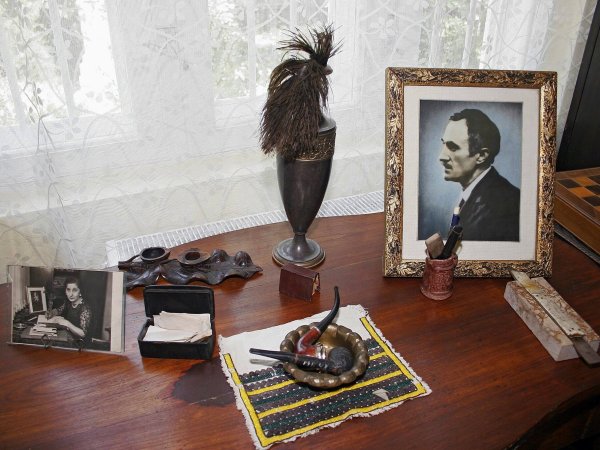
The exhibition includes numerous personal objects of the Bacovia family: pieces of furniture, documents, manuscripts, photographs, and other elements that reconstruct the domestic and intellectual world of the poet. According to official presentations and museum guides, the interior contains family photos, personal papers, Bacovia’s library volumes, and items recreating the ambiance in which guests were received. The living room, with its furniture, tea set, and old radio, faithfully recreates the intimate climate of the house and the way this space functioned in everyday life.
This domestic aspect is essential because George Bacovia is often perceived mainly through his work—through its oppressive, symbolist atmosphere, its melancholy, and depressive tone. The house, however, adds a very concrete human dimension: it brings the poet back into a family existence, with objects, routines, and recognizable spaces. The visitor does not encounter only the canonized figure of the writer but also traces of his life as a person.
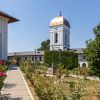
Another important element of the exhibition is the flower-filled garden, consistently mentioned in museum presentations. It completes the visit experience and introduces an interesting contrast between Bacovia’s public image and this living, delicate vegetal frame. The garden is not merely decorative but an integral part of the location’s atmosphere. It recalls a Bucharest of another time and a historical period traversed by numerous cultural currents and artistic sensibilities.
This combination of interior and garden space makes the museum more than just a collection of objects. It is a carefully preserved biographical setting, allowing for a more nuanced reading of George Bacovia’s personality and Agatha Bacovia’s role in conserving his memory. For literature lovers, students, or tourists interested in Bucharest’s cultural landscape, the house offers a calm yet dense experience.
Visiting schedule and practical access information
Beyond historical and cultural interest, visitors need clear practical information. Currently, the George and Agatha Bacovia Memorial House is open to the public from Tuesday to Sunday, closed on Mondays. The visiting hours are seasonal: from November 1 to February 28, the museum operates from 9:00 to 17:00, and from March 1 to October 31, the schedule is 10:00 to 18:00. These hours are indicated in the official presentations by the National Museum of Romanian Literature.
This clarification is important because many older materials cite a single fixed schedule, usually 10:00 to 17:00. For a well-planned visit, it is crucial to take into account the seasonal variation.
Additionally, the ticket office has its own cutoff time. Official information states it closes at 16:30 or 17:30, depending on the season, and the last guided tour starts at 16:00 or 17:00. This means it is not recommended to arrive just before closing, especially if you wish to benefit from a guide or explore the exhibition calmly.
There are also a few access rules visitors should know in advance. Large accessories, luggage, umbrellas, and heavy coats are not allowed inside the rooms and are taken by supervisors. Food and drinks are strictly prohibited. These rules are natural for a memorial space with heritage objects and help protect both exhibits and the authentic atmosphere of the place.
For those planning a more extensive visit, such as a group or educational trip, it is advisable to check the possibility of reservations through the National Museum of Romanian Literature network. There are also associated online ticketing platforms, but the primary reference remains the official MNLR page.
Tickets, special rates, and photography conditions
Regarding tickets, the standard rates communicated officially are: 30 lei per day for adults and 15 lei per day for pensioners, students, pupils, military personnel, organized groups, and adults with mild or medium disabilities. Entry is free for children under 7, children with disabilities and their accompanying person, as well as for adults with severe or pronounced disabilities and their companions. These rates appear in the official presentation of the memorial house by the National Museum of Romanian Literature.
In addition, there is a guide fee of 30 lei per visitor per day. For many, a guided tour can be very useful, especially in a memorial space where many details make sense only in context. The Bacovia house is not just a place to visit, but a place to understand, and explanations can significantly enhance the experience.
Photography and filming rules differ depending on the purpose. Professional filming or photography inside the house costs 100 lei per square meter per hour, applicable to television, documentary or artistic films made by specialists, or private event requests. Moreover, commercial or documentary filming of items that are part of the national movable cultural heritage, owned publicly, can only be done with written approval from the managing authority (the National Museum of Romanian Literature), under contract, and respecting copyright laws.
For tourists who wish to photograph or film inside the house for personal purposes, the fee is 50 lei per day per visitor. Visitors should be aware of this rule in advance, especially as many document their visits using phones or cameras. In a memorial space, these activities are regulated precisely to protect the heritage and normal visitor flow.
It is worth noting a practical detail from online ticketing platforms: some display slightly different final prices due to processing fees. Therefore, the official base rate should be distinguished from the final online purchase cost. For the clearest information, the MNLR official page remains the primary reference.
Why visiting the Bacovia House is worthwhile
The George and Agatha Bacovia Memorial House is worth visiting not only because it is part of Bucharest’s museum circuit but because it provides direct contact with a literary world that otherwise risks remaining abstract. In textbooks and literary histories, George Bacovia appears as a canonical author, associated with symbolism, melancholy, the gray urban atmosphere, and oppressive modern sensitivity. In his house, however, all these critical layers intersect with real life: objects, rooms, photos, documents, manuscripts, silences.
At the same time, the museum tells Agatha Bacovia’s story, without whom the poet’s memory would have been much more fragile. She built the house, organized family life, and insisted on turning the residence into a museum. In this sense, a visit is not just “Bacovian,” but also an encounter with the quiet effort of a woman who understood the value of cultural memory.
For Bucharest residents, the house has the charm of a quieter urban landmark, away from the busiest tourist routes. For visitors from outside the city, it complements a literary map of the capital, alongside other memorial houses and museum locations under the National Museum of Romanian Literature. For students, it offers a concrete experience, greatly helping to understand an author who sometimes seems too distant when read only on the page.
Ultimately, the George and Agatha Bacovia Memorial House is not just a historical address nor simply a collection of personal objects. It is a form of continuity between literature and the real space in which it was lived. And precisely this continuity makes it a place worth seeing slowly, patiently, and attentively.
We also recommend: Theodor Aman Museum, the first artist’s house-studio in Romania and one of the most beautiful residences of the Capital