The composer Gioachino Rossini, the genius of comic opera and Verdi’s mentor, has a street named after him in Bucharest
- Articles
- 27 AUG 26
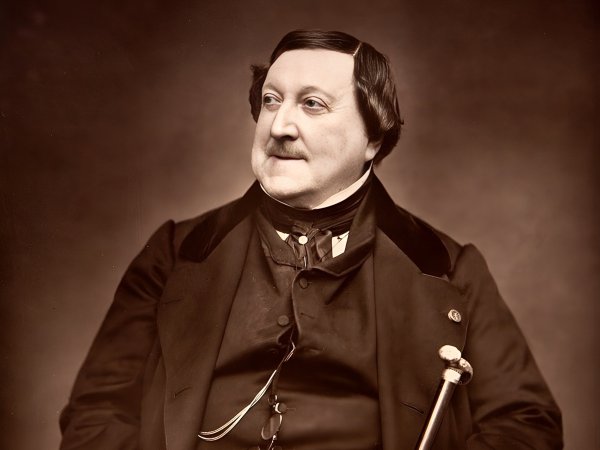
Few personalities in the history of music managed to transform opera into such a lively, spectacular and accessible show as Gioachino Rossini. An extremely prolific Italian composer, famous for his musical humor, dizzying rhythms and celebrated crescendos, Rossini dominated the European stage during the first part of the 19th century and became one of the figures who paved the way for what would later be called the “Golden Age” of Italian opera. His name is primarily associated with “The Barber of Seville”, one of the best-known comic operas of all time, but his work is much broader. He wrote 39 operas, according to institutions dedicated to his work, in an incredibly short period, and he also composed chamber music, songs, piano works and sacred music. His connection with Bucharest is discreet today, but visible in the city’s street names. In Sector 2 there is Gioacchino Rossini Street, in an area where the streets bear the names of great composers such as Frédéric Chopin, Wolfgang Amadeus Mozart, Giuseppe Verdi and Ludwig van Beethoven. Official documents of the Bucharest electoral administration confirm the existence of the street, while a recent document from Sector 2 includes it among the public infrastructure of the area.
The child prodigy born into a family of musicians
Gioachino Antonio Rossini was born on February 29, 1792, in Pesaro, into a family in which music was part of everyday life. His father, Giuseppe Rossini, was a horn and trumpet player, active in the city orchestra and in theatres, while his mother, Anna Guidarini, was a singer. Gioachino’s childhood therefore unfolded close to theatres and performances, and his early contact with the musical world would decisively influence his destiny.
The family moved to Bologna and then to Lugo, where the young Rossini received his first serious music lessons. Canon Giuseppe Malerbi taught him figured bass and composition and introduced him to the works of Wolfgang Amadeus Mozart and Joseph Haydn. Mozart’s influence was so strong that Rossini would be nicknamed “Tedeschino”, meaning “Little German”, in his youth, although Mozart had, of course, been Austrian.
In 1806, Rossini entered the Musical Lyceum in Bologna, where he studied cello and piano and later counterpoint. Even during his adolescence he showed a remarkable compositional talent. The famous “Sei sonate a quattro”, associated with his formative period, date from his youth and demonstrate how early he had begun to think like a mature composer.
The meteoric rise of the composer who wrote at astonishing speed
Rossini entered the world of musical theatre when he was only 18. His official theatrical debut took place on November 3, 1810, at the Teatro San Moisè in Venice, with the farce “La cambiale di matrimonio”. From that moment, his career developed at an extraordinary pace. By the time of “Semiramide”, presented in Venice in 1823, the composer already had more than 30 seria, semiseria and buffa operas behind him.
The year 1813 was one of the decisive moments in his consecration. “Tancredi” and “L'Italiana in Algeri” premiered in Venice, and their success quickly turned him into a well-known name throughout Italy. According to biographical tradition, Rossini had already become famous at around the age of 20, and his success continued to grow during the following years.
In 1816 came “The Barber of Seville”, his comic masterpiece, followed in 1817 by “Cinderella”. In Naples, where he settled in 1815 and where he worked for the royal theatres under impresario Domenico Barbaja, Rossini also intensively approached opera seria, composing works such as “Otello”, “Armida”, “Mosè in Egitto”, “La donna del lago” and “Maometto II”.
In total, Rossini composed 39 operas. The pace is all the more impressive considering that most of his theatrical production was concentrated in a relatively short period. He became known for the speed with which he worked, but also for his ingenuity. He sometimes reused musical themes that he had previously composed, adapting them for new works, a practice that must be viewed in the context of the extremely demanding pace of theatrical production at the time.
“The Barber of Seville” and the revolution of comic opera
Rossini is considered one of the three great representatives of the bel canto tradition, alongside Vincenzo Bellini and Gaetano Donizetti. His particularity, however, lies in the way he transformed comic opera into a genre of unprecedented energy and virtuosity.
“The Barber of Seville”, presented in 1816, became the emblem of this revolution. The fast pace, comic situations, spectacular vocal ensembles and dynamic orchestration created a type of musical entertainment capable of captivating the audience from the very first measures. Rossini raised opera buffa to an artistic level that went far beyond its simple entertainment function.
One of his best-known trademarks was the crescendo, repeatedly used to intensify tension and the comic or dramatic effect. This is where the nickname “Monsieur Crescendo” came from, an ironic reference precisely to his insistent use of this technique. In Rossini’s hands, however, the crescendo became an instrument of dramatic construction, not merely a device.
His influence was enormous. Rossini changed the relationship between voice and orchestra, exploited the virtuosity of singers and created musical situations in which ensembles became genuine engines of drama. This is precisely why his opera continues to be performed on major international stages.
A genius who abandoned opera at the height of his glory
One of the most surprising decisions in Rossini’s life was his withdrawal from opera composition. In 1829, in Paris, he presented “William Tell”, his final opera. After this monumental creation, Rossini gave up opera composition, although he was only 37 years old and still at the height of his glory.
The decision remained one of the great mysteries in the history of music. Rossini did not completely stop composing. In the following years he wrote songs and piano works and, later, important religious compositions. Among them is the “Petite messe solennelle”, a work composed during the late period of his life, which demonstrates that withdrawing from opera did not mean abandoning music.
Another fascinating aspect of his personality was his laziness. Rossini also became famous for anecdotes about the way he worked, including the story that he often composed in bed. When a page of sheet music supposedly fell onto the floor, instead of getting up to retrieve it, he allegedly preferred to rewrite the passage. The story, which became part of Rossini’s mythology, captures very well the image of an extraordinarily talented and fast composer who was ironic about his own habits.
Rossini, the man who turned gastronomy into part of the spectacle
Rossini’s personality cannot be separated from his passion for gastronomy. The composer was a great gourmet, but also a respected cook and host. During the period when he lived in Paris, he organized lavish meals for friends, artists and personalities of the time.
His name also remained connected to the famous “Tournedos Rossini”, a dish consisting of beef, foie gras, truffles and Madeira sauce. The association with French gastronomy helped transform Rossini into a cultural figure whose influence extended far beyond the stage. The dish is attributed by various sources to great French chefs, including Marie-Antoine Carême, a friend of the composer.
Rossini himself combined gastronomic humor with music. During his later period, he composed piano works and songs with titles inspired by culinary dishes, appetizers and desserts. For him, food and music were part of the same art of pleasure, while his Parisian dinners became legendary.
The friendship with Mozart and the memorable meeting with Beethoven
If Mozart was the idol of his youth, Beethoven was one of the great composers whom Rossini deeply admired. In a famous statement, Rossini said that Beethoven should be listened to twice a day, Haydn four times, and Mozart every day, because Mozart was “always adorable”.
Rossini met Beethoven in Vienna, at a time when the great composer was already seriously ill, almost completely deaf and struggling with financial difficulties. The meeting between the two remained one of the best-known anecdotes in music history. Beethoven, after learning that the young Italian was the author of “The Barber of Seville”, allegedly advised him to continue writing comic operas, believing that this genre suited him naturally.
Regardless of the exact form in which the dialogue was transmitted, the episode expresses something essential about the position Rossini had already achieved in the European musical world. He was a young, famous composer, influential enough to be received by one of the greatest musicians of the era.
The connection with Verdi and the musical tribute after his death
Rossini exerted an important influence on the generation that would take Italian opera into a new era, and among his admirers was Giuseppe Verdi. Therefore, Rossini’s association with Verdi should not be understood merely through the chronological proximity between the two, but also through the influence that the Rossinian generation exerted on the development of Italian opera.
After Rossini’s death, on November 13, 1868, Verdi proposed the creation of a great Mass to commemorate the first anniversary of the composer’s death. The project brought together 13 Italian composers, each contributing a section of the work. “Messa per Rossini” was intended to be performed in Bologna, at the Basilica of San Petronio, one year after Rossini’s death.
Because of financial, logistical and organizational problems, the project was not carried out at that time. The complete score was rediscovered by musicologist David Rosen in 1986 and received its first performance in 1988, in Stuttgart. In December 2017, the work was also performed in the Basilica of San Petronio in Bologna, the place for which the tribute had originally been conceived.
Thus, almost a century and a half after Rossini’s death, the public was finally able to hear, in the place originally intended for it, this great declaration of admiration by Verdi and his colleagues.
Gioacchino Rossini Street in Bucharest, in a neighborhood of great composers
In Bucharest, Rossini’s memory is preserved through a street in Sector 2. Gioacchino Rossini Street is located in the Floreasca area and is officially included in the administrative and electoral delimitation of Sector 2. Public documents indicate the street as a complete thoroughfare and place it in the same area as streets bearing the names of famous composers.
Its presence here is all the more interesting because the symbolic topography of the area brings together names such as Mozart, Beethoven, Chopin and Giuseppe Verdi. In practical terms, a walk through this part of Bucharest can become, at least through the street names, an excursion into the history of European music.
For Bucharest, the street name represents a discreet form of homage to a composer who permanently changed the history of opera. For Rossini, however, the true measure of his legacy is not a street, a monument or a memorial plaque, but the fact that his music continues to be performed.
“The Barber of Seville”, “Cinderella”, “William Tell”, “Semiramide” and his other operas continue to be part of the repertoire of major opera houses. Rossini lived for only 76 years, but left behind a body of work created with astonishing speed and an inventiveness that permanently changed musical theatre.
The composer born in Pesaro was, at the same time, a child prodigy, a European star, a master of comic opera, an author of serious operas, an admirer of Mozart, an interlocutor of Beethoven, a reference point for Verdi, a gourmet, a host and a personality with a distinctive sense of humor. And Gioacchino Rossini Street in Bucharest preserves, in one corner of the city, the name of one of the men who made Italian opera one of the most spectacular forms of art in the world.
We also recommend: Oedipe, the masterpiece on which the great George Enescu worked for 20 years: “it is the dearest to my soul!”