Oedipe, the masterpiece on which the great George Enescu worked for 20 years: “it is the dearest to my soul!”
- Articles
- 11 DEC 25
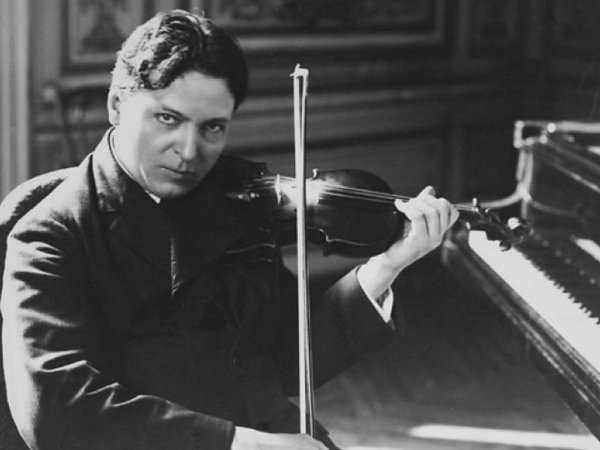
The opera Oedipe remains to this day the most extensive, most profound, and most personal creation of George Enescu, a monumental work born from an idea that sprouted in his mind since his youth. The year 1906, when the composer was only 25 years old, marks the moment when he began to dream of a grand opera. But the decisive impulse came a few years later, in 1909, after Enescu attended a performance of the tragedy Oedipe Roi at the Comédie-Française in Paris. The interpretation of the famous actor Mounet-Sully overwhelmed him, triggering within him a fascination he would follow obsessively: “Leaving the theater, I was hallucinated, possessed. A fixed idea seized me: to compose an Oedipe!”, he later confessed.
The birth of an idea and the beginnings of an enormous artistic journey
Without yet having a libretto, Enescu began in 1910 to sketch the first melodic lines. Aware that the theme of the ancient tragedy was one of the most complex in world literature, he approached the project with meticulous patience and a sincere desire to transform it into a total opera.
In 1912, Edmond Fleg offered him the first version of the libretto, but it was far too extensive, conceived for two evenings of performance. Enescu, attentive to essence and dramatic rhythm, asked Fleg to reduce the text. “Do what a good cook does. Put it back on the fire and let it reduce,” he told him, aware that the monumentality of an opera does not lie in quantity, but in density and expressive force.
A creation born from sacrifices, losses, and artistic obsession
The composition process was a difficult one, spanning more than two decades. By 1922, Enescu had completed the music, but the orchestration — the most difficult part, as he confessed — would last nine more years, until 1931.
In an interview given to Bernard Gavoty, the composer revealed the immense weight of this work: “It is dreadful: you have to think of everything at the same time. Everything must flow from one single stream of ideas.”
But beyond the intellectual and emotional effort, the opera was almost lost during the First World War. In 1917, a chest containing manuscripts, including the sketches of Oedipe, was sent to Moscow together with part of Romania’s treasury.
It disappeared for years, swallowed by the Bolshevik chaos, being recovered only in 1924 with the help of the French authorities. For Enescu, this recovery was more than the salvation of some sheets of paper: it was the recovery of a part of his life, of his labor and of the dream that accompanied him day and night.
The opera is structured in four major sections — prologue, two acts, and epilogue — following the entire life of Oedipus, from birth to death. The tragic destiny is announced from the beginning, when the prophet Tiresias foretells the curse that haunts the royal infant: he will kill his father and unite with his own mother.
Although his parents, Laios and Jocasta, try to break fate by abandoning the child, destiny follows its course. Oedipus is saved, raised at the court of the king of Corinth, and in his attempt to flee the prophecy, he ends up falling directly into it: he kills his father in an unknown confrontation, frees Thebes from the Sphinx, and becomes king, taking Jocasta as his wife.
The discovery of the terrible truth brings the tragic outcome: Jocasta commits suicide, and Oedipus, crushed by guilt, blinds himself and leaves in exile, dying eventually at Colonus. Enescu captures in his music not only the tragedy of a man, but the initiatory path of a human being crushed by his own condition, transforming the story into a universal meditation on destiny, guilt, and redemption.
The world premiere and the definitive consecration of master Enescu
After more than twenty years of uninterrupted effort, the composer’s dream becomes reality on March 13, 1936, when Oedipe has its world premiere at the Paris Opera. Under the baton of conductor Philippe Gaubert, in a staging directed by Pierre Chéreau and with bass-baritone André Pernet in the main role, the opera is received with enthusiasm. The event was broadcast live in Romania by Radio Bucharest, marking a historical moment for Romanian culture.
French critics praised the work, considering it one of the most powerful lyrical creations of the modern era. The premiere was followed by a performance at the Universal Exhibition in Paris in 1937, confirming the opera’s international recognition. Until then, Enescu was celebrated mainly as a prodigious violinist and an appreciated conductor, but the appearance of Oedipe radically changed the perception of him, consecrating him definitively as a first-rank composer of the 20th century.
The Romanian premiere took place only in 1958, at the first edition of the “George Enescu” Festival, three years after the composer’s death. Under the direction of Constantin Silvestri and with David Ohanesian in the main role, the opera resonated for the first time on a Romanian stage, in a performance in the Romanian language. Since then, Oedipe has continued to be staged on major world stages: Berlin (1996), Vienna (1997), Covent Garden – London (2016), confirming its place among universal masterpieces.
An opera born from the soul and becoming a symbol of a creative life
For George Enescu, Oedipe was not only a work of art, but a fragment of his own existence, a projection of his inner struggles and of his creative force. In a moving confession, the master said: “I have no right to say whether Oedipe is or is not the most perfect of my works. But I can say with certainty that it is the dearest to me.
First because it cost me months of work, years of torment. Then, I put here my whole being, to the point of identifying myself, in some moments, with my hero.”
This profound identification explains the emotional intensity and psychological complexity of the opera. Enescu transposed into the score an entire world: the mystery of antiquity, the tension of destiny, the inner turmoil, but also the hope of redemption at the end.
He himself confessed that, when working on his opera, he lived in a state of exaltation hard to imagine: “Such a subject you do not choose, it chooses you. It seizes you, holds you and does not let you go.”
Today, Oedipe is considered one of the greatest operas of the 20th century, a unique creation that combines the force of ancient drama, the refinement of modern music, and the genius of a composer who invested in this work not only talent, but his entire life. For Enescu, Oedipe was his soul’s child; for the whole world, it remains one of the brightest achievements of universal music.
We also recommend: Filarmonica George Enescu in Bucharest, a century and a half of history through excellence and music at the highest level