The stars of interwar Bucharest: Lisette Verea left the Alhambra to shine as an actress in Hollywood
- Articles
- 05 JAN 26
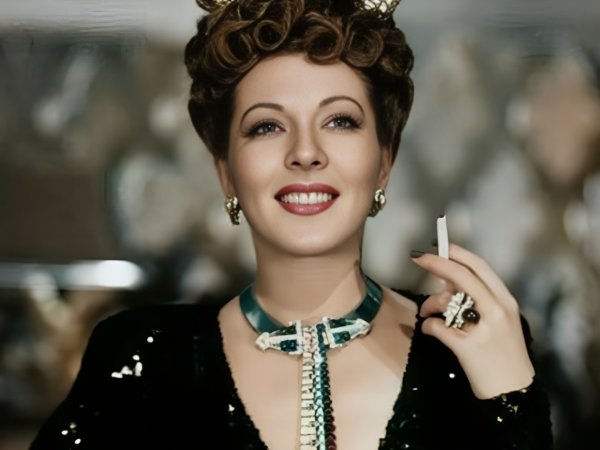
Lisette Verea remains one of the most spectacular female figures of the Romanian interwar stage and, at the same time, a name that achieved the rare performance of crossing Europe’s borders to reach the glittering world of Hollywood. Her story is one of ambition, charm, freedom, and courage, of a young woman who refused conformity and chose a risky but luminous path. From 1930s Bucharest to the luxurious tables of American stars, Lisette Verea lived a life worthy of a film script.
Childhood and the desire for freedom
Lisette Verea was born on October 2, 1914, in Bucharest, into a large family with six children. She came from a modest but stable environment, in which her parents valued education and wished for their daughter to follow a serious course of study. Although she did not face severe material deprivation, Lisette felt from an early age that she did not fit into the traditional patterns imposed on a respectable young woman of the time.
At just 13 years old, she decided to leave school, a choice considered scandalous in those days. Poverty was not what pushed her to make this decision, but an intense desire for independence. As she would later confess, she longed for the freedom of the girls who worked, earned their own money, and lived without constraints. She began working as a saleswoman in an elegant shop on Calea Victoriei, the place where Bucharest’s social life was at its peak.
The encounter with theater and the first disappointments
After losing her job at the shop, destiny offered her an unexpected chance. Her natural beauty, charm, and stage presence were noticed by director N. Kanner, one of the pioneers of revue theater in the 1930s. He proposed that she become an actress at the Colos Theater, an invitation that would change her life forever.
Her stage debut, however, was not spectacular. She received a minor role in the show Nothing New on the Bucharest Front, written by N. Kirițescu. Disappointed by the lack of importance of the role and by the difficulties of the beginning, Lisette Verea was tempted to give up an acting career. Still, the Bucharest cultural world was vibrant, and her talent did not go unnoticed.
The path to recognition and decisive encounters
An essential role in her artistic revival was played by writer Camil Petrescu, who introduced her to the circle of director Soare Z. Soare. He sensed the young woman’s potential and insisted that she enroll at the Conservatory, believing she needed a solid foundation to build a lasting career.
The decisive moment came in the autumn of 1932, when Lisette Verea received an offer to perform at the Majestic Theater. Shortly afterward, she debuted in Sinaia in a couplet specially written for her by N. Kirițescu, entitled The Debutante. The role brought her resounding success and the admiration of the public, who were captivated by her naturalness, voice, and elegance.
The diva of the Bucharest revue stage
In just two years, Lisette Verea became one of the biggest stars of Bucharest’s revue theater. She was accepted into the troupe of the Cărăbuș Theater by Constantin Tănase himself, a supreme recognition for any artist of the time. Her name on the poster guaranteed full halls, and the audience came not only for the shows, but also to see Lisette.
She performed in highly successful productions such as Cărăbușul in Splendor, The Stroe-Vasilache Festival, Our Place in Rio, Cărăbuș Sings, Bucharest Sings, Bucharest Laughs, The Bucharest Ball, The Grand Duchess of Alhambra, The Blue Danube, Cărăbuș Express, and The Kubinsky Affair. Her warm voice, beauty, and charisma turned her into a true diva of the capital.
Hollywood and the encounter with great stars
In 1933, Lisette Verea received an offer to appear in a film, thus opening the gates to the world of international cinema. Arriving in Hollywood, she discovered a fascinating world, full of contrasts, in which stage brilliance often concealed deep personal dramas.
In interviews given to the Romanian press, the actress spoke candidly about life across the ocean and about her encounters with the great stars of the era. One of the most memorable relationships was with Clark Gable, whom she described as extremely communicative, amusing, and full of charm. Lisette Verea admitted that she became deeply attached to him, even though their relationship remained at the level of a close friendship.
By contrast, she did not have the same admiration for Greta Garbo, whom she considered distant, arrogant, and difficult to approach, an almost untouchable presence in the Hollywood world.
A life lived intensely and a discreet ending
Lisette Verea chose to remain in the United States, where she continued her life far from Romania. Although she no longer had the same public impact as during her interwar glory years, her name remained linked to the golden age of Romanian revue theater and to the charm of a vanished generation.
She passed away on August 27, 2003, in New York. Her artistic importance was recognized internationally, and her obituary was published by the editorial staff of the prestigious newspaper The New York Times, a rare honor for an actress of Romanian origin.
The legacy of a diva
Lisette Verea was more than a beautiful and talented actress. She was the symbol of a generation of women who dared to follow their dreams, to defy conventions, and to live life by their own rules.
Her story remains an example of courage, ambition, and freedom, and her name deserves to be rediscovered as an essential part of Romanian cultural history.
We also recommend: Mia Apostolescu, the diva of interwar Bucharest, the right hand of Constantin Tănase. The story of the stunning cupletist from Cărăbuș