Tei Park in Bucharest, the history of one of the most beautiful oases of tranquility of the Capital
- Articles
- 09 APR 26
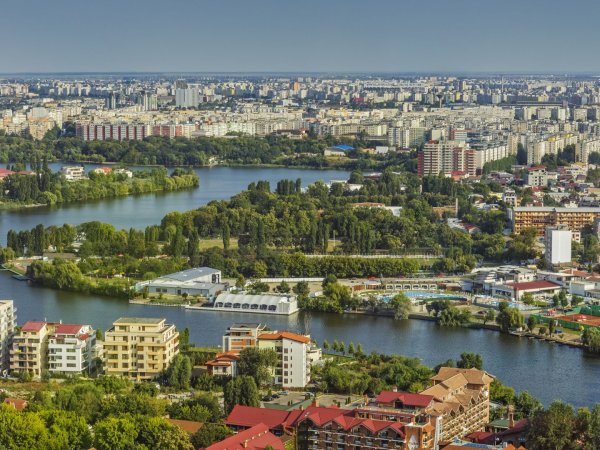
Parcul Tei today represents one of the most appreciated green spaces in the capital, a place where nature, history, and entertainment intertwine in a unique way. Located in sector 2 of the city, on the south-eastern shore of Lake Tei, this park offers visitors an ideal alternative for relaxation, outdoor exercise, and escape from urban agitation. Over time, Tei Park has undergone numerous transformations, from an industrial land to one of the most frequently visited recreation areas in Bucharest. Its story reflects not only the evolution of the city, but also the social, economic, and urban changes through which Romania’s capital has passed.
The origins of the park and the transformation of an industrial space
The history of Tei Park begins in a completely different context compared to its current image. The area where the park is located today was, in the past, used for industrial purposes, more precisely for the extraction of clay needed for the Tonola brick factory. These lands were marked by pits and uneven terrain, without any landscape or recreational value.
The first initiatives to arrange the area appeared in 1935, when the transformation of this space into a modern park was desired, strategically placed on the shore of the lake. The project was carried out by professor Dorin Pavel, under the coordination of Nicolae Caramfil, two important figures in the field of urban planning and infrastructure of that period.
However, the works were interrupted in 1939, with the outbreak of the Second World War. Only after the end of the conflict, in 1948, the project was resumed, and in 1950 the park was completed and opened to the public under the name “Garden of the Linden Trees”. The initial surface was approximately 9 hectares, but the arrangement of Lake Tei, which reached about 80 hectares, significantly contributed to creating a special natural setting.
The name of the area comes from the numerous linden trees existing here, which gave the name not only to the park, but also to the neighborhood and the nearby streets, such as Ramuri Tei or Ghica Tei.
The evolution and charm of the Tei area over time
The Tei neighborhood had an interesting evolution, initially being an area with a mixed character. On one hand, there were industrial buildings and blocks built during the communist period, and on the other hand, interwar houses built by the Society for Cheap Housing, some of which have been preserved to this day.
Until the 1990s, the area was not considered particularly attractive, being rather associated with industrial activities and “dormitory” type housing. However, the existence of green spaces, such as Tei Park and Parcul Circului, contributed to the gradual change of perception regarding the neighborhood.
Today, the area is much more appreciated, and the park has become a point of attraction both for residents and tourists. Its positioning, bordered by Lacul Tei Boulevard, Petricani Street, and the lake, makes it easily accessible from multiple directions.
Historical attractions and disappeared elements
One of the most interesting attractions from the past of Tei Park was the little train inaugurated in 1951. It was composed of a locomotive and two carriages and offered visitors a ride of approximately 1.5 kilometers along the lake. For that period, the train represented a real attraction, especially for children and families.
However, this facility was taken out of service in 1970, being later replaced by a tram line. The disappearance of the train marked the end of a romantic stage in the park’s history, but it made room for new urban developments.
After the 1980s, both the park and the surrounding area entered a period of degradation. The lack of investments and the negligence of the authorities led to the deterioration of infrastructure and to the decrease of the attractiveness of this green space.
The modernization of the park and international influences
A turning point in the recent history of Tei Park took place after 2002, when local authorities began extensive rehabilitation works. These were continued and expanded in 2007, following a friendship agreement between Romania and Republic of Azerbaijan.
The modernization included the refurbishment of alleys, installation of new urban furniture, arrangement of artesian fountains, creation of playgrounds, and implementation of a modern lighting system. These investments completely transformed the appearance of the park, bringing it to modern standards.
As a symbol of this collaboration, the Heydar Aliyev Alley was arranged in the park, where the bust of the former Azerbaijani president Heydar Aliyev is located. In the same context, in the capital of Azerbaijan, Baku, a statue of the Romanian composer George Enescu was inaugurated, thus marking an important cultural exchange between the two countries.
The organization of the park and thematic areas
Currently, Tei Park is structured into several distinct areas, delimited by two main alleys that divide the space into three large sectors. Each of them has its own theme, inspired by Romanian fairy tales.
Among the names of these areas are well-known characters and symbols such as Ileana Cosânzeana, Făt Frumos, Green Emperor, the Seven-Headed Dragon, or the Enchanted Bird. This approach gives the park a playful and attractive character, especially for children.
In the first area there are the Silver Forest and the Copper Forest, spaces that evoke the atmosphere of stories and offer a quiet setting for walks. The second area is dominated by the Big Wheel and by modern playgrounds, equipped with swings and slides.
The third area includes attractions such as the House of Horror, the Small Wheel, and other elements specific to an amusement park, being especially oriented toward entertainment.
The amusement park – between ambition and controversies
An important and controversial chapter in the recent history of Tei Park is represented by the inauguration of the amusement park in 2016, during the mandate of former mayor Neculai Onțanu.
The project, carried out with an investment of approximately 14 million euros, aimed to attract a large number of visitors and to transform the area into a major entertainment point. Authorities estimated a flow of about 13,500 visitors per month.
Reality, however, was different. In the first months, the number of visitors was lower than estimated, and later it decreased significantly. Over time, the amusement park generated considerable financial losses, reaching approximately 20 million lei.
One of the main reasons for the failure was the dissatisfaction of the residents in the area. Many of them criticized the transformation of a green space into a noisy area, similar to a fairground. Problems related to noise pollution and lack of parking spaces also contributed to this negative perception.
In addition, ticket prices were considered too high for the economic level of visitors, which led to a decrease in interest in the attractions offered.
The current situation and future perspectives
In recent years, the operation of the amusement park has continued to be problematic, and the pandemic period further aggravated the financial difficulties. In this context, the current mayor of Sector 2, Radu Mihaiu, proposed the concession of the park to a private operator.
The motivation for this decision was the lack of expertise of the public administration in managing such a complex project. Authorities initiated steps to attract specialized consultancy, in order to establish the concession conditions.
Even though the future of the amusement park remains uncertain, Tei Park maintains its role as an essential green space for the community. Despite the controversies, it continues to be a valued place for walks, sports, and relaxation.
Today, Tei Park remains one of the most beautiful oases of tranquility in Bucharest, a place where the past and the present meet, offering visitors a complex and authentic experience.
We also recommend: The story of the Tei neighborhood in Bucharest: the dormitory blocks, the children in sack shirts, the linden trees and the green-blue paradise of the Capital