The story of the Tei neighborhood in Bucharest: the dormitory blocks, the children in sack shirts, the linden trees and the green-blue paradise of the Capital
- Articles
- 09 MAR 26
The Tei neighborhood is today one of those places in Bucharest where the past and the present coexist in a surprising way. On one hand, the area is known for the apartment blocks built during the communist period, for the crowded boulevards and for the modern residential complexes that appear more and more often on the lakeshore. On the other hand, the history of the neighborhood hides dramatic episodes, stories of extreme poverty, but also moments when the place was considered a true natural paradise.
One of the Capital’s most beautiful neighborhoods
The linden tree, the tree that gave the neighborhood its name, is not just a vegetal symbol. In the past, the perfume of its flowers spread over the lakes and gardens, and the area was famous for its extensive orchards and gardens. Today, although many of these spaces have disappeared or have been radically transformed, the neighborhood remains surrounded by a true “green and blue gold mine”: the lakes in the north of the Capital, Tei Park and Circus Park.
The story of the neighborhood is a complex one. From the extremely poor slum at the beginning of the 20th century, to the standard houses built for clerks, from the industrial area dominated by dormitory blocks to the luxurious real estate projects of today, Tei has gone through spectacular transformations.
The Tei slum at the beginning of the 20th century
At the beginning of the 20th century, the Tei slum was considered one of the poorest areas of Bucharest. Far from the image of a green neighborhood that it has today, the place was marked by poverty, precarious housing conditions and a population made largely of workers or people without stable income.
A shocking image of those times appears in a report published in January 1937 in the magazine “Realitatea Ilustrată”. The journalist Alex. F. Mihail arrived in the neighborhood during the Christmas period and described a reality that seems hard to imagine for a European capital. The title of the article was suggestive: “African aspects in Bucharest: naked children”.
The reporter told how, in the middle of winter, on the streets of the slum one could see children completely naked or dressed only in shirts made from sacks, searching for food among the remains thrown on wastelands. In crowded courtyards, made up of rows of small and unhealthy rooms, numerous families lived, marked by poverty and illness.
The article mentioned mothers sick with tuberculosis, former workers left without jobs, widows with many children and even a blind man who raised his nine children alone. Many of these children walked barefoot even in the winter frost. Some had trousers, but no coat, and overcoats were an unimaginable luxury.
The homes were described as dilapidated huts or improvised storage sheds, with doors made from boards recovered from old crates. Inside there were only a few small chests covered with torn mats. It was, practically, a world of survival, in which children often fell asleep hungry.
The intervention of the Society for Cheap Housing
In the 1930s, the city authorities tried to improve the housing situation in the poor areas of the Capital. In this context appeared the intervention of the Municipal Society for Cheap Housing, which decided to create a modern parceling in the area of Lake Tei.
The project was carried out between 1936 and 1944 according to the plans of the architect Dan Ionescu. The parceling included more than 200 standard houses, but also important urban facilities for the community: a school, a kindergarten and a cultural center for children.
The area included several important arteries: Lacul Tei Boulevard, Județului Street, Banul Dumitrache Street, Maria Ghiculeasa Street, Banu Scarlat Street, Ghica Tei Boulevard, Sfânta Treime Street and Scheiul de Sus Street. At that time the neighborhood was part of Sector I Galben and was located near the Tonola Brick Factory.
The urban engineer Cincinat Sfințescu had planned this area in the City Systematization Plan as a space intended for cheap housing, for the population with modest incomes.
The architect Dan Ionescu designed ten different types of houses, among which some – the types T1, T2 and T3 – were especially conceived for corners or intersections. The houses were set back from the street alignment by four or five meters, which created small gardens in front of them.
The houses had either ground floor only or ground floor and one floor, and the roofs were made of tiles, the Society giving up the use of eternit. This parceling still represents one of the few examples of interwar social urbanism in Bucharest.
A controversial parceling
Although the project brought new and more sanitary homes for Bucharest clerks, it also generated dissatisfaction among the residents of the area.
Many of those who had modest houses near the land destined for the parceling discovered that the new constructions blocked their access to the street. For people who had built their homes with great sacrifice, this situation was dramatic.
A group of residents sent a letter to the Bucharest City Hall asking for the situation to be resolved. They presented themselves as “poor people, servants at various institutions in the Capital”, saying that their only support were those houses built with the toil of their poverty.
Unfortunately for them, the request was not taken into consideration by the authorities. The parceling continued, and the neighborhood gradually began to acquire a more organized urban structure.
Even today these houses built by the Society for Cheap Housing can still be seen, especially on Lacul Tei Boulevard and on Banu Dumitrache, Maria Ghiculeasa or Ghica Tei Boulevard.
The linden garden and the old vineyards of the Ghica family
Long before the intense urbanization of the area, the lands around Lake Tei belonged to the boyar family Ghica. Until close to the First World War, vast vineyards and gardens stretched across this area.
One of the best known was the Linden Garden, considered the largest natural garden around the lake with the same name. During the summer, the perfume of the linden flowers spread throughout the city, and the place became a favorite space for walks and picnics.
From early spring until late autumn, people of Bucharest came here for outings on the grass. The area was appreciated for the dense shade of the trees and for the water of the lake, suitable for bathing.
Near the lake, close to the Toboc weir, there were a mill and a slaughterhouse where fresh fish was also cooked. These places were frequented by locals and by those who came from the city for a day of relaxation.
Everyday life in the neighborhood
In the first half of the 20th century, life in the neighborhood had a different rhythm from today. The streets were crossed by carts loaded with wood and coal, coming from the depots located on Lacul Tei Boulevard.
The houses were generally small, with a single level, but they had courtyards with flowers and fruit trees. Walnut trees and linden trees were very numerous, and in June their smell perfumed the entire area.
On Județului Street there was a railway line that connected Obor with Băneasa. Freight trains crossed the neighborhood daily, and the steam locomotives moved slowly among the blooming acacias.
This railway line was removed only after the 1980s. Today only a few traces of it can still be seen: alignments of old poplar trees and several small railway guard houses.
Nearby there was also an inn known as “La Furtună”, where carters used to stop. In the 1950s the building was nationalized and transformed into a building inhabited by several tenants.
The dormitory blocks and the communist transformations
The communist period brought major changes to the Tei neighborhood. The area gradually became an industrial one, and on the vacant lands dormitory blocks began to appear for workers.
Near the Holy Trinity Church, one of the identity landmarks of the neighborhood, there was once a land of about 5000 square meters surrounded by a field of old linden trees. In 1986 all these trees were cut down.
In their place crowded apartment blocks were built, typical of communist urbanism. This intervention radically changed the appearance of the area and significantly reduced the green spaces.
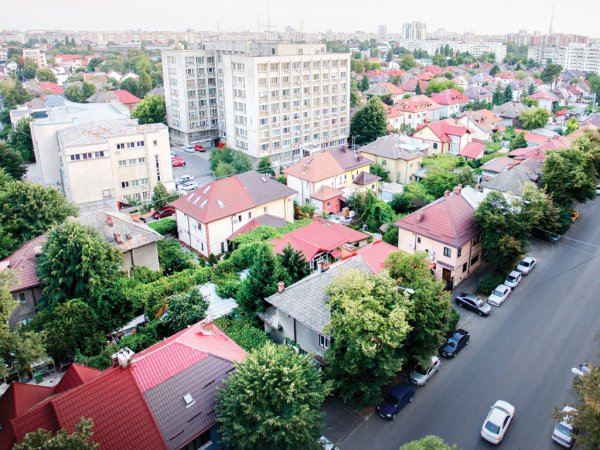
However, some of the interwar houses were lucky enough to escape demolition and can still be seen today, hidden among the blocks.
Lake Tei and the disappeared bathing resorts
An important chapter in the history of the neighborhood is connected to the recreation area on the lakeshore. In the past, Lake Tei was surrounded by six or seven very popular bathing resorts.
These places offered the people of Bucharest the possibility to relax at affordable prices. There were beach areas, simple restaurants and spaces for entertainment.
After 1990, many of these bathing resorts entered into decline. Today most of them are abandoned or in a state of degradation.
Although the city administration has been talking for years about a large project for the redevelopment of the chain of lakes in Bucharest, the plan has so far remained only on paper.
The luxury on the lakeshore
In the last two decades, the shores of Lake Tei have become extremely attractive for real estate developers. The view over the water and the proximity to green spaces have turned the area into a very sought-after place for new constructions.
Thus modern residential complexes appeared, some of them extremely luxurious. A complex located near the Bamboo Club offers apartments with panoramic views toward the lake, interior gardens and fountains.
The rent prices in such buildings can reach even 2000 euros per month, something that would have been unimaginable for the residents of the slum almost a century ago. The contrast between the poor past of the neighborhood and the present dominated by real estate investments is obvious.
The linden tree between memory and future
Today the Tei neighborhood remains one of the most interesting urban spaces in Bucharest. Its history reflects the transformations through which the city has passed in the last century: from a poor slum to an interwar urban experiment, from industrialization to accelerated real estate development.
Although many of the old gardens and orchards have disappeared, the neighborhood still keeps an important advantage: the proximity to lakes and green spaces.
Tei Park and Circus Park, together with the water of the lakes, form a landscape that is rare for a crowded capital. Precisely this combination of green and blue continues to define the identity of the place.
In a city that changes rapidly, Tei remains a neighborhood of contrasts: between blocks and old houses, between the memory of the fragrant linden trees and the new glass buildings, between the harsh history of the slum and the promise of a more balanced urban future.
We also recommend: The history of the Domenii neighborhood, the elite area of 20th-century Bucharest, with Art Deco and Neo-Romanian villas