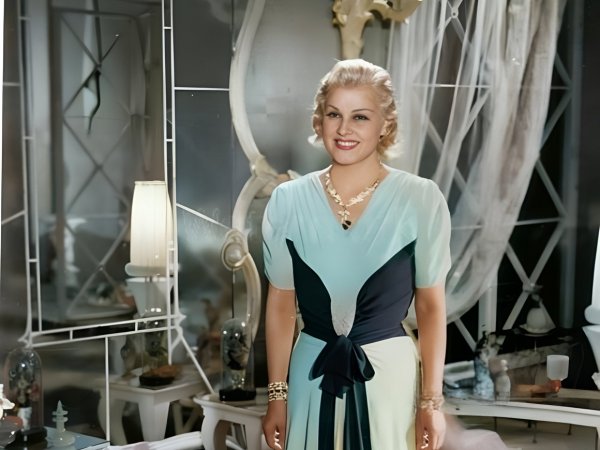
Stars of Interwar Bucharest: Elvira Popescu, the actress who played in Hollywood with Alain Delon and Claudia Cardinale
- Articles
- 08 JAN 26
Elvira Popescu was one of the brightest figures of the Romanian and international stage, a name that crossed cultural and linguistic borders with elegance throughout Europe. She was born in Bucharest on May 10, 1894, at a time when the capital of Romania was beginning to shape its modern identity.
Childhood and the formation of a future star
From childhood, Elvira stood out through the naturalness with which she expressed herself, through the grace of her movements, and through a rare sense of spectacle.
During her adolescence, she turned her steps toward the Conservatory of Dramatic Art, an institution she successfully graduated from. Her studies strengthened her native talent and provided her with the necessary tools for a stage career.
Shortly after completing her education, she was hired at the National Theatre in Bucharest, where she performed leading roles that quickly propelled her to the forefront of Romanian cultural life.
Interwar Bucharest and the first theatrical successes
During the interwar period, Bucharest was a vibrant city, and Elvira Popescu fit perfectly into this dynamic artistic context. On the stage of the National Theatre, her presence was remarkable: she had poise, an elegant walk, and an extraordinary ability to win over the audience. The roles she played turned her into a highly appreciated actress, and success soon opened new horizons for her.
Together with actors Ion Manolescu and Ion Iancovescu, Elvira Popescu founded the Mic and Excelsior Theatres, actively contributing to the development of Bucharest’s theatrical life. This period represented for her a stage of artistic maturation, but also the moment when she began to be noticed by cultural figures outside Romania.
The decisive meeting with Louis Verneuil
A crucial role in Elvira Popescu’s destiny was played by the French playwright Louis Verneuil. He became not only an important collaborator, but also a profound admirer of the actress. At that time, Verneuil was one of the most appreciated French authors, and his plays enjoyed considerable success. Fascinated by Elvira’s talent and personality, he began to write especially for her, offering her roles that highlighted her charm and stage intelligence.
The relationship between the two went beyond the professional sphere, and the society press of the time intensely speculated about their bond. It was said that the playwright was hopelessly in love with the Romanian actress, and that this feeling deeply influenced his life and creation.
Paris and international consecration
In 1923, at the age of 29, Elvira Popescu arrived in Paris, the city that was to define her artistic destiny. Louis Verneuil opened the doors of French theatre to her, hiring her at the Théâtre de la Michodière. He also wrote for her the comedy “The Cousin from Warsaw,” the play with which Elvira made her Parisian debut.
The success was overwhelming, despite the fact that the actress did not yet master the French language very well. Her foreign accent, far from being an obstacle, became her main asset. The French public was fascinated by Elvira Popescu’s exotic beauty, elegance, and naturalness. After this debut, Verneuil continued to write for her a large part of the plays that were to bring her international fame.
Queen of the French stage
After a decade spent in Paris and several hundred performances, Elvira Popescu became one of the most popular actresses in France, surpassing in notoriety even names such as Greta Garbo. The public adored her, and critics called her “Notre-Dame du Théâtre,” considering her a true queen of the stage.
In addition to the plays signed by Louis Verneuil, Elvira also performed in works by important playwrights such as Henry Bernstein, André Roussin, and Sacha Guitry. Some of the productions in which she appeared exceeded the impressive number of 2,000 performances, a sign of her extraordinary popularity and of the constant demand from the French public.
Cinematic career and encounters with great names
Alongside theatre, Elvira Popescu successfully ventured into cinema as well. Her film career spanned approximately half a century, during which she appeared in over 30 productions made outside Romania. Among the most well-known films are “La Présidente,” “Ils étaient neuf célibataires,” “Austerlitz,” “Plein Soleil,” and other productions appreciated by audiences.
During this period, Elvira Popescu played alongside major international stars such as Alain Delon and Claudia Cardinale, consolidating her status as a first-rank actress. She was also appointed director of important cultural institutions, including the Théâtre de Paris and the Théâtre de Marigny, a rare recognition for an actress of foreign origin.
Some critics maintain that Elvira Popescu’s charm and elegance may have inspired Henri Matisse in creating the famous painting “La Blouse Roumaine,” painted in 1940.
Personal life and stories behind the scenes
On a personal level, Elvira Popescu married Baron Maximilien Sébastien Foy, who later became a count, and she received the title of countess. Her relationship with Louis Verneuil came to an end, and the playwright fell into deep depression. He left for America and returned to Paris after the end of the Second World War. In 1952, Verneuil committed suicide in a hotel room in France, leaving behind three wills.
All three wills were declared valid, and in two of them Elvira Popescu was named heir. After the death of Count Foy, the actress in turn received a considerable fortune and a property in Mézy, confirming her privileged status in French society.
The final years and the legacy of a diva
Having reached old age, Elvira Popescu preserved the charm that had made the French fall in love with her for decades. In her apartment on Avenue Foch, she continued to host a salon frequented by literary, political, and financial personalities. Among those who visited her were André Roussin, Guy de Rothschild, Jacques Chirac, Pierre Cardin, and Valéry Giscard d’Estaing, all captivated by her stories and spirit.
Elvira Popescu was awarded the “Molière” Prize for Best Actress, granted by the French Actors’ Association, and received the Legion of Honour twice, one of the highest distinctions offered by the French state. She passed away in Paris on December 11, 1993, at the venerable age of 99, leaving behind the image of a true legend of European theatre and cinema.
We also recommend: The stars of interwar Bucharest: Silly Vasiliu, the Alhambra star whom her parents wanted to force into marriage at 14