Restaurant Odobești, the Old Calea Moșilor and the Brigada Diverse Films. The History of a Legendary Bucharest Local
By Bucharest Team
- Articles
- 15 SEP 26
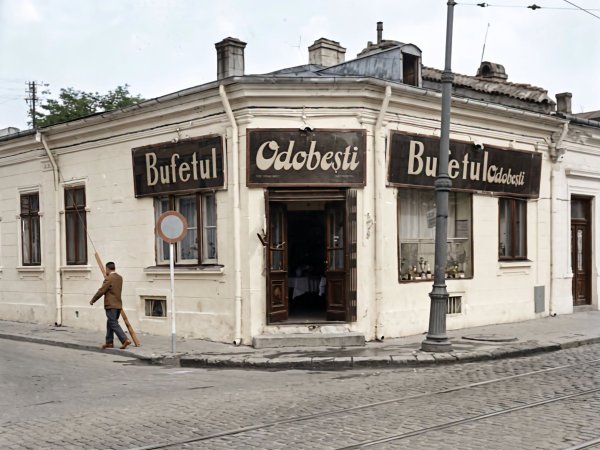
Few places from the vanished Bucharest of the past have remained as strongly in the memory of those who knew them as Restaurant Odobești. It was one of the popular establishments of the old Calea Moșilor, a restaurant with the profile of a zahana, a summer garden and an atmosphere impossible to confuse with that of the Capital’s elegant grand restaurants. Here came very different people, from workers and civil servants to merchants, drivers or Bucharest residents looking for their portion of tripe soup, tuslama, grilled meat and wine. Today, Odobești can no longer be found on the old Calea Moșilor. The building disappeared in the wave of demolitions and urban transformations that radically changed this artery during the communist period. Instead, the name of the establishment survived in photographs, in the memories of former customers and, above all, in the cinematic images of old Bucharest. Its story is all the more interesting because it intersects with one of the most popular series of Romanian comedies: the “Brigada Diverse” films, in which Bucharest of the 1960s and 1970s remained, without necessarily intending to do so, documented on film.
Odobești, a traditional tavern on the old Calea Moșilor
Restaurant Odobești must first of all be viewed through the perspective of old Bucharest, in which the major commercial arteries were dotted with restaurants, taverns, buffets and drinking establishments, each of which had its own clientele and reputation. Calea Moșilor was one of the city’s most important such arteries. It connected the city center with the Obor area and, until the period of major urban transformations, preserved an important part of the appearance of old Bucharest.
Memorial sources and recollections dedicated to the establishment place it on the old Calea Moșilor, in the area near Oltarului Street. Other memories place it in the area of the Olari Church and along the old route of the artery, before the widening and systematization carried out during the communist period. What matters is that Odobești belonged to that urban world of Calea Moșilor which was largely to disappear during the final decades of the communist regime.
The establishment was known as a zahana, a term used for taverns traditionally associated with meat dishes and butcher-style cuisine. In Bucharest, such places could have a very popular and straightforward character, without the pretensions of luxury restaurants. They were spaces where substantial food, wine and socializing were the main attractions.
Odobești had, however, an additional charm. Behind the building there was a small summer garden, covered with gravel and shaded by large trees. A tall fence covered with ivy separated the garden from the bustle of Calea Moșilor. At the back there was a small stage where bands of the period performed.
The image is characteristic of a certain type of popular Bucharest, in which a tavern could simultaneously become a meeting place, a neighborhood restaurant and a small entertainment venue. Spectacular décor was not necessary. The trees, tables, wine, music and surrounding bustle were enough for the place to acquire its own personality.
From Gherghiceanu’s tavern to Restaurant Odobești
In the oral history of the area, Odobești is also connected with the old Gherghiceanu tavern. According to recollections published later, Gherghiceanu was known for the seriousness with which he managed his establishment and for his wines. The basement had wine cellars, and later the space would become associated with Restaurant Odobești.
Some contemporary sources of the current restaurant speak of a tradition beginning around 1911, although this date should be treated with a certain degree of caution, because the documentation accessible today does not provide a complete and uninterrupted chronology of the establishment. What is certain is that the name Odobești came to designate a well-known gastronomic landmark of Calea Moșilor during the 20th century.
The name itself was appropriate for a restaurant renowned for wine. Odobești in Vrancea was one of Romania’s major wine-growing regions, and the wines produced there were well known in Bucharest. It is therefore no coincidence that recollections of the restaurant on Moșilor speak insistently about the wine served by the liter, grilled meat and substantial dishes.
In the post-war period and especially during the communist decades, the restaurant became a place frequented by a very mixed clientele. A recollection published in the contemporary press describes mornings when the tables were occupied by workers, civil servants, store managers and other categories of Bucharest residents. Tripe soup was one of the specialties for which the establishment became known.
In a Bucharest where traditional restaurants were undergoing a process of deterioration and standardization, Odobești preserved precisely its popular character. It was not a restaurant intended for an elite, but a place where everyday urban cuisine met the tradition of the old Bucharest taverns.
The summer garden, music and neighborhood life
A restaurant such as Odobești cannot be understood only through its menu. An important part of the establishment’s reputation came from its summer garden. In summer, the tables placed beneath the tree canopies offered an unexpected refuge in a busy part of the city.
The garden was small, intimate and protected from the main street by the ivy-covered fence. At the back stood the stage where bands of the period performed. These were not grand shows, but restaurant music, popular songs and arrangements of well-known melodies.
For the generations who grew up nearby, Odobești was more than a place where people ate. It was part of the everyday landscape of the neighborhood. In recollections published about the old Calea Moșilor, there are stories about children who collected beer caps from around the establishment and later used them for improvised games.
Such apparently ordinary details are important for the history of the city. They show how everyday life functioned in a Bucharest where television, mobile phones and the internet had not yet radically changed the way people spent their free time. For the children of that time, the space around the restaurant became a territory of play and encounters.
Odobești was therefore part of a community. It had regular customers, employees known for generations and a reputation that was passed from mouth to mouth. In such a Bucharest, a restaurant’s fame was not built through sophisticated advertising, but through people’s memories.
What does Odobești have to do with the “Brigada Diverse” films?
One of the reasons why Odobești has remained so visible in Bucharest’s cultural memory is its association with the “Brigada Diverse” film series. The first film, “B.D. intră în acțiune” (“B.D. Goes into Action”), was made in 1970, directed by Mircea Drăgan, with Toma Caragiu, Sebastian Papaiani, Puiu Călinescu, Dem Rădulescu, Jean Constantin and Iurie Darie in the cast. Filming took place in Bucharest and other locations between May and October 1970.
The series became one of the most popular Romanian film productions, while the scenes filmed in Bucharest have a particular documentary value. They capture streets, buildings, shops, restaurants and urban spaces which, in many cases, were to disappear in the following years.
There is, however, an important nuance here. In public memory, Restaurant Odobești on Calea Moșilor is associated with the B.D. films, and recollections from former residents claim that they saw the film crew at the establishment. However, information about the exact filming locations shows that some scenes attributed to Odobești were actually filmed in another restaurant.
In the case of the film “Brigada Diverse în alertă” (“Brigada Diverse on Alert”), sources about the production indicate a restaurant on the former Galați Street, today Vasile Lascăr Street, which was later demolished. This clarification is important because there is a risk that two Bucharest establishments may be retrospectively confused. Restaurant Odobești on Calea Moșilor and the restaurant used for certain cinematic scenes should not automatically be treated as one and the same place.
Even so, the connection between Odobești and the B.D. universe remains one of the most interesting stories surrounding the establishment. The films preserved on celluloid the atmosphere of Bucharest at that time, and today those scenes are also viewed as fragments of a city that no longer exists.
The demolition of Calea Moșilor and the disappearance of a Bucharest landmark
The fate of Odobești was connected to the radical transformation of Calea Moșilor. After the 1977 earthquake, the artery entered an extensive process of widening and systematization. In order to create the new urban configuration, numerous houses and buildings were demolished, while the old street fabric was broken up by new apartment blocks and road infrastructure.
Odobești did not survive this transformation. Its building and summer garden disappeared, like many other restaurants, houses and small commercial landmarks of the old Calea Moșilor. The destruction did not mean only the loss of a building, but also the disappearance of a place where part of the neighborhood’s everyday life had been concentrated.
Photographs and recollections thus became the only ways through which the image of the establishment can be reconstructed. For those who knew Odobești, its demolition meant the disappearance of a piece of familiar Bucharest. For younger generations, the story can be recovered only from archives, films and memories.
Today’s Calea Moșilor is, in many places, very different from the one known by Bucharest residents before the systematization. Precisely for this reason, the history of establishments such as Odobești becomes important: they provide reference points for understanding the city that existed before the apartment blocks and major urban interventions.
The name Odobești returned to Bucharest
The story did not end, however, with the demolition of the establishment on Moșilor. The name Odobești was brought back into Bucharest’s gastronomic circuit through a restaurant opened in the Traian area, at 126 Traian Street, near Hala Traian.
The current establishment explicitly promotes its connection with the old tradition and states that the restaurant continues the story more than a century after the original opening. The address is different, however, and the current building should not be confused with the historic restaurant on Calea Moșilor.
The return of the name is relevant precisely because it demonstrates the strength of Bucharest’s gastronomic memory. A restaurant can disappear physically, but its name can continue to circulate among people, to be associated with certain dishes, a street, a summer garden or a film set.
Today, when we look at images of Bucharest from the B.D. films, it is easy to focus on the actors and the lines that became famous. Behind them, however, there is an entire city: streets, trams, shops, restaurants and houses that have since disappeared. Odobești is one of these landmarks.
The history of the restaurant is, ultimately, the history of an urban world. From the old tavern and zahana, to the summer garden with music, from tripe soup and wine by the liter to its indirect appearances in the memory of the B.D. films, Odobești belonged to a Bucharest in which restaurants were true meeting points for the community.
The building no longer exists, and the old Calea Moșilor has been profoundly transformed. But the name Odobești continues to function as a small capsule of urban memory, connecting today’s Bucharest with the popular, noisy and diverse city of past decades.
We also recommend: