Popa Soare: the church, the priest and the street in Bucharest. Where the name actually comes from
- Articles
- 17 AUG 26
Bucharest is a city in which the names of streets and neighborhoods often preserve stories that go back centuries. Behind many apparently ordinary names are churches, priests, merchants, boyars or forgotten historical events that helped shape the city’s identity. One of the most interesting examples is Popa Soare, a name associated today with a street, an old neighborhood and a historic church in the eastern-central part of Bucharest. The name is sometimes treated simply as a traditional place name, but its origin is much more precise. The street took its name from the parish and church of Popa Soare, a place of worship whose history goes back to the middle of the 18th century. The church was built in 1745, and its old records preserve the memory of the priest who gave it its name. The history of the place is also connected with an important architectural ensemble, old houses dating from the 19th and 20th centuries, personalities of Romanian culture and even the memory of philosopher Petre Țuțea. Popa Soare is therefore much more than a street name. It is a small historical landscape in which religious, architectural and cultural memories overlap.
The Popa Soare neighborhood and the old streets of Bucharest
The Popa Soare neighborhood appears in historical documents as early as 1752. It developed close to other old Bucharest neighborhoods, including Mântuleasa, Negustori, Sfântul Ștefan and Olari. These areas formed part of the eastern side of the historic city, where streets, churches and private residences gradually created a dense urban fabric.
The name of the neighborhood was preserved for centuries, becoming associated with the church that stood at its center. Around the church developed an urban community whose history was closely connected with the traditional occupations, families and institutions of the area. By 1862, the neighborhood was also known by another name, Mecetul turcesc, a designation that recalls the complex historical and cultural environment of old Bucharest.
The urban transformation of the area became more evident during the 19th century. In the 1871 urban plan of Bucharest, streets were increasingly given official names and houses began to receive numbers. Among the streets recorded at the time were Mântuleasa, Romulus, Dimineții and Popa Soare.
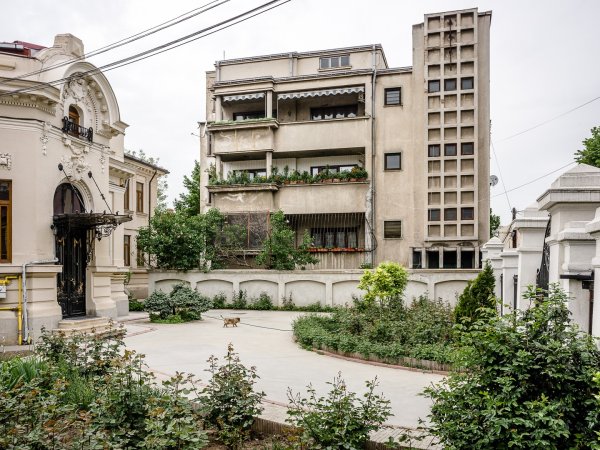
Over the decades, Popa Soare Street was gradually lined with residences, including elegant houses belonging to wealthy families. Many buildings erected during the 19th and 20th centuries have survived, contributing today to the historical character of the area. The architectural ensemble of Popa Soare Street is one of the elements that give the neighborhood its distinctive appearance.
Where does the name Popa Soare actually come from?
The explanation of the name can be found in the history of the church itself. The Church of Popa Soare, located today at 7 Dr. Burghelea Street, dates from 1745. It was built by Jupân Iane the merchant, also known as Ene Boldescu, a merchant from Buzău.
The church did not originally receive its name because of the street. On the contrary, it was the church and its first important servant that gave the name to the neighborhood and later to the street. According to the old church diptych, Popa Soare was the church’s first servant, or one of its most worthy priests. His name was preserved in the religious records, and eventually became the name by which the entire area was known.
This detail is particularly important because it corrects a possible misunderstanding about the origin of the name. Popa Soare is not simply an arbitrary name chosen for a street. It is a historical name inherited from an 18th-century religious foundation and preserved through generations.
The parish itself is therefore more than two and a half centuries old. Its survival explains why the name has remained so deeply rooted in Bucharest’s urban memory. Even after the city changed dramatically, the old name continued to identify the area.
A church built in 1745 and preserved through centuries
The Church of Popa Soare is an Eastern Orthodox Romanian church with three patron saints: the Dormition of the Mother of God, celebrated on August 15, Saint Hierarch Theodosius of Brazi Monastery, celebrated on September 22, and Saint Nicholas, celebrated on December 6.
Its original architectural form has been preserved to a remarkable degree. The church has a trefoil plan, a very broad porch and a nave covered by a closed spherical dome. Originally, it had two wooden towers, one of which also served as a bell tower. The tower above the nave was removed between 1940 and 1942, during consolidation works.
The interior also preserves important elements from different periods of its history. The iconostasis was made at the beginning of the 19th century from lime wood gilded with bronze. The oil paintings were executed around the 1880s by Anton Serafim, a church painter who studied at the Căldărușani school of painting and was a disciple of Gheorghe Tattarescu.
In 1924, the church received stained-glass windows made in Vienna, while the carved and painted oak furniture was created in 1937 by master Grigore Dumitrescu. The parish house was also constructed around the same period.
The earthquakes and the many restorations of the church
Like many old buildings in Bucharest, the Church of Popa Soare has survived several earthquakes and has undergone numerous repairs and structural interventions. The first major renovation mentioned in the church’s history took place in 1791–1793, when Jupâneasa Călina and her sons supported extensive works.
At that time, the nave and narthex were paved, while imperial icons were donated to the church. These icons were subsequently covered in silver in 1833 and 1834. The porch was also paved through the contribution of Voicana “Doftorița”.
The devastating earthquake of 1838 caused serious damage and led to the closure of the church for major repairs. The local community contributed to restoring the building, demonstrating the importance the church already had for the neighborhood.
Additional works were undertaken in 1902, when a porch with a portico was added at the entrance. Further consolidation and repair works took place in 1924 and after the earthquake of 1940. The earthquake of 1977 also required additional repairs.
The paintings were restored several times, in 1914, 1924 and 1948, the latter restoration being carried out by Gheorghe Eftimiu. In 1967, painter Gheorghe Teodorescu Romanați restored the paintings and also painted the entrance facade panels depicting Saints Peter and Paul.
The most extensive modern restoration campaign took place between 1998 and 2004. It included structural consolidation, interior and exterior repairs, restoration of the paintings, replacement of the electrical and heating systems and works on the roof. Following these interventions, the church was reconsecrated.
Further rehabilitation and consolidation works were carried out between 2013 and 2015, including improvements to the surrounding roads, leveling, drainage and lighting. These successive interventions explain how the historic building managed to preserve its architectural identity while adapting to the requirements of modern times.
The church, its priests and the people who shaped its history
Over the centuries, the Church of Popa Soare was served by several notable priests. Among them was Nifon Criveanu, who later became Metropolitan of Oltenia. He served as parish priest between 1922 and 1924.
Another important figure was Father Atanasie Paraschivescu, who served as parish priest from 1924 to 1964 and is remembered as a major benefactor and founder associated with the church’s 19th-century history. The interior of the church preserves six funerary stones belonging to founders and benefactors of the holy place, dating from 1755 to 1793.
The religious history of the church is also connected with the local community. During the early period of its existence, the coppersmiths of the neighborhood celebrated here their spiritual patrons, Saints Athanasius and Cyril of Alexandria. This detail illustrates the close connection between the church and the traditional occupations of the people who lived in the area.
Today, the parish continues its religious activity. The church is served by parish priest Nicolae Vladu and priest Gheorghe Tudose.
Popa Soare Street and its old houses
Popa Soare Street is not important only because it leads to the historic church. It is also part of an architectural landscape that has preserved numerous buildings from the 19th and 20th centuries. Their facades, proportions and decorative details contribute to the atmosphere of old Bucharest.
The street begins at Calea Călărașilor, crosses Romulus Street and reaches the intersection with Sfântul Ștefan Street. It continues past Dr. Burghelea Street, intersects Constantin Kirițescu Street and eventually ends at the well-known Traian Street.
Walking along the street reveals a succession of historic houses, many of them associated with the architectural development of Bucharest during the 19th and early 20th centuries. Their presence explains why the architectural ensemble of Popa Soare Street is significant for the city’s heritage.
Among the buildings associated with the area is the house of Mircea Vulcănescu, located at number 16 bis. The philosopher, philologist, publicist and Romanian politician lived there with his family. His home was visited by important intellectuals of the period, including Mircea Eliade, Constantin Noica and Petru Comarnescu.
The history of the house is therefore connected with the intellectual life of interwar Bucharest, adding another layer of cultural significance to the street.
The Petre Țuțea monument in the churchyard
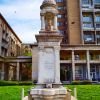
Another unusual element associated with the Church of Popa Soare is the monument dedicated to philosopher Petre Țuțea. In 2004, Bucharest Sector 2 City Hall placed a statue of Țuțea in the churchyard. The work was created by sculptor Vasile Gorduz.
The presence of the monument adds a modern cultural layer to the historic religious space. Petre Țuțea is one of the personalities associated with the Romanian intellectual world of the 20th century, and his statue in the churchyard creates a symbolic connection between the religious history of the place and the cultural memory of modern Romania.
The churchyard thus becomes more than an annex of the old building. It is also a space in which different chapters of Romanian history meet, from the 18th-century foundation of the church to the intellectual personalities of the 20th century.
Why Popa Soare remains one of Bucharest’s fascinating names
The story of Popa Soare demonstrates how a Bucharest street can preserve much more than a geographical reference. The name brings together the memory of an 18th-century priest, a historic parish, an old church, a traditional neighborhood and generations of residents.
The origin of the name is therefore closely connected with the Church of Popa Soare and with the priest remembered as its first servant, or one of its most worthy early servants. From the church, the name extended to the surrounding neighborhood and was eventually preserved by the street.
At the same time, Popa Soare Street is an important example of the way in which Bucharest’s architectural heritage survives alongside the modern city. Historic houses, religious buildings, cultural memories and old street layouts continue to create an urban landscape in which the past can still be read.
Today, someone walking from Calea Călărașilor toward Traian Street may see only a relatively quiet Bucharest street. Yet behind its name lies more than 250 years of history. The Church of Popa Soare, the old houses, the memory of Mircea Vulcănescu and the monument dedicated to Petre Țuțea together create a remarkable cultural portrait of this corner of the capital.
Popa Soare is therefore not merely the name of a street. It is the surviving trace of a priest whose name became attached to a church, a parish and eventually an entire neighborhood. It is also a reminder that Bucharest’s history is often hidden in the names we pass every day, waiting to be rediscovered.
We also recommend: Popa Nan: the street, the church and the man. Where the name of one of Bucharest’s best-known areas comes from