Popa Nan: the street, the church and the man. Where the name of one of Bucharest’s best-known areas comes from
- Articles
- 05 FEB 26
At the beginning of the 18th century, Bucharest was a city in constant transformation, with fluid boundaries and neighborhoods that were gradually taking shape beyond the commercial and administrative center. In 1719, the Metropolitanate of Bucharest decided to send a young priest, named Nanu, to a peripheral area known as the “Plasa Târgului de afară”. This decision was not accidental, but reflected the need to extend religious and community life toward the new settlements emerging on the edge of the city.
A Bucharest on the outskirts, at the beginning of the 18th century
The area was located near the north-eastern barrier of Bucharest, one of the 13 barriers that delimited the city at that time.
These barriers did not serve only administrative or fiscal roles, but also marked the passage between the organized city and spaces that were still rural, dominated by orchards, vacant land and small households.
In this context, the mission of priest Nanu was a complex one: not only to build a church, but to contribute to the consolidation of a community.
The birth of the Popa Nan church and of a neighborhood
Upon arriving in this marginal area, priest Nanu found approximately 90 scattered houses, surrounded by orchards and open fields. The inhabitants lived from agriculture, small crafts or occasional trade, and the lack of a place of worship made community life fragmented. In this setting, the construction of the church became a founding act, not only religious, but also urban.
The Popa Nan church was built through the joint efforts of the priest and the parishioners, quickly becoming a landmark of the area. Around it, the neighborhood began to take shape, and the priest’s name gradually turned into a designation that would endure for centuries. Popa Nan was no longer just the man, but became the symbol of the place, the reference point by which the area was known.
The development of the neighborhood and the link with neighboring quarters
With the appearance of the church, the Popa Nan neighborhood began to develop naturally, attracting new residents and activities. Expansion took place in all directions, in close connection with neighboring quarters: Lucaci, Sfântul Ștefan, Mântuleasa, Negustori and Vergului. These areas formed an urban mosaic, in which traditions, trades and lifestyles intertwined.
The relationship between these neighborhoods was dynamic. People moved from one area to another, married, traded goods or participated in common religious life. The Popa Nan church thus became not only a local place of worship, but a meeting point for broader communities, contributing to the consolidation of the identity of eastern Bucharest.
The 19th century and the emergence of a commercial street
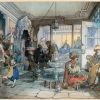
At the beginning of the 19th century, Bucharest experienced significant growth, and the Popa Nan area was no exception. As the city expanded, Popa Nan Street began to acquire a more urban character, attracting merchants and traders from various ethnic communities. Greeks, Jews, Macedonians and Romanians chose to build houses, shops or warehouses here.
This diversity contributed to the transformation of the street into a lively space, animated by commercial and social activities. The houses built during this period reflected the status of their new owners: some modest, others imposing, with shops on the ground floor and living spaces above. Popa Nan thus became an important artery, linking the outskirts with the more central areas of the city.
Controversial areas in the vicinity of Popa Nan
Alongside commercial and residential development, the Popa Nan area was also marked by the existence of less respectable, but extremely well-known spaces. Nearby was Strada Fetițelor, the location of the famous “Crucea de Piatră” brothel, a symbol of Bucharest’s underworld. This presence added a note of contrast to daily life in the area, where the sacredness of the church coexisted with the harsh realities of the city.
At the same time, the Anestinelor quarter was known as a center of craftsmen, especially silversmiths and coppersmiths. They formed a tightly knit community, with its own traditions and an important role in the local economy. Their presence near Popa Nan reinforced the multicultural and complex character of the area, where trades, beliefs and lifestyles met on a daily basis.
Popa Nan in the 20th century: between tradition and modernity
With the arrival of the 20th century, Popa Nan Street continued to adapt to new urban realities. The modernization of the city, the emergence of public transport and the expansion of infrastructure gradually transformed the area. Even so, Popa Nan preserved part of the charm of old Bucharest, with tree-lined streets, houses with inner courtyards and a neighborhood atmosphere.
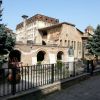
During this period, the street also became a favored place for artists and intellectuals. An emblematic example is Maria Tănase, the famous singer, who lived as a tenant, in her final years, in a building on Popa Nan covered in ivy. Her presence added a layer of legend to the place, and the house became, in collective memory, a cultural landmark.
A street with a complex route and urban significance
From an urbanistic point of view, Popa Nan Street follows a route that reflects the city’s evolution. Starting in Pache Protopopescu Boulevard, one of the major arteries of the eastern area, the street heads south, intersecting with Mecet and Țepeș Vodă streets. These intersections mark points of connection between neighborhoods with different, yet complementary histories.
Further on, Popa Nan forms a junction with Calea Călărași, a major commercial artery, then cuts across Matei Basarab Street, continuing until Theodor Speranția Street. Its end, just a few minutes from Piața Alba Iulia, places the street in a transition zone between old Bucharest and more recent urban developments. This route makes Popa Nan a representative artery of the city’s evolution.
Everyday life along Popa Nan Street
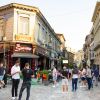
Today, a walk along Popa Nan Street offers a diverse urban experience. Along it are lined administrative buildings, restaurants, small businesses and residences, each contributing to the specific atmosphere of the area. Whether you choose to linger on the terrace of a restaurant or have matters to settle at one of the local institutions, the time spent here gains a certain density and value.
The street is not exclusively tourist-oriented, but rather a space of everyday life, where past and present coexist. Long-time residents meet newcomers, and the rhythm of urban life unfolds in a setting that still preserves echoes of history.
The past and present residents of the Popa Nan area
Over time, Popa Nan has been inhabited by very different people, from priests and craftsmen to merchants, artists and intellectuals. If in the past the area was known for its heterogeneous communities, today it is home to public figures, businesspeople, bank directors and company owners.
Among the well-known names of the present is actor Romică Țociu, who has chosen this area for his residence. This continuity in attracting public figures suggests that Popa Nan remains an appealing space, capable of offering both privacy and easy access to the heart of the city.
The meaning of the name and the identity of a place
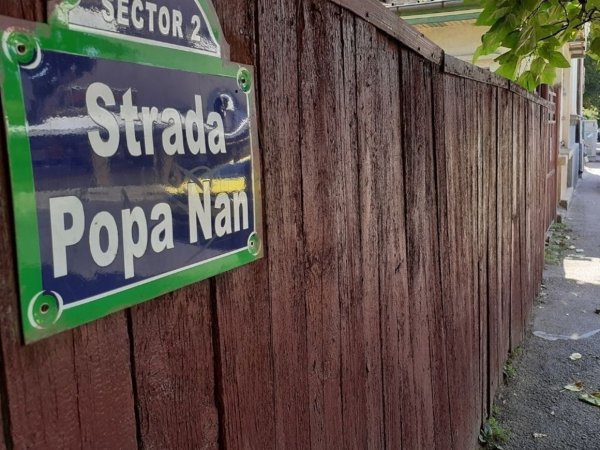
The name Popa Nan is not just an urban label, but a story condensed into a simple expression. It refers to the man who laid the foundations of the community, to the church built on the city’s edge and to the street that grew around this nucleus. Few areas of Bucharest preserve so clearly the connection between name, history and space.
In a city where many names have been changed or have lost their original meaning, Popa Nan remains an example of continuity. It is proof that a single person, through an apparently modest gesture, can leave a lasting mark on the city.
Popa Nan, between memory and present
Today, Popa Nan is more than a street or a church. It is an area that concentrates almost three centuries of Bucharest’s history, from the rural outskirts of the 18th century to the complex urban neighborhood of today. Every building, every intersection and every name carries fragments of this story.
Seen as a whole, the Popa Nan area reflects Bucharest’s ability to reinvent itself without forgetting its roots. The street, the church and the man who gave them their name together form a symbol of urban continuity, a place where history is not only remembered, but lived day by day.
We also recommend: The Delea Veche Neighborhood, Cireșului Street, and the Place Where Mihai Eminescu Read Letter V