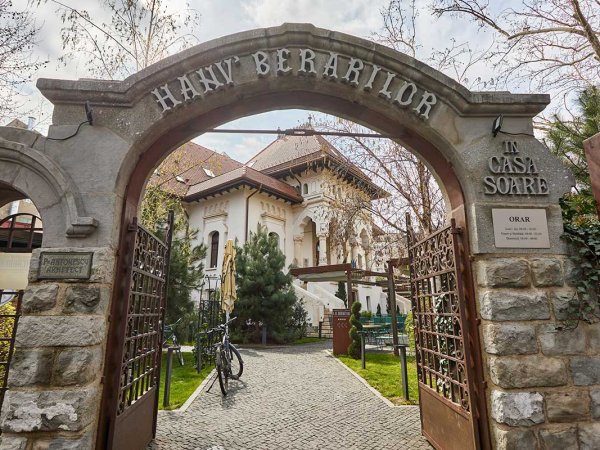
Oprea Soare House, history with tradition. Today it hosts Hanul Berarilor, one of the most famous restaurants of the Capital
- Articles
- 29 NOV 25
Oprea Soare House is one of those buildings that seem to concentrate within their walls the entire spirit of an era. Built at the beginning of the 20th century, in the Neo-Romanian style, it perfectly represents the direction in which Bucharest was heading in those years: a combination of tradition, urban ambition and modernity. Located in the immediate vicinity of Națiunile Unite Square and just a few steps from Unirii Square, the building discreetly dominates the historic area, attracting attention not only through its architecture but also through the complex story it carries.
The origins of an emblematic building in the center of Bucharest
The edifice was constructed around the years 1913–1914 by the architect Petre Antonescu, one of the most important creators of the Neo-Romanian style. The beneficiary of the construction was the Bucharest merchant Dumitru Oprea Soare, who erected the house on land inherited from his father. Its central position in the city was not accidental, as the area was in full development, and wealthy families sought to build imposing residences meant to reflect their social status.
At the time of its construction, the building was intended exclusively for private life. Oprea Soare House functioned as a luxurious residence, arranged according to the most modern standards of the early 20th century.
The Neo-Romanian style chosen by Antonescu was meant to emphasize Romanian identity in a period when the Capital was increasingly adopting Western influences. The result was a harmonious, elegant and solid edifice, which would go on to cross a century filled with transformations.
Neo-Romanian architecture and the elegance of details
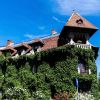
Casa Oprea Soare is still today considered an excellent model of Neo-Romanian architecture, a style that combined medieval elements, Brâncovenesc motifs, and Byzantine and Gothic influences. The façade of the building is imposing and rich in decorative details.
Columns and carved balustrades, traditional arches and ornaments inspired by the architecture of old princely courts give the building a unique visual identity. The large windows, framed by sculpted edges, allow natural light to flood the interior generously, enhancing the sense of space and refinement.
The roof, made of glazed tiles, harmoniously completes the entire ensemble. The well-balanced proportions of the construction, together with the details inspired by Romanian tradition, create an aesthetic equilibrium rarely encountered today in the urban center.
The interior of the house was divided into three levels: basement, ground floor and upper floor. The basement initially hosted utility spaces: the kitchen, storage rooms and offices. On the ground floor were the rooms dedicated to social life, an imposing hallway, a reception salon, the library and dining rooms. The upper floor was reserved for bedrooms and guest rooms.
A remarkable aspect of the building is that many of its original elements have been preserved to this day. Sculpted furniture, colored stained-glass windows, ornamental floors and stone fireplaces are testimonies of early 20th-century elegance and of the craftsmanship of Romanian artisans. These details contribute to the special charm of the building, making it a true monument of Bucharest refinement.
The transformations Casa Oprea Soare underwent during the 20th century
Although initially conceived as a private residence, the history of the Oprea Soare House was marked by numerous changes, reflecting the tumult of the 20th century in Bucharest and, implicitly, in Romania as a whole. Between 1914 and 1940, the building served as the residence of the Oprea Soare family, preserving its character as a luxury home.
A radical change came during the Second World War. Between 1940 and 1944, the house was requisitioned by German troops, who installed administrative functions here. This period left traces both on the structure of the building and on its history, marking it with dramatic events.
After 1945, once the communist regime was installed, the fate of the building changed again. Oprea Soare House was taken over by the state and became the headquarters of various public institutions. It hosted, successively, a civil registry office and later a police center. The building, designed for comfort and representativeness—was now used in a way completely different from its original purpose.
After this period, the property was transformed into a restaurant and even into a restricted-access casino, adapting to the needs of the city and the social context of the time. This stage prepared the ground for its modern transformation, in a period when Bucharest began reclaiming its historical and cultural identity.
The decisive moment came after 2008, when the building was returned to the heirs of the Oprea Soare family and then carefully restored. It thus re-entered the public circuit, becoming a landmark of the historic center and an example of the revitalization of built heritage.
Oprea Soare House today: the rebirth of a symbol
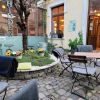
Today, Casa Oprea Soare hosts Hanul Berarilor, one of the best-known restaurants of the Capital. Its transformation into a famous gastronomic space has not diminished its historical value—on the contrary: it has turned the building into a place where architectural tradition meets the bohemian atmosphere of contemporary Bucharest.
Hanul Berarilor manages to preserve the historical charm of the building, offering visitors not only a culinary experience but also authentic contact with a part of the city’s heritage. The spacious halls, elegant vaulted ceilings, tall windows and carved details create a unique ambience in which past and present intertwine harmoniously.
Oprea Soare House is currently included on the list of historical monuments of Bucharest, with the LMI code B-II-m-A-18000. This inclusion in the official heritage confirms the cultural and architectural value of the edifice and emphasizes the importance of its protection. It represents the ideal of Romanian architecture from the first half of the 20th century: a construction that integrates national tradition into a modern urban context, offering both elegance and comfort.
Through its rich story, spectacular architecture and transformation into a vibrant space, Oprea Soare House remains an important landmark in the landscape of the Capital. It is a place where history comes to life, where the past breathes through every detail and where tradition is harmoniously blended with the energy of the modern city.
Today, located on 2 Poenaru Bordea Street, Oprea Soare House continues to attract visitors, both locals and tourists. It is a monument that deserves to be discovered and admired, a testimony of old-world elegance and an example of how heritage can be reintegrated harmoniously into the life of contemporary urban society.
We also recommend: Hanul Drumețului: The History of the Bucharest Restaurant Where Good Food and Fiddlers Set the Tone of the Party