Norihiro Haruta, the Japanese photographer who captured Bucharest in 1990. What he saw in the capital and what he discovered when he returned
By Raluca Ogaru
- Articles
- 30 SEP 26
In late August 1990, a Japanese student stepped off a train at Bucharest’s Gara de Nord railway station in the middle of the night. He spoke no Romanian, knew only a little English and had never visited the country before. What he did have was a Nikon camera and a desire to see for himself what was happening in a part of Europe he knew mainly from news reports broadcast in Japan.
His name was Norihiro Haruta. He was 22 years old and studying Sociology in Tokyo. More than a quarter of a century later, the photographs he took in Bucharest would become a visual archive containing over 500 images. They show food queues, crowded buses, newspaper vendors, children playing in the street, markets, trams and the buildings of a city caught between communism and a democracy it was still learning how to navigate.
He travelled from Berlin to understand the Romanian Revolution
Norihiro Haruta was born in Japan in 1968. In 1990, he took a year off from university and set out on a journey through Eastern Europe. He had no professional training as a photographer. He was familiar with major landmarks of photojournalism, including the Magnum agency and “Life” magazine, but admitted that he was only beginning to understand photography.
Before reaching Romania, Haruta travelled to Berlin, where he witnessed the period leading up to German reunification. At the hostel where he was staying, other travellers spoke about Czechoslovakia, Hungary and Poland. Romania seemed different. The December 1989 Revolution was officially over, but images of protests and violence in Bucharest continued to appear on European television.
“After a moment, I decided to go to Romania to experience the revolution,” Haruta recalled in a testimony later published by the Bucureștiul meu drag Association.
He boarded a train in Berlin and crossed Europe to Bucharest. The journey and the border crossing engaged all his senses: the smells, people’s voices, the tranquillity of the fields he saw after sunrise and the atmosphere inside the train compartments were entirely different from Japan. The train arrived at Gara de Nord around midnight, and the young traveller found a hotel nearby.
The Bucharest he encountered in the summer of 1990
Haruta saw the capital in daylight for the first time the following morning. He later remembered a dusty city under the bright August sun, with trams moving across uneven cobbled streets and horse-drawn carts passing by. It was a landscape completely different from Berlin and almost impossible to compare with Tokyo.
He began walking through the streets and taking photographs. He was not interested only in the traces of the Revolution or political confrontations. His camera turned towards everyday life: a vegetable seller at Matache Market, crates of milk and yoghurt at Norilor Market, people waiting for food, street vendors, children in University Square and passengers crowding public transport stops.
The archive includes images from Dacia Boulevard, Calea Griviței, Lipscani Street, Berzei Street, Roman Square, Union Square and 21 December 1989 Square. The National Bank of Romania, Monteoru House, the Majestic Hotel and the Palace of Parliament appear alongside secondary streets rarely included in official albums about Bucharest.
Haruta did not create a collection of landmarks. He documented a living city. One photograph shows a cat jumping over a fence. Another captures a bicycle on Lipscani Street. Other images feature a public toilet in Roman Square, a queue for newspapers on Magheru Boulevard and children playing in the fountains in Union Square.
READ ALSO:
The photographers who captured Bucharest before much of the city disappeared
The people of Bucharest made him look beyond politics
Haruta initially spent two weeks in Bucharest. People approached him, helped him find his way and invited him into their homes. A young man he met on the street helped him put together a small English–Romanian dictionary. Others simply called him “frate” — “brother” — a word the Japanese visitor would remember many years later.
Near Gara de Nord, he met a teenage girl from Horezu who told him about her hometown. The encounter persuaded him to leave the capital for a while and discover rural Romania. In Horezu, he met Valentin Diaconu, who was then a high school student. The two remained friends, and Diaconu later became a photographer.
After the first few weeks, Haruta’s interest shifted away from political events and towards people. Romania was no longer simply the country of a revolution he had watched on television. It had become a place where he was discovering human connections, traditions and a way of life he had never encountered in Japan.
This closeness explains why his photographs do not view Bucharest with the detachment of a reporter sent to cover an international event. The people in his images are not part of the background. They are the main characters of the city.
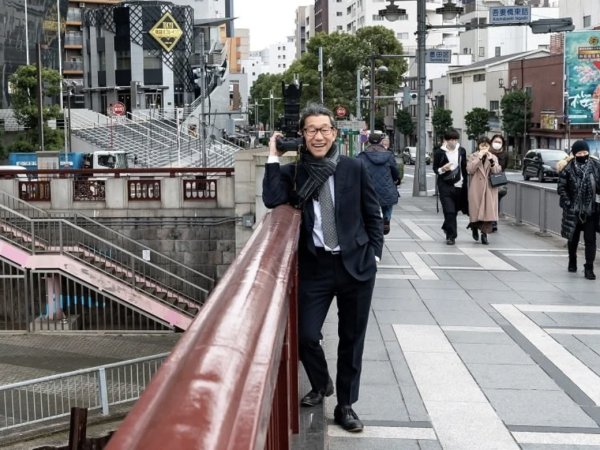
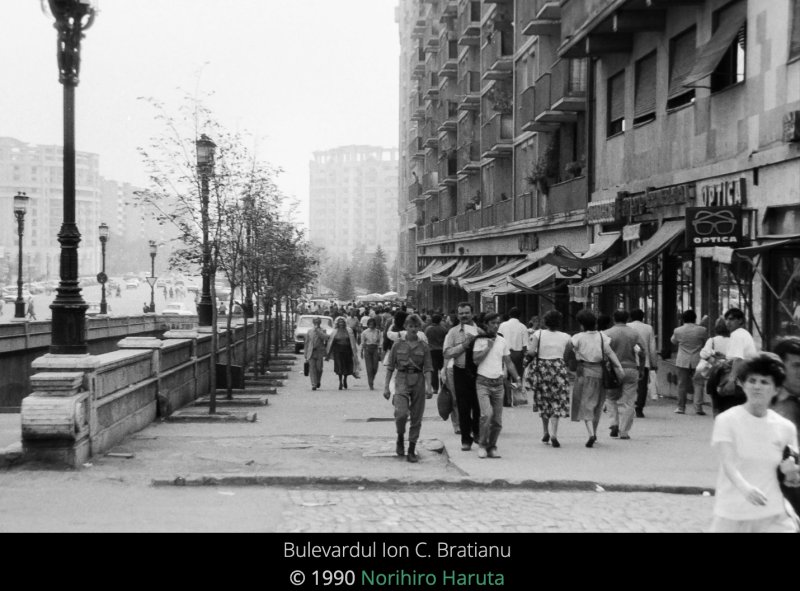 Norihiro Haruta captured Bucharest in the summer following the 1989 Revolution. (Photo source: https://www.bucurestiulmeudrag.ro/profil/NorihiroHaruta; photo credit: Norihiro Haruta, 1990)
More than 500 photographs remained unseen for over two decades
Norihiro Haruta returned to Romania at the end of 1990 to spend Christmas in Horezu. Between 1990 and 2001, he came back ten times, almost every year, and spent a combined total of more than two years in Romania. Most of that time was divided between Bucharest and Horezu.
After returning to Japan, he created a portfolio and organised an exhibition in Shinjuku, Tokyo, in 1996. The photographs from his Romanian journey did not circulate widely, however. His archive of Bucharest in 1990 only returned to public attention after Valentin Diaconu and the Bucureștiul meu drag Association re-established contact with him.
The collection received by the association contains more than 500 photographs. Mihai Petre researched the images and identified the locations where they had been taken, including places where the original urban landmarks had almost entirely disappeared.
In 2020, the Bucharest Municipality Museum hosted the open-air exhibition “Years Have Passed: 1990 vs 2020” at Suțu Palace. The project presented 31 images taken by Haruta in 1990 alongside photographs recreated three decades later by members of the Bucureștiul meu drag Association. The comparison revealed demolished buildings, transformed public spaces and places that appeared surprisingly unchanged.
READ ALSO:
Three major ways Bucharest changed between 1990 and 2026
What Haruta found when he saw Bucharest again
Over three decades, Bucharest changed its shops, cars, advertisements and the rhythm of its streets. Food queues disappeared, Lipscani became a district of restaurants and bars, and new buildings appeared where houses or vacant plots once stood. Yet the comparative photographs also show that urban transformation did not always mean preserving the old city.
In a Euronews report published in 2024, Haruta spoke about fast-food restaurants, cafés and shops, but also noted the lack of care shown towards certain historic buildings. His conclusion summed up the relationship he had developed with the capital: “The whole city remained like a museum to me.”
His perspective changed alongside the city. In 1990, he was drawn to dusty streets, trams, markets and people emerging from a dictatorship. During later visits, he discovered that modernisation could erase the memory of a place, while neglect could accidentally preserve urban settings that other capitals had already lost.
Norihiro Haruta’s Bucharest is not beautiful in the conventional sense of a tourist album. It is crowded, poor, sometimes disorderly and deeply contradictory. That honesty is precisely what gives the archive its value. The photographs do not show the city as it wanted to be seen, but as people actually experienced it.
Why his photographs still matter today
In 1990, few people owned cameras, and even fewer could afford to use dozens of rolls of film to document ordinary street scenes. The press focused on political events, while family photography remained centred on relatives and friends. Haruta photographed the space between these two worlds: everyday life that seemed unimportant at the time.
For Bucharest residents who experienced that period, the images can recover details buried by memory. For younger generations, they make the transition easier to understand than a succession of historical dates. The clothes, shop windows, expressions, crowds and condition of the buildings tell a story that official documents cannot convey on their own.
The archive also has urban and historical value. Comparing the 1990 photographs with present-day images shows what was built, demolished, restored or allowed to deteriorate. Some photographs preserve buildings that no longer exist. Others reveal that several of Bucharest’s problems have survived every political and economic transformation.
Norihiro Haruta came to Bucharest hoping to understand a revolution. Instead, he found a city that made him return. Without knowing it at the time, the Japanese student gave the capital one of the most direct visual records of its first year of freedom.