“Like in Venice”: The history of the Monte Carlo restaurant in Cișmigiu, the place where high society has gathered for “a coffee and a gossip” 100 years ago
By Bucharest Team
- Articles
- 17 JUN 26
Few places in Bucharest have managed to gather around them as many stories, memories, and legends as the Monte Carlo restaurant in Cișmigiu Garden. Located on the island on the lake, surrounded by greenery, water, and romantic alleys, this establishment has been for more than a century one of the symbols of social life in the Capital. Bourgeois, artists, intellectuals, truant students, and simple lovers have passed through its tables over time, transforming Monte Carlo into a place where gastronomy, conversation, and the everyday spectacle of Bucharest intertwined. The charm of this corner of the city did not go unnoticed even by the great writers of the period. The author Mircea Damian described Cișmigiu as a universe separate from the rest of Bucharest, a space where the noise of trams, dust, and the agitation of the city disappeared completely. In his vision, the garden became a refuge where people could become “drunk both on wine and on love,” under the star-filled sky, among ancient trees, boats floating peacefully on the lake, and lights reflected in the water.
Cișmigiu, the green paradise in the middle of the bustling Bucharest
During the interwar period, Cișmigiu Garden represented one of the most elegant promenade places in the Capital. Unlike the crowded streets of the city, visitors discovered here an almost magical atmosphere. The shaded alleys, old trees, flowers, and the expanse of the lake offered the feeling of an escape from reality.
One of the most spectacular elements of the landscape was the water display in the middle of the lake. The fountain raised dozens of streams of water that, with the arrival of evening, were illuminated in different colors such as green, blue, red, or yellow. The reflections on the surface of the water, combined with the light of the stars and the tranquility of the park, transformed Cișmigiu into an almost unreal setting.
It was precisely this special atmosphere that made the Monte Carlo restaurant become one of the most sought-after places in Bucharest. Its location directly on the lake gave it a unique advantage, and a simple meal served here transformed into a complete experience, where nature and urban elegance met.
From Dura’s tavern to a restaurant frequented by the bourgeoisie of the Capital
The history of the establishment on the island in Cișmigiu begins around 1850, when Dura’s tavern operated in that place. The privileged position on the shore of the lake and the relaxing atmosphere made the establishment quickly beloved by the residents of Bucharest, especially by the bourgeoisie that was developing rapidly.
At the beginning of the 20th century, around 1905, the owner of the restaurant was Mihalcea, a well-known municipal councilor and a great beer enthusiast. His name is also linked to the famous playwright Ion Luca Caragiale, alongside whom he opened several beer halls on Șelari and Gabroveni streets toward the end of the 19th century.
The establishment, however, also went through dramatic moments. Toward the end of the First World War, the restaurant building was completely destroyed in a fire, and one of Bucharest’s most beloved meeting places temporarily disappeared.
Monte Carlo reborn: the elegance of a restaurant “like in Venice”
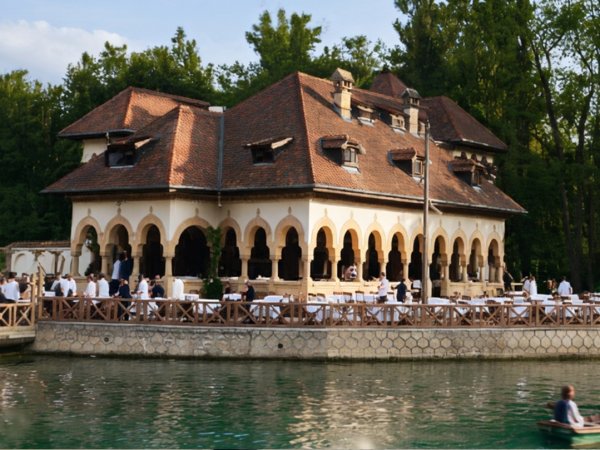
The story of Monte Carlo continued in 1926, when businessman Partenie decided to rebuild the restaurant and restore its former glory. The new building was constructed in the Neo-Romanian style and impressed through its size, elegance, and spectacular location on the island in the middle of the lake. The project is attributed by some historians to architect Ion Mincu, although there are also opinions according to which the building plans belonged to architect Petre Antonescu.
Around the restaurant, a generous garden was arranged, with approximately 400 tables, which filled every evening with Bucharest residents eager to enjoy music, food, and pleasant company. Some of the most appreciated traditional musical ensembles of the time performed here, and the atmosphere was often compared to that of a romantic resort on the canals of Venice.
Mircea Damian perfectly captured the charm of this place, describing Monte Carlo as a restaurant “on the water like in Venice,” where the smell of grilled minced meat rolls blended with music, moonlight, and the image of boats floating on the lake. In the boats were families, lovers, or lonely people rowing slowly under the night sky, while those sitting at the restaurant tables watched the spectacle of nature, ate grilled minced meat rolls, pretzels, and peanuts, and threw bread crumbs to the fish in the water.
The place where Bucharest residents came for a coffee, a dessert, and the latest gossip
Monte Carlo was not only a restaurant, but also a true social center of Bucharest. After walks through Cișmigiu, representatives of the bourgeoisie came here to drink coffee, enjoy a dessert, and discuss the latest social, political, or cultural events of the city.
Surprisingly, the mornings had a completely different atmosphere. The restaurant tables were often occupied by students from “Gheorghe Lazăr” College, who skipped the first classes in order to spend time in this special setting. It seems that the habit of playing truant in a café with friends is not at all an invention of modern generations.
Monte Carlo distinguished itself from many other establishments of the era through the refinement of its services and menu. There were no untidy waiters here, but elegant waiters dressed in striped waistcoats. Wine was served by the bottle, beer came from the famous Opler brewery, and the menu included dishes inspired by Western cuisine. Simple snacks were replaced with sophisticated entrées such as vol-au-vent or fish in aspic, while Eastern influences could be found in the seasoned rice side dishes.
At the same time, traditional drinks began to be replaced by symbols of European refinement. The small glass of Muscel plum brandy gave way to an elegant flute of champagne, a sign that interwar Bucharest was trying to adopt the customs of the great Western capitals.
The destruction, reconstruction, and transformation of a symbol of the Capital
Monte Carlo’s destiny was once again marked by a tragedy on the night of November 27–28, 1940, when the powerful earthquake that struck Romania completely destroyed the beautiful building raised during the interwar period. Only 14 years after its inauguration, one of the most elegant restaurants in Bucharest became a ruin.
The restaurant was rebuilt in the first years of the communist period, in a form similar to the one known by recent generations. The press of the time announced the reopening of the new Monte Carlo, which was described as a place “more intimate, more pleasant, and quieter,” adapted to the new realities of the era.
Throughout the decades, the restaurant maintained its status as a landmark of Cișmigiu, even though Bucharest changed radically around it. In 2024, the establishment entered a new stage of its existence, being purchased by the owner of the City Grill group and rebranded under the name N/A Not Available.
Today, even though the Monte Carlo name no longer appears on the sign, its memory continues to exist in the memory of Bucharest. Its story is that of a city that went through fires, wars, earthquakes, and regime changes, but which always preserved its desire to enjoy a good coffee, a charming conversation, and the beauty of an evening spent on the shore of the lake in Cișmigiu.
We also recommend: