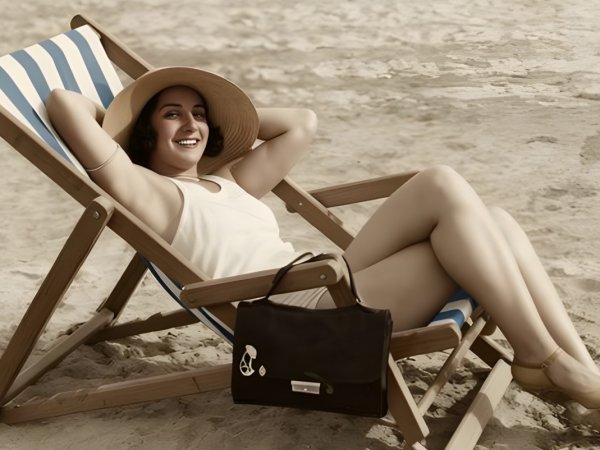
Kiseleff Lido, the favorite place of interwar Bucharest residents: sports competitions and Miss contests were organized here
- Articles
- 20 MAR 26
In interwar Bucharest, few places concentrated so well the changes in mentality, the new tastes of the public, and the fascination for modern life as the Kiseleff Lido. It was not just a place where people came to cool off on hot summer days. It was a space in which the Capital practiced its new lifestyle, in which the body, sport, tan, elegance, and sociability became signs of modernity. For Bucharest residents between the two world wars, the lido was, at the same time, a place of leisure, a sports arena, a fashionable stage, and the setting of a freedom that, only a few years earlier, would have seemed inconceivable.
From separate baths to the cult of the body and of modern freedom
If before the war men and women bathed separately, and the rules of decency imposed strict control over the body and over its appearance in public, the interwar period brought a major change. Along with this era there appeared more and more clearly the cult of the healthy, athletic body exposed to the sun, an ideal that would become familiar to later generations as well. It was no longer enough for the body to be well hidden and disciplined by severe moral conventions. It had to be maintained through movement, shaped through sport and, above all, seen. A tan was beginning to be associated with vitality, and the bathing suit, once scandalous through its mere existence, gradually became acceptable in the urban public space.
In this context, the appearance of the Kiseleff Lido meant more than the inauguration of an impressive pool. It meant the consecration of a new vision of spending free time and of the way in which the city could offer entertainment, hygiene, and spectacle in the same space.
Kiseleff quickly became one of the symbols of the Bucharest summer, a place where people came not only for bathing, but also to see and be seen, to participate in events, to listen to music, to dance, and to take part in a world in full change.
The change best illustrated by the interwar Bucharest lidos concerns the way of relating to the body and to morality. Before the First World War, the rules were much stricter. Bucharest men and Bucharest women bathed separately, at the Tirul lido, the only one of this kind in the Capital, and women’s access was limited to a precise time interval.
The pool was open to them only between 10 and 12 o’clock, after which the space returned exclusively to men. It was an arrangement that reflected very clearly a society dominated by modesty, by separation between the sexes, and by the idea that the exposure of the female body had to be carefully controlled.
After the war, however, Western influences became stronger and stronger, and in Europe there emerged not only a social emancipation of women, through broader access to higher education and to professions once reserved for men, but also a bodily emancipation. The female body, kept for centuries under heavy layers of clothes meant to hide any trace of “temptation,” began to be represented differently, including in public space.
In Romania of the 1930s, although society was still marked by rigid morality, clear signs already appeared that the old prohibitions were being overcome. It became possible to organize Miss contests, including Miss Lido or Miss Romania, and the presence of women in bathing suits in front of a mixed public no longer provoked the same indignation as a decade earlier.
This transformation is essential in order to understand why the Kiseleff Lido had such a great impact. At Kiseleff, men and women not only bathed in the same place, but participated together in the same culture of visibility and summer sociability. Men could watch women parading in bathing suits, and feminine beauty became part of the public spectacle. What once would have been classified as scandalous or immoral came to be interpreted through the grid of sport, health, and the new urban mentality.
It is not by chance that in the press of the time more and more advertisements for women’s stockings and bathing suits appeared. Whether photographed or drawn, these images brought into widely circulated publications representations of the female body which, until then, would have been considered taboo. The lidos contributed decisively to this change. They normalized the idea of the exposed body, of mixed bathing, of tanning, and of physical freedom, associating them with sport, hygiene, and modernity.
The construction of a giant of the Bucharest summer
The first great lido of this new era was Kiseleff, built in 1929 and presented at the time as the largest pool in Europe. This label says much about the ambition of the project and about the desire to offer Bucharest a place comparable to the great Western facilities. The lido was built in only 52 days, a pace that impressed contemporaries as well. The speed of the construction, doubled by the impressive dimensions of the complex, turned the inauguration into a top urban event.
Those who crossed its threshold discovered a space much more complex than the simple idea of a public pool. Kiseleff had 200 cabins, an artificial beach of 12,000 square meters, racing tracks, a tennis court, a restaurant, a brasserie, a café, shops, a post office, telephone, telegraph, Berlin jazz music, and even a special floor for dancing. There was also a children’s pool, besides the adults’ one, and both were supervised by swimming instructors. Inside the lido there also operated a medical office, with two doctors available to the public.
The schedule too was adapted to intensive use. The beach and the bath were open from 6 in the morning until 20 in the evening, which made possible the presence of a very varied public, from early risers to lovers of long summer evenings. From an announcement regarding the opening of the summer season in 1931 it appears that the lido had come to have a total of three pools, ping-pong tables, sunbathing areas, and Monopol Azuga restaurants with accessible prices. Even the entrance fees were carefully communicated: 52, 32, and 20 lei for children, and in the evening 20 lei for everyone.
The impression the place produced was one of scale and spectacularity. Contemporaries insisted on its dimensions and on the fact that only a walk among the alleys and annexes could give the exact measure of the enterprise. In the middle stood the large pool, surrounded by the vast artificial beach, and the ensemble offered the image of a modern and imposing urban facility. Kiseleff was not only functional, but also meant to impress.
A true complex of leisure, sport, and sociability
The success of the Kiseleff Lido was also due to the fact that it responded to very diverse needs. Like Lido, which was to open in 1930, Kiseleff was not just a swimming space. It was a complex intended for spending free time in the broadest sense. Here you could drink a lemonade, a coffee, or a beer, eat a grilled steak or a little sausage, make a phone call or send a telegram, listen to jazz, and dance on the dance floor. All of this turned the lido into a center of urban life, not into a simple sports facility.
During summer, Kiseleff became probably the most intense place of socializing in Bucharest. Here young people, families, athletes, fashionable people, curious people, and lovers met. It was the place where relationships were more easily formed, where conversations started naturally, and where the appearance of a new conquest was as possible as entering a pool. In a city that was discovering the pleasure of free time spent in public, the lido became the perfect background for flirtation, for displaying summer elegance, and for the uninterrupted spectacle of fashionable life.
It is also important that here women could bathe freely, without the humiliating restrictions of the old arrangement at Tirul. This detail, apparently administrative, was in reality an expression of a deep social change. Woman was no longer tolerated in a limited and separate interval, but participated naturally in the public life of the lido, in the same space and at the same time as men. Thus, Kiseleff became not only a place of entertainment, but also a visible sign of the relaxation of social codes.
The press of the era observed this mutation very well. The lido and Lido, seen at first by moralists as “institutes of perdition,” would quickly be accepted as legitimate places of sports and fashionable life. Costumes and attitudes no longer shocked, because everything was beginning to be interpreted through the prism of the new conceptions about sport, hygiene, and modernity. What seemed dangerous became natural, and what had been shameful turned into urban normality.
Kiseleff, a stage for sports competitions and performance
The lido was not only a space of fun, but also one of sports performance. Important competitions were organized here, some supported even by publications of the time, which shows how closely linked the press, sport, and fashionable life were. An eloquent example is the nautical contest organized by the magazine Romanian Illustration between August 15 and 17, 1929, shortly after the inauguration of the lido. The event gathered the main sports clubs and attracted a number of participants that exceeded all expectations.
More than that, the results were remarkable, several records being broken. The press underlined that four records of Romania gave way before the drive of the swimmers of the Capital. Werner Borck and Iosef Eminger stood out in particular. The first set new performances in the 100- and 800-meter freestyle, and the second, representing the university club, did the same in the 200-meter breaststroke for juniors and the 100-meter backstroke for seniors.
The ranking by clubs also confirms the level of the competition. In first place stood Sportul Studențesc, with 89 points, followed by Tennis Clubul Român, with 64 points, and Sparta C.A. Bucharest. Such contests show that the Kiseleff Lido was integrated into a sports culture in full affirmation, in which swimming was becoming spectacle, performance, and a reason of prestige for Bucharest clubs.
The fact that such competitions took place in a space frequented by the wide public also contributed to the popularization of sport. Swimming was no longer only a utilitarian activity or one reserved for a narrow elite, but became part of urban entertainment. Spectators could watch the competitions, admire the performances, and associate sport with elegance, summer, and modernity.
Miss contests, boxing, and the spectacle of the interwar summer
One of the most spectacular dimensions of life at Kiseleff remains linked to fashionable events and beauty contests. In a Romania that still kept many conservative reflexes, the fact that Miss Lido contests or even competitions such as Miss Romania could be organized shows how much the urban atmosphere had changed. The lido became a veritable stage on which the female body was not only tolerated, but admired and publicly evaluated.
This practice would have seemed unimaginable a decade earlier. But in the 1930s, the tanned, slender body and as little hidden as possible was beginning to be promoted as a sign of health and modernity. The Miss contests fit perfectly into this new logic. They were part of a broader spectacle of the summer, in which the elegance of the bathing suit, the grace of appearance, and personal charm became attributes publicly valued.
At the same time, Kiseleff also hosted other spectacular events, including demonstrations and boxing matches. Famous names of the time took part in them, such as Moti Spacov, Romania’s boxing champion, the Frenchman Michel Riond, Marcel Schoenfeld, Alexandru Bunea, former champion in the lightweight category, Ion Firu, and Aurel Goldemberg. The atmosphere of these galas was not without comic elements either. A memorable episode was the one in which the Frenchman Riond let himself be beaten by a woman, adding a note of humor and extra attractiveness for the public.
All these events show how complex the universe of the lido was. It was not only about bathing and beach, but about an entire industry of urban leisure. Kiseleff brought together sport, spectacle, music, flirtation, gastronomy, and social novelty in a single place. That is why, for interwar Bucharest residents, it was not only a seasonal space, but a defining experience of summer in the Capital.
A symbol of modern Bucharest
Seen in retrospect, the Kiseleff Lido was much more than a successful facility. It was one of the places in which interwar Bucharest displayed most clearly its desire for modernization and synchronization with the West. Here one could see the change of mentalities, the emancipation of the body, the relaxation of norms, the appearance of a new culture of free time, and the consolidation of sport as a mass practice and form of prestige.
For many of those who crossed its threshold, Kiseleff probably meant the first experience of urban vacation lived in their own city. It was the place in which summer was no longer only the season of heat, but also that of an intense sociability, of contests, of music, and of the feeling that Bucharest could be, at least for a few months a year, a truly modern, open, and cosmopolitan city.
The Kiseleff Lido thus remained in the memory of the era as one of the great settings of interwar life. Here sport and fashionable life, performance and seduction, the discipline of the pool and the freedom of the beach met. Around it a new world was built, one in which the body was affirmed, not hidden, and summer became a public spectacle. Precisely for this reason, Kiseleff was not only the favorite place of interwar Bucharest residents, but also one of the liveliest symbols of the transformation of the Capital into a city of modernity.
We also recommend: Famous Boulevard Names: Pavel Kiseleff, the Russian General Who Loved Romania and Gave Us the First Constitution