Ion Creangă Theatre in Bucharest, six decades of history. How the most famous children’s theatre in Romania was born
- Articles
- 02 DEC 25
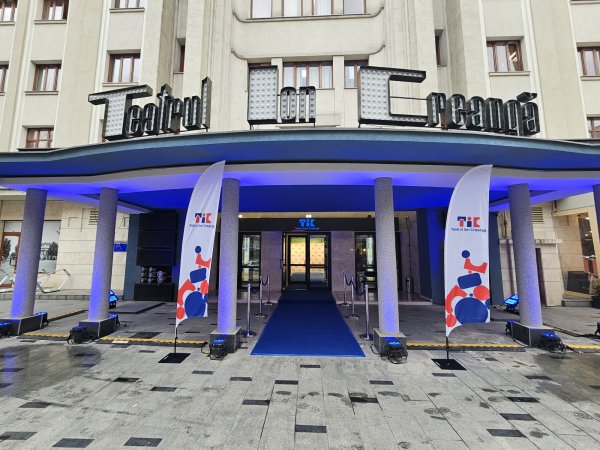
In 2025, the Ion Creangă Theatre celebrates 61 years of existence, being one of the most important public performance institutions for children in Romania. Founded with the purpose of creating and promoting theatrical productions of high artistic value, the theatre also carries out educational, social, and aesthetic-formative programs, aimed at children aged 0 to 12 years. It also addresses educators, specialized teachers, parents, and legal guardians, with a clear mission: shaping aesthetic taste and stimulating the creativity of the youngest spectators.
The founding of the theatre and its mission
The Ion Creangă Theatre invites young spectators to participate in special programs, which include theatre performances, as well as colorful gifts, thus offering memorable encounters with some of the best-known characters and stories of universal childhood.
In parallel, the theatre develops interactive and musical play-performances, dedicated to preschoolers, as well as sensory activities for babies, specially designed to stimulate the senses and curiosity of the youngest audience.
The first performances and official recognition
The first children’s and youth theatre performance of the Ion Creangă Theatre took place on December 24, 1964, with the staging of Harap Alb, directed by Ion Lucian. The performance marked the theatre’s debut in Piața Lahovari, its first headquarters.
On May 4, 1965, the decree establishing the Ion Creangă Theatre officially was issued. In the same year, Romania became a founding member of the International Association of Theatre for Children and Young People (ASSITEJ), consolidating the theatre’s status on the international stage.
An important step in the theatre’s internationalization occurred in 1968, when the performance Năzdrăvăniile lui Păcală, by Letiția Popa, directed by Barbu Dumitrescu with set design by Elena Simirad Munteanu, was presented on its first foreign tour.
International tours and artistic recognition
In 1972, the performance Snoave cu măști was presented in Italy, Canada, the United States, and Cuba, marking the international debut of actors who would become key figures in children’s theatre: Ion Arcudeanu, Alexandrina Halic, Daniela Anencov, Genoveva Preda, Jeanin Stavarache, and Ion Lucian. This success was followed in 1974 by the appointment of writer Alecu Popovici, renowned for his literature dedicated to children, as director of the theatre.
In 1976, the theatre inaugurated its new headquarters in Piața Amzei, and in the same year, director Cornel Todea made his debut on the theatre stage with the performance Hocus Pocus și-o găleată, after A.E. Greidanus, with set design by Ion Dogar Marinescu and music by Johnny Răducanu. The cast included important actors such as Genoveva Preda, Anca Zamfirescu, Dumitru Anghel, and Boris Petroff.
The year 1986 was remarkable, as the performance Snoave cu măști held 80 shows in Japan over 110 days, and another tour in the same country included 54 performances of Cenușăreasa. Two years later, the theatre premiered Carlo Gozzi’s Turandot, 20 years after the premiere of Regele cerb, with Marioara Sterian in the lead role, directed by Gelu Colceag, with scenography by Nicolae and Mihaela Ularu.
Repertoire development and national recognition
In 1990, Grigore Gonța, former actor and director at the Bucharest National Theatre, took over the Ion Creangă Theatre and introduced his aesthetic program, debuting with the Ionesco text Ce nemaipomenită harababură, which he also directed, starring Marin Moraru. In 1991, director Cornel Todea returned, and the performance Țiganiada, directed by Mircea Cornișteanu, participated in the Balkan Theatre Festival in Skopje.
In 1993, the theatre staged its first performance created by an international English team: Matilda, after Roald Dahl, dramatized by Alexandru Pleșcan, directed by Thomas de Mallet Burgess, with scenography by Spyros Coscinas. In the same year, Ivan Turbincă, by Alecu Popovici, dramatized after the eponymous tale by Ion Creangă and directed by Cornel Todea, participated in the International Children’s Theatre Festival in Greece.
In 1994, Furtuna participated in the International Theatre Festival in Taipei, Taiwan, and in 1995, the third Ionesco title in the theatre’s history, Improvizație la Alma, premiered at the French Institute in Vienna, in French, directed by Cornel Todea, and was performed in France, Belgium, Czechia, Egypt, Denmark, Syria, and Cyprus.
Participation in European networks and international awards
In 1996, the Ion Creangă Theatre became a member of EU NET ART, a European network based in Amsterdam, which unites 100 members: theatres, associations, and professional organizations in children’s performing arts.
The same year, the theatre received international nominations for service and quality awards, including the International Grand Prix and International Gold and Silver Award, and Cornel Todea won the directing award for L’Impromptu de l’Alma by E. Ionesco at the Short Theatre Festival in Buzău.
Subsequent years brought numerous national and international awards: in 1998, UNITER awarded Alexandrina Halic for her lifetime achievements; in 2002, Radu Apostol received the debut prize for directing Acasă, based on a scenario by Ludmila Razumovskaia, also receiving the OPERA PRIMA prize and a PROMETHEUS nomination.
In 2003, the National Prize for children’s theatre went to Pinocchio, directed by Cornel Todea, and in 2004, De-aș fi Scufița Roșie, directed by Sorana Coroamă-Stanca, won Best Performance at the Piatra Neamț Theatre Festival, alongside a special UNITER prize for actor Boris Petroff.
International festivals and continuous recognition
In 2005, the first edition of the International Children’s Theatre Festival 100, 1.000, 1.000.000 de povești took place, where Harap Alb, directed by Cornel Todea, received the Best Creation award. The same year, at the Piatra Neamț Theatre Festival, Inimă rece, directed by Sorana Coroamă-Stanca, earned the Diploma of Excellence, and Lucian Ifrim received a UNITER special prize.
From May 19–26, 2006, the theatre participated in the itinerant MONDOINSCENA International Children’s Theatre Festival in Italy with Farsa jupânului Pathelin, performed in Italian, gaining public acclaim and media attention.
In 2007, Cornel Todea received the UNITER special prize for children’s theatre, and Tigrișorul căruia îi plăceau clătitele, adapted from a scenario written by children, received Best Set and Costume at the 100, 1.000, 1.000.000 de povești Festival. In 2009, the Firebird Trophy for Best Actress in a Leading Role went to Ani Crețu for the role of Pinocchio.
European projects and ISO certification
In 2011 and 2012, the theatre continued to receive awards for scenography and acting at international festivals. In 2014, Amintiri din copilărie received the Cornel Todea award for the best performance for children aged 6 to 12 at the 10th edition of the International Children’s Theatre Festival 100, 1.000, 1.000.000 de povești.
Also in 2014, the theatre troupe participated in Small size, big festival in Northern Ireland, marking the end of the European project Small size, big citizens, in which the theatre has participated since 2009.
On October 24, 2014, the Ion Creangă Theatre became an ISO 9001 certified institution, implementing and maintaining a quality management system according to SR EN ISO 9001:2008 standards.
Between 2014 and 2018, the theatre was involved in the European project Small size, Performing Arts for Early Years, part of the EU cultural and audiovisual support program Creative Europe, selected from 74 candidates alongside prestigious European institutions such as Baboro Galway International Children’s Festival (Ireland), La Baracca – Testoni Ragazzi (Italy), and Toihaus Theater (Austria).
Over more than six decades, the Ion Creangă Theatre has become a true reference institution in children’s theatre, both nationally and internationally. From its first performances in Piața Lahovari to participation in international festivals and European projects, the theatre has consolidated its identity through a diverse repertoire, professionalism, and care for the artistic education of young audiences, remaining a key cultural landmark in Bucharest and across Romania.
We also recommend: The story of the Odeon Theatre: the princely court, the 1945 bombings and today’s temple of the arts