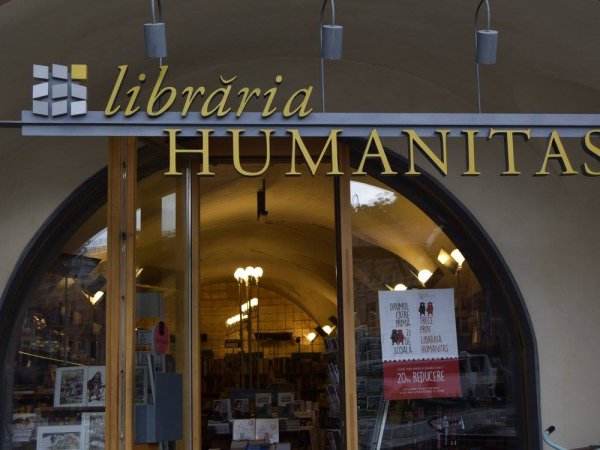
Humanitas, the publishing house of the human sciences, set out by publishing books banned during the communist period
- Articles
- 04 DEC 25
Humanitas, one of the most influential publishing institutions in contemporary Romania, has its origins in the effervescent period that followed the fall of the communist regime. The publishing house was founded on February 1, 1990, in Bucharest, at the initiative of Andrei Pleșu, who was, at that time, the minister of culture.
The beginnings of a publishing house born from a historical turning point
The new institution took shape on the structure of the former Political Publishing House, dissolved after the Revolution. Its leadership was entrusted to Gabriel Liiceanu, a writer and researcher in philosophy and art history, who would later become one of the central figures of the Romanian cultural space.
Humanitas defined itself from the very beginning as a “publishing house of the human sciences,” a vision that also influenced the choice of its name. Although its editorial profile later expanded significantly, the initial mission was extremely clear: to recover a cultural heritage that had been hidden, forbidden, or censored for decades.
In a society that was emerging from totalitarianism and rediscovering its identity, Humanitas quickly became one of the main channels through which the Romanian public gained access to the great authors of the interwar period and to essential works of philosophy, memoirs, literature, and political reflection.
In February 1991, only a year after its founding, Humanitas was privatized. This step contributed to strengthening its independence and allowed the publishing house to develop a coherent and courageous editorial strategy, guided by cultural values rather than ideological constraints.
In the early years of the 1990s, Humanitas became widely known thanks to the publication of numerous works and authors who had been banned or marginalized under the communist regime. These books were not only literary and philosophical landmarks but also symbols of a collective liberation of thought.
Books once forbidden, brought back to light
Among the most important editorial events of that period were the publications of large parts of the works of Emil Cioran, Mircea Eliade, and Eugène Ionesco, authors who had been almost completely absent from the Romanian cultural space under communism.
Their return to bookstores represented not just a recovery of valuable literature but also an act of moral justice. At Humanitas, a series of pre-war or unpublished texts by Constantin Noica and Lucian Blaga appeared, enriching the understanding of two fundamental spirits of Romanian thought.
Alongside them were published volumes by Monica Lovinescu and Virgil Ierunca, intellectuals who had long supported from exile the fight against totalitarianism and the defense of Romanian culture.
Important editorial series followed, such as the Memoirs of Constantin Argetoianu, as well as the Conversations of Mircea Ciobanu with King Michael I, which offered unique insights into the recent history of Romania. These releases positioned Humanitas among the most respected cultural institutions of the moment and strengthened its role in shaping the intellectual landscape of the new Romania.
From the very beginning, the first collections of the publishing house were marked by the mission of recovering a precious past and by the belief that society could be changed through appropriate readings.
Collections such as “Totalitarianism and the literature of the East,” “Memoirs/Journals,” or “Civil Society” responded to the acute need to reexamine history, identity, and the mechanisms of oppression. For readers thirsty for knowledge and freedom, these books were true windows to another world, long inaccessible.
Editorial expansion and the diversification of fields
Over time, Humanitas expanded its editorial profile, adapting to the needs of an increasingly diverse audience. Today, the publishing house covers a wide range of fields: the human sciences, philosophy, history, social and political sciences, psychology and anthropology, religion and spirituality, fiction and memoir literature, science, practical books, school textbooks and auxiliary materials, children’s books, as well as audiobook collections.
Most of the books published by Humanitas are grouped into series and collections, organized in a coherent way so as to offer readers complete perspectives on certain topics or authors. Among the most important are the series dedicated to major Romanian authors, both interwar and contemporary. These collections contribute to maintaining a solid connection between past and present, between tradition and modernity.
Humanitas is part of the Humanitas Group, which also includes other specialized publishing structures. This affiliation allows the development of a rich and varied editorial program, based on a consistent cultural policy and a rigorous selection of titles.
Among the most important collections in the publishing house's portfolio are “History” and “Contemporary History,” the “Zeitgeist” collection, the “Memoirs/Journals” collection, the literary collections “Bedside Book,” “Denise’s Shelf,” “The World’s Laughter,” “Italian Library,” as well as series dedicated to foreign writers such as Mario Vargas Llosa, Milan Kundera, Marguerite Yourcenar, Nina Berberova, Fernando Pessoa, Isabel Allende, Eric-Emmanuel Schmitt, and Paulo Coelho.
The “Nipponica” collection brings Japanese culture closer to the Romanian reader, while the “Science” series and the “Practic” series address both specialists and the general public.
Humanitas also pays special attention to audiobook production, through the collections “Audiofiction” and “Listen and Learn,” which offer listeners new ways of discovering literature and knowledge. The diversity of formats reflects the intention to reach as wide an audience as possible and to adapt to contemporary consumption habits.
A publishing house that shapes society through culture
Today, Humanitas publishes both original books and translations. Until the end of 2009, the number of new titles published reached 2,200, while the total number of copies—new titles and reprints, excluding school textbooks—exceeded 15 million. Many of these books have become bestsellers in Romania, and the publishing house has earned the trust of readers through editorial consistency and quality.
Humanitas is more than a publisher: it is an institution that has contributed to redefining the cultural landscape of post-communist Romania. Through its careful selection of titles, through the recovery of forbidden works, and through the promotion of major authors, the publishing house has facilitated the reconnection of Romanian culture to European and universal thought. For many readers, the books published by Humanitas have been a gateway to freedom of conscience, critical thinking, and rediscovered identity.
Even today, the publishing house remains loyal to its founding mission: to cultivate the human sciences, to promote essential literature, and to support the development of a society based on knowledge, culture, and open dialogue. Its history is inseparable from the history of the last decades of Romania, and its contribution to the public sphere continues to be profound and lasting.
We also recommend: Bucharest’s bookstores: cultural spaces shaped by curation, audience and identity