How to Prepare for IVF: The Questions Nobody Thinks to Ask, a Realistic Timeline, and Where to Go in Bucharest
- Articles
- 12 MAR 26
Update: 30.04.2026
The decision to pursue IVF treatment usually comes after months or years of waiting. What makes the difference between a chaotic journey and one where you feel in control is preparation — medical, financial, and emotional — before you actually enter the protocol.
An IVF cycle, step by step
From the first consultation to the pregnancy test, the process typically takes four to six weeks. It starts with ovarian stimulation: for 9 to 15 days, you administer daily hormone injections, returning to the clinic two or three times for ultrasound monitoring. Once the follicles reach the optimal size, a trigger injection prepares the egg retrieval — a 15 to 20-minute procedure under sedation, performed 35 to 36 hours later. The retrieved eggs go straight to the lab, where they are fertilised with the partner's sperm using conventional IVF or ICSI. The embryos are monitored for three to six days, after which the doctor and embryologist decide which ones to transfer to the uterus and which to cryopreserve. Twelve to 14 days after the embryo transfer, a beta-hCG blood test gives the result.
Before entering the protocol, both partners undergo a full fertility assessment. For the woman, the key tests are:
- FSH, LH and oestradiol — drawn on days 2–3 of the cycle, showing how the ovaries will respond to stimulation
- AMH (anti-Müllerian hormone) — the most stable marker of ovarian reserve, used to calibrate gonadotropin doses
- TSH and prolactin — an untreated thyroid imbalance reduces implantation chances and must be corrected before stimulation
- Transvaginal ultrasound with antral follicle count — gives a precise picture of the ovaries
- Hysteroscopy or HyCoSy — assesses the uterine cavity and fallopian tubes
- Serology (HIV, hepatitis B and C, syphilis) — mandatory for the safety of the procedure
The partner is tested for:
- Full semen analysis — concentration, motility, morphology
- Semen culture — detects subclinical infections that can affect sperm quality
- Sperm DNA fragmentation test — recommended when the semen analysis shows borderline results
- Serology (same viral markers)
Questions worth asking at the first consultation
The first visit to a fertility specialist is both an assessment and an opportunity to understand what you are dealing with. A few questions on diagnosis and procedure:
- What is, based on our results, the main cause of our infertility?
- What are the success rates per cycle, given my age and ovarian reserve?
- Is IVF the first recommended option, or should we try intrauterine insemination first?
- How many senior embryologists does the clinic have, and who monitors the embryos during culture?
- Do you transfer on day 3 or day 5, and what determines that decision?
- Do you recommend preimplantation genetic testing (PGT-A) in my case, and why?
On costs and logistics:
- What is included in the IVF package and what remains out of pocket?
- Is the clinic a partner in the 2026 National IVF Programme, and can you help with the application file?
- Can I combine the National Programme with the Bucharest City Hall FIV3 Project?
- Will I have a dedicated coordinating doctor throughout the protocol, or will I rotate between specialists?
- How do I reach the team outside office hours if unexpected symptoms appear?
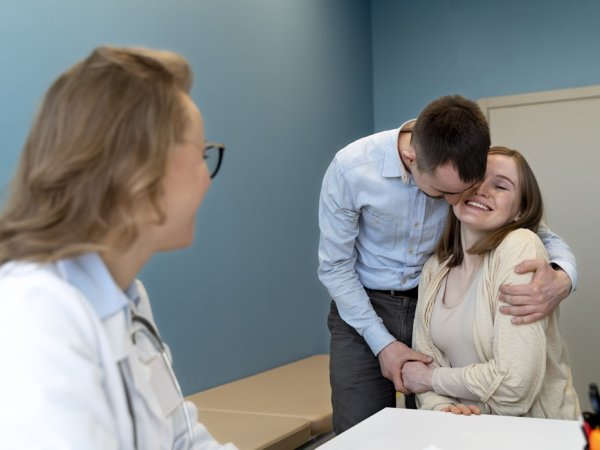
The partner should attend the initial consultation — many Bucharest clinics require both partners at the first visit, as the male fertility assessment is part of the same file.
Also recommended IVF in Bucharest 2026: Three Sources of Funding and How to Use Them at a Private Clinic
The Best-Known Fertility Clinics in Bucharest
1. Embryos – Fertility and Gynecology Clinic
Founded in 2020 by three experienced OB-GYN and assisted reproduction specialists — Dr. Ionela Anghelescu, Dr. Andreea Velișcu, and Dr. Tarig Massawi — Embryos has grown rapidly, contributing to the birth of over 800 babies and reaching a turnover of €6.5 million in 2023. The Embryos clinic has invested over €2 million in laboratory equipment, including a microTESE microscope described as unique in Romania at the time of acquisition, essential for severe male infertility cases. Partner of the National IVF Program.
Services: IVF, ICSI, PICSI, intrauterine insemination (IUI), micro-TESE, MESA, preimplantation genetic testing (PGT-A), hysteroscopy, cryopreservation, oocyte activation, endometrial PRP therapy, integrated psychological support.
Address: Str. Gheorghe Polizu nr. 58–60, Sector 1, Bucharest Phone: 021 9353 Website: embryos.ro
2. Gynera Fertility Clinic
The first clinic in Romania exclusively specialized in assisted reproduction, founded in 2007 by Dr. Laura Dracea. In 2019, Gynera joined the European FutureLife group, expanding its donor cell services. The clinic reports over 3,000 babies born since its founding and a 67% success rate within the national program.
Services: IVF, ICSI, intrauterine insemination, preimplantation genetic testing (PGT-A and PGT-M), egg and sperm donation, cryopreservation, embryo monitoring with EmbryoScope.
Address: Șos. Pipera nr. 43, Floreasca Park, Sector 2 Website: gynera.ro
3. Fertility Institute (formerly Columna) – Regina Maria Network
The largest IVF-dedicated center in Romania, with a team of 15 specialists and over 27 years of experience in assisted reproduction. Fertility Institute is the only center in the country with 5 ESHRE-accredited senior embryologists. In 2024, the team contributed to the birth of 359 babies. Reported success rate: 1 in 2 women under 35 and 1 in 3 women of advanced reproductive age achieved motherhood. Equipment includes AI-assisted embryo selection.
Services: IVF, ICSI, egg and sperm donation, genetic testing, cryopreservation, intrauterine insemination. Patients benefit from full Regina Maria integrated care.
Address: Str. Țepeș Vodă nr. 51 (corner of Str. Gheorghe Costa-Foru), Sector 2 Website: reginamaria.ro/clinici/fertility-institute
4. Umana Fertility
A clinic opened in 2023 with an investment of €3 million. Despite being relatively new, the team of senior doctors and embryologists has over 15 years of experience in the field. In its first year of activity, it recorded over 10,000 appointments and 442 IVF procedures — a record for a clinic at launch. Umana Fertility is a partner in both the National IVF Program 2025 and the Bucharest FIV3 Project 2025–2026. It offers integrated psychological support and all investigations under one roof.
Services: IVF, ICSI, intrauterine insemination, hysteroscopy, HyCoSy, genetic testing, spermogram, cryopreservation, nutritional counseling and psychological support.
Address: The Bridge II, Str. Sergent Constantin Ghercu nr. 1A, Bucharest Website: umanafertility.ro
5. SANADOR IVF Center
Opened in June 2023 following a €5 million investment, the SANADOR IVF Center operates within the SANADOR Floreasca Day Hospital and is led by Assoc. Prof. Dr. Nicolae Poiană — a university lecturer, Doctor of Medical Sciences, and senior OB-GYN specialist with over 40 years of experience, more than 10,000 deliveries, and hundreds of successful IVF cases over 15 years dedicated to assisted reproduction. The key advantage over standalone fertility clinics is its integration within the SANADOR ecosystem: patients have direct access to the largest private multidisciplinary clinical hospital in Romania, including a maternity ward and neonatal intensive care. Partner of the National IVF Program.
Services: IVF, ICSI, egg and sperm cryopreservation, ovarian and endometrial PRP therapy, intrauterine insemination.
Address: Calea Floreasca nr. 165, 2nd floor, Sector 1 Website: sanador.ro/fertilizare-in-vitro-fiv
6. Fertilia Clinic
With over 20 years of activity in assisted reproduction, Fertilia is one of the longest-standing fertility clinics in Bucharest. The most frequently mentioned doctor in patient reviews is Dr. Ruxandra Dumitrescu. The clinic is a partner in the National IVF Program and provides full assistance with subsidy applications. It also has a location in Ploiești.
Address: Str. Popa Nan nr. 111, Sector 3 Website: fertilia.ro
7. Genesys Fertility Center
A Romanian clinic founded in 2007, located in Sector 1, with a multidisciplinary team of senior physicians specialized in assisted reproduction, laparoscopy, hysteroscopy, maternal-fetal medicine, and obstetric ultrasound. The clinic reports that infertility can be successfully treated in over 95% of cases and claims to have contributed to the highest number of IVF-conceived babies nationally. Genesys offers full assistance with National IVF Program applications, including SMS notifications for patients.
Services: IVF, ICSI, assisted reproduction, reproductive surgery, urology, maternal-fetal medicine, ovarian rejuvenation, dermatology.
Address: Str. Căpitan Nicolae Drossu nr. 9, 2nd floor, Sector 1 Website: genesys-fertility.ro
8. Dacia Medical Center
Founded in 2010 on Bulevardul Dacia in central Bucharest, Dacia Medical Center is one of the most experienced assisted reproduction clinics in the capital. The clinic is led by Dr. Chadi Muheidli — a senior OB-GYN specialist with nearly 15 years of experience dedicated exclusively to assisted reproduction — alongside Dr. Denisa Nica (senior physician), Dr. Tarek Abdou, and Dr. Ciprian Pop-Began (specialists). The clinic's embryologist is Anastasio Argyriou. A distinctive advantage is Dr. Muheidli's availability for online consultations, particularly useful for patients outside Bucharest who want to discuss their situation before traveling. Partner of the National IVF Program, with full support for subsidy applications.
Services: Classic IVF, ICSI, artificial insemination, ovulation monitoring, embryo and oocyte cryopreservation, peripheral blood karyotype, andrology and urology testing.
Address: Bd. Dacia nr. 101 (near Piața Spaniei), Sector 2, Bucharest
When Should You See a Specialist?
Following standard medical guidelines: if you are under 35 and have been trying for over 12 months without success, it's time for a specialist consultation. Between 35 and 40 — after 6 months of trying. Over 40 — as soon as you decide you want to conceive.
Bucharest offers a mature fertility medical ecosystem, with well-equipped clinics, doctors trained to European and international standards, and significant public funding programs that can dramatically reduce costs. The first step remains the same regardless of clinic: an initial consultation to identify the cause of infertility and establish the right treatment plan.
Also recommended The best private clinics in Bucharest: Services and facilities