How Pharmacy No. 40 on Calea Călărașilor Disappeared, a Symbol of Communist Bucharest
By Bucharest Team
- Articles
- 09 SEP 26
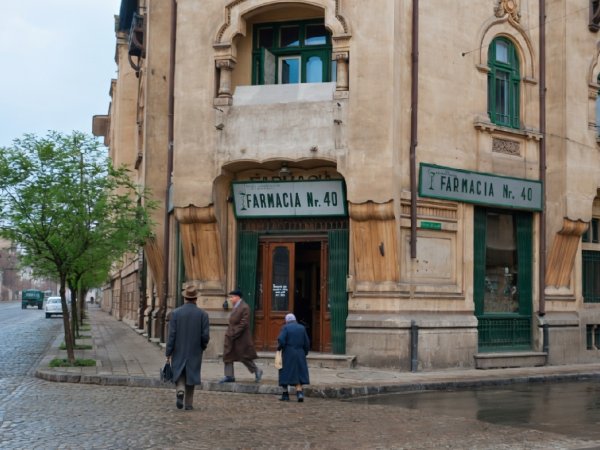
There are buildings in Bucharest that disappear in a single day, through demolition, and there are places that continue to exist physically but gradually lose their identity until their memory becomes almost impossible to recognize. The story of Pharmacy No. 40 on Calea Călărașilor belongs to the second category. The building has not disappeared from the city map, but the pharmacy that operated here and the atmosphere that made it famous were lost along with the transformation of its interior. For generations of Bucharest residents, Pharmacy No. 40 represented one of the landmarks of a historic area of the capital. During the communist period, when numerous commercial spaces were standardized and pharmacy numbers had become part of the familiar geography of the city’s everyday life, the name “Pharmacy No. 40” was enough for the residents of the neighborhood to know which place was being referred to. It was not merely a place where one could buy medicines. It was an interior with personality, with period furniture and an image that recalled a time when a pharmacy was conceived not only as a utilitarian space but also as a representative one. Today, this identity has been lost. The space has been transformed, and the old interior, with its furniture and the atmosphere specific to a historic pharmacy, no longer exists in the form that made it famous. At a time when the preservation of heritage buildings is being discussed more and more, the disappearance of Pharmacy No. 40 raises an essential question: what happens when the walls remain, but the heritage inside disappears?
A pharmacy that was more than a simple commercial space
Pharmacy No. 40 was not an isolated case in the landscape of old Bucharest. It belonged to a category of commercial spaces in which practical function was accompanied by an obvious concern for architecture and interior design. In Bucharest during the first half of the twentieth century, but also in the years that followed, a pharmacy could be a spectacular space, carefully organized and designed to inspire confidence.
The shelves, cabinets, display cases, and counters were not merely objects occupying an interior. They formed a permanent setting. The crafted wood, the compartmentalization of the space, and the proportions of the rooms contributed to the creation of a distinctive atmosphere. The pharmacist worked in a place that was meant to convey seriousness, rigor, and professionalism at the same time.
In the case of Pharmacy No. 40, it was precisely these elements that represented the most valuable part of its identity. In the urban memory of Bucharest, the pharmacy was associated with a period interior and an elegance that few commercial spaces managed to preserve until recent decades.
The pharmacy was also associated with a particular architectural tradition. Over time, it came to be regarded as a “sister pharmacy” of the famous Hotăranu Pharmacy on Vasile Lascăr Street. This connection was not accidental. The two spaces were perceived as belonging to the same aesthetic family, in which the pharmacy was not reduced to the simple function of a shop but was integrated into a broader conception of the city and the elegance of commercial space.
Such interiors had a special importance in a Bucharest where everyday life unfolded through a dense network of shops, cafés, bookstores, confectioneries, and pharmacies. Each of these places contributed to the identity of the street. In many cases, people did not remember only the address of a shop but also the color of its façade, its display window, or the furniture they passed every day.
The connection with the famous Hotăranu Pharmacy
In order to better understand what was lost in the case of Pharmacy No. 40, it is important to look at the Gheorghe Hotăranu Pharmacy, one of the most spectacular examples of pharmaceutical heritage preserved in Bucharest. The building on Vasile Lascăr Street, constructed in 1925 and designed by architect Statie Ciortan, has preserved a large part of its original furniture and equipment.
Inside the Hotăranu House, elements can still be seen that offer an image of an early twentieth-century pharmacy. The furniture made especially for this space, the display cases, cabinets, and working facilities were conceived as a unified ensemble. In this case, the building and its interior have remained connected to one another.
This is, in fact, one of the great differences between the Hotăranu Pharmacy and Pharmacy No. 40. While the former managed to preserve an essential part of its original universe and there are projects for its restoration and museum development, the latter lost precisely the elements that gave it personality.
In recent years, Pharmacy No. 40 has been remembered as a less fortunate “sister” of the Hotăranu Pharmacy. The comparison is suggestive not only because of the association between the two places in the memory of the city but, above all, because of the different fate of their heritage. One remained a time capsule. The other preserved the building but lost an important part of the memory of its space.
This difference demonstrates that heritage cannot be reduced to a façade. A building can survive while its heritage can nevertheless almost completely disappear. If interiors are radically altered, if the original furniture is removed, and if the proportions of a space are changed, the connection with the past becomes increasingly weaker.
How Pharmacy No. 40 became a landmark of communist Bucharest
The paradox of Pharmacy No. 40 is that its identity became strongly associated with communist Bucharest, even though the aesthetics of such a space referred to an earlier period. The communist regime radically changed the economic structure of the city, nationalized numerous properties, and reorganized trade. Pharmacies became part of a state-controlled system and were identified, for the public, through names and numbers.
In this context, the number 40 became part of the identity of the place. For the residents of Bucharest, Pharmacy No. 40 did not need a complicated introduction. It was simply the familiar pharmacy in the neighborhood, a landmark of everyday routes.
It is precisely here that one of the particularities of communist Bucharest can be found. Behind the new names and centralized organization, traces of the city from before communism continued to exist in numerous places. Some commercial spaces operated in old buildings, with inherited furniture and interiors that did not always fit the standardized image of the new era.
Pharmacy No. 40 was one of these places. Although it operated within the communist system and bore the number assigned by the administrative organization of the period, its interior preserved the image of another tradition. In this way, the pharmacy became a mixture of historical periods: an institution of communist Bucharest housed in a space that retained traces of the city of the past.
For the people who entered here every day, this overlapping of historical periods had become natural. The pharmacy was part of their present, but its furniture and atmosphere recalled a Bucharest that had survived political change.
The moment when the interior heritage disappeared
The disappearance of Pharmacy No. 40 should not be understood as the physical disappearance of the building. The walls remained, and the address still exists. What was lost is more difficult to measure and, precisely for this reason, easier to ignore.
With the disappearance of the old furniture and the transformation of the space, the pharmacy lost its historic atmosphere. The wooden cabinets, display cases, and the specific organization of the interior were not simply objects that could be replaced with modern furniture. Together, they formed an ensemble.
In a historic interior, value is not determined only by each individual piece. Sometimes, the true heritage lies in the relationship between the objects. The position of the counter, the way the cabinets follow the walls, the light falling on the display cases, and the proportions of the room create an atmosphere that is impossible to reconstruct after the original elements have disappeared.
In the case of Pharmacy No. 40, the transformation produced precisely this rupture. The space became a contemporary one, adapted to a different commercial function. For those who did not know the pharmacy before the change, it is difficult to imagine what once existed there.
This is one of the quietest forms of heritage disappearance. A building is not demolished, no photographs of bulldozers appear, and it does not necessarily provoke a public debate. One day, the interior is simply changed, and what made the place special disappears.
Small-scale heritage, the city’s overlooked problem
The story of Pharmacy No. 40 brings into discussion an important problem for Bucharest and for many other cities in Romania: the fragility of interior heritage.
Legislation and public debates focus, quite naturally, on historic monuments and valuable buildings. Façades, roofs, structural elements, and architectural volumes are protected and discussed more often. Much more vulnerable, however, are the objects found inside.
An old cabinet, a display case, a counter, a sign, wooden paneling, or a system of shelves can disappear much more easily than a building. Very often, owners or administrators consider these elements to be simple pieces of furniture without noticing that they are part of the historical identity of a place.
Pharmacy No. 40 is an eloquent example. Even if not all components of an old interior benefit from individual protection, together they can have considerable cultural value. Their loss can permanently alter the character of a space.
In a city such as Bucharest, where numerous urban transformations have already erased important parts of the past, small-scale heritage acquires even greater value. It is what preserves the details of everyday life. Through a pharmacy interior, people can understand what a particular way of working, building, and organizing a space once looked like.
Why the preservation of the Hotăranu Pharmacy makes the loss of Pharmacy No. 40 even more visible
Today, the project to restore and transform the Gheorghe Hotăranu House with Pharmacy into a museum provides an example of what the preservation of such heritage could mean. Instead of the original furniture and objects being removed to make room for a modern design, they are considered an essential part of the value of the place.
It is precisely this perspective that makes it possible to understand the true scale of the loss suffered by Pharmacy No. 40. If an interior such as the one at Hotăranu can become a living document about the history of the city and the profession of the pharmacist, then other similar spaces also deserved, before being transformed, to be regarded as something more than their immediate commercial function.
Not every old pharmacy has to become a museum. Not every interior has to be preserved intact. However, the transformation of a space with historical value should be preceded by serious documentation and, where possible, by the preservation of the elements that define it.
Pharmacy No. 40 can no longer be known today in the form in which previous generations knew it. Its story has remained, however, and it can become a warning about the fragility of urban heritage.
A building that remained, but a place that disappeared
So how did Pharmacy No. 40 on Calea Călărașilor disappear? Not through demolition. Not through a fire, nor through the disappearance of the building. It disappeared through a more discreet process: the loss of the interior that gave it its identity.
It is one of the most important lessons offered by this episode in the history of Bucharest. The city is not made up only of buildings. It is also made up of what exists inside them: furniture, details, objects, and atmospheres.
For decades, Pharmacy No. 40 was a landmark of Bucharest. During the communist period, its number became part of the city’s everyday memory. At the same time, its interior preserved a connection with an older tradition, in which the pharmacy was a space designed with care for both aesthetics and functionality.
Today, the old place exists mainly in the memories of those who knew it and in the images or testimonies that managed to preserve something of its atmosphere. The building survived, but Pharmacy No. 40, in the historical and cultural sense of the name, disappeared.
By contrast, the Hotăranu Pharmacy demonstrates how different the fate of a space can be when its furniture and interior are considered part of its heritage. One of the two “sisters” preserved its material memory almost intact and has the chance to become a museum. The other was left without the elements that gave it personality.
The story of Pharmacy No. 40 therefore remains more than the history of a disappeared pharmacy. It is the story of a Bucharest in which heritage can be lost without a single building being demolished. And it is a reason why, when we look at the old city, we should pay attention not only to walls and façades but also to what lies beyond the doors.
We also recommend: The history of the first pharmacies that appeared in Bucharest, with the private apothecaries that contained “the herbs useful for medicines”