How Bucharest Survived the Early Years of Communism: Tricks, Connections, and the Black Market
- Articles
- 12 JUN 26
On June 11, 1948, Romania woke up to a different economy. The nationalization law passed through the Grand National Assembly in a matter of hours — the draft had been presented to the government that morning and voted through unanimously by midday — and by evening, factories, banks, and transport companies had changed hands without a penny of compensation to those who had built them. A few months later, in November 1948, the state extended its control over cinemas and healthcare facilities. By 1950, pharmacies, chemical enterprises, and a significant portion of privately owned housing had also been absorbed into state ownership.
Bucharest had changed overnight. And with it, the rules by which daily life was supposed to work.
Morning in Front of an Empty Shelf
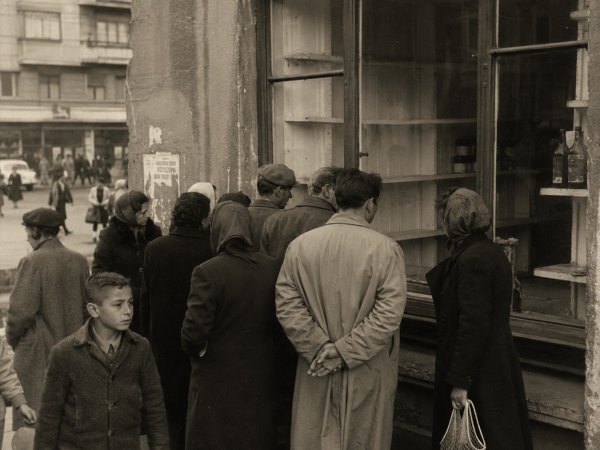
Food ration books had existed before — during the war years, when scarcity was explained by the logic of the front. What caught people off guard in the early years of communism was something else entirely: their persistence in an era that had promised abundance. Queues formed before dawn, sometimes the night before, outside state-run grocery stores. Meat, sugar, cooking oil, flour, eggs — all had entered a rationing system under which each family received a fixed monthly allowance, calculated by the number of household members. In theory. In practice, the products were often absent even for those holding valid ration books.
The morning smell of a Bucharest apartment block in the 1950s was roasted barley coffee — the only kind consistently available — and the faint sharpness of an onion kept on the windowsill. Real coffee arrived, when it did at all, through other channels.
Children were sent to hold places in the queue before sunrise. Bags and string nets were left on the pavement to mark a position in the owner's absence — an unwritten protocol observed out of necessity. Those who arrived later and found nothing left went home empty-handed, with a day spent and nothing to show for it.
PCR: Pile, Cunoștințe, Relații
The official acronym belonged to the Romanian Communist Party — Partidul Comunist Român. In the everyday speech of Bucharest residents, the same three letters had quietly taken on another meaning: pile, cunoștințe, relații — leverage, connections, relationships. The phrase traveled in whispers, accompanied by a knowing smile, and captured the city's actual operating system more accurately than any economic analysis could.
The network of personal connections was not a communist invention — informal ties had always existed in Romanian cities. What the regime had done was transform them from the exception into the rule. When official distribution worked poorly, or not at all, the personal network was the alternative. You knew someone at the bakery? Your bread was set aside before it reached the shelf. A friend had access to a state warehouse? A sack of sugar disappeared through the back door. Your brother-in-law worked at the local clinic? The prescription came through faster, and the medicine actually existed.
It was not corruption in the classical sense — money did not always change hands. More often what circulated was reciprocity: a favor for a favor, a service for a service. Sociologist Cătălin Augustin Stoica, in his research on social continuity across communism and post-communism, describes this informal network as a functioning parallel economy that filled the gaps left by centralized planning — gaps that the official system consistently failed to close.
What You Could Buy Under the Table
The black market operated in layers. The most visible and most accessible was food: eggs brought from the countryside by relatives, sheep's cheese that never made it to any shop, a chicken slaughtered in someone's yard and sold at free-market prices — two or three times the official rate, if the official rate had been available on any shelf at all. People arriving from the provinces carried with them whatever surplus their rural households could spare. The platforms of Gara de Nord smelled of smoked sausage and aged cheese, transported in leather bags buried under clothing — hidden in plain sight.
A layer below that were industrial goods: construction materials taken from socialist building sites, spare parts for appliances that were no longer manufactured, medications that had vanished from pharmacy shelves. Workers left construction sites in the evening with heavier pockets than they had arrived with — not out of premeditated calculation, but out of a survival logic that those who saw it and said nothing understood perfectly well.
The most opaque layer was currency. Holding foreign currency was illegal. This did not prevent its quiet circulation in certain Bucharest neighborhoods, in certain cafés, through certain acquaintances. American dollars and Swiss francs commanded a purchasing power that the official leu could not approach.
The House You Lived in Was No Longer Yours
Decree 92 of 1950 nationalized housing deemed surplus to the owner's family needs. The criteria were open to interpretation, applied unevenly, and often used as a political instrument. Families in the older Bucharest neighborhoods — Floreasca, Dorobanți, Cotroceni — found themselves legally entitled to a single apartment in a house their grandparents had built, with the rest passing into state management through the Housing Administration Enterprise, known as IAL, which administered tens of thousands of nationalized properties in Bucharest and across the country.
State-assigned tenants sometimes cohabited with the former owners, separated by a thin wall. The tensions generally went unspoken — not from goodwill but from caution. The Securitate, the secret police, operated through informants, and a disgruntled neighbor could at any moment become the source of a denunciation.
Some former owners arrived at compromises: they formally relinquished ownership but continued to live in the house, paying rent to the state for their own rooms. Others renegotiated informally with their new state-assigned neighbors in exchange for small advantages — a repair done quietly, a shared silence, a deliberately averted gaze.
Ingenuity as a Way of Life
The ordinary Bucharest resident — the one without connections, without anyone at the right place, without relatives in the countryside sending packages — developed a domestic engineering of survival. Whatever could be repaired was repaired. Shoes were resoled three times before being discarded. Clothes were remade: a man's overcoat could become a woman's coat through turning the fabric inside out and cutting it down. The burlap sack that had held sugar became a work garment.
Cooking adapted to what existed, not to what the recipe required. A bone broth, simmered for hours because bones were the only animal product available, filled the entire stairwell with its smell. Pickled cabbage, potatoes, cornmeal porridge — foods that fell outside the rationing system and could be found with some reliability — became the backbone of family cooking.
Relatives with land in the countryside became strategically important. The relationship with a cousin from Ploiești or an aunt from the Muscel region, maintained through letters and carefully timed visits, brought in autumn a supply of pickles, oil pressed at the local mill, and flour from a village mill that slipped below the radar of central planning.
What Changed Toward the Mid-1960s
The first period of maximum tightening — roughly 1948 to 1956 — gave way to a relative easing. Ration books gradually disappeared, supply improved, and for a few years in the early part of the 1960s, Bucharest shelves looked different. Historians who have studied this period — among them Dennis Deletant, in his work on the Gheorghiu-Dej police state — document this oscillation between restriction and relative normalcy as a deliberate mechanism of the regime: the tightening of the grip, the loosening, the rekindling of hope, the tightening again.
The informal mechanisms — the connections, the favors, the black market — did not disappear when supply improved. They had embedded themselves into the social reflexes of the city and would remain there for decades, outlasting the regime that had made them necessary.
Do you have parents or grandparents who lived in Bucharest during these years? Their personal stories are historical documents. Share them in the comments.
Also recommended What childhood looked like in Bucharest during the communist years, between 1960 and 1989