How “A Stormy Night” unfolded at the Union Garden in prewar Bucharest
- Articles
- 16 JAN 26
Prewar Bucharest was a city situated at the boundary between East and West, a space of contrasts, rapid transformations, and an increasingly animated social life. In this urban setting, summer gardens played an essential role in the social and cultural life of the capital. Among them was the Union-Suisse Garden, a seemingly modest place that might have disappeared without a trace from the city’s memory if it had not been immortalized by Ion Luca Caragiale in his famous comedy A Stormy Night.
The Union-Suisse Garden, a modest place with an intense life
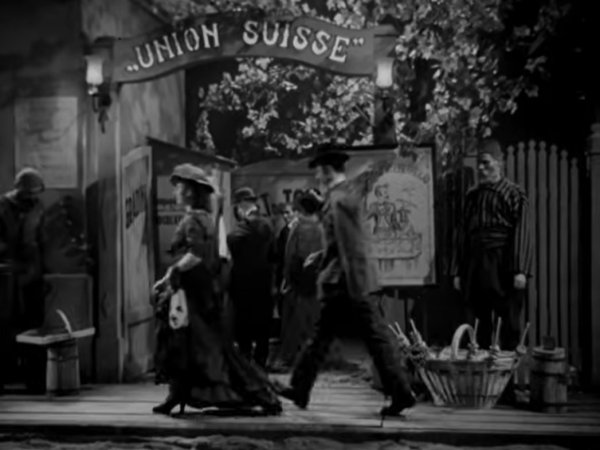
Through the playwright’s eyes, the Union Garden became the stage of events full of humor, jealousy, and ridicule, faithfully reflecting the morals of Bucharest residents in the second half of the nineteenth century. For Caragiale’s contemporaries, this space was not merely a theatrical backdrop, but a real, lively place, frequented by the public, where performances, music, and social encounters intertwined with the small dramas of everyday life.
The Union-Suisse Garden did not impress through size or remarkable architecture. Essentially, it was a relatively simple courtyard, with a few trees, tables set up for the audience, and a small house that hosted the Club of the Swiss colony in Bucharest. Here, club members and their guests would meet, mainly to play skittles, one of the most popular pastimes of the time.
During the summer season, the garden was rented to various variety troupes, which staged revue performances, an extremely popular genre in that era. These shows combined music, humor, songs, and satirical moments, attracting a diverse audience eager for entertainment. Although nothing seemed spectacular at first glance, the lively atmosphere and the accessibility of the place turned the Union Garden into a point of attraction in prewar Bucharest.
The decisive role of I. D. Ionescu in the garden’s fame
The fame of the Union-Suisse Garden is closely linked to the name of I. D. Ionescu, a singer, actor, and director of a variety troupe. He understood the potential of the place and invested time, energy, and resources to transform it into an attractive space for the Bucharest public. His ambition is clearly expressed in an announcement published in Curierul spectacolelor, three years before the appearance of the comedy A Stormy Night.
In that text, Ionescu expressed his hope that, after the efforts he had made to equip the garden with a proper stage, new sets, boxes for the comfort of families, and a military band, he would be supported by the honorable Bucharest public. The announcement reflects not only a desire for success, but also the beginning of a professionalization of urban entertainment, in an era when performances were still largely improvised.
A success that exceeded all expectations
The expectations of I. D. Ionescu were not only met, but greatly exceeded. In a short time, the Union-Suisse Garden became overcrowded due to the growing number of spectators. At each performance, approximately 200–300 people were left outside, unable to find a free seat. This success demonstrates the appetite of Bucharest residents for entertainment and their desire to participate in the cultural life of the city.
The audience was extremely diverse, ranging from merchants and clerks to small bourgeois and respectable families, all eager to spend a pleasant evening outdoors. The revue performances offered exactly what the public wanted: accessible humor, lively music, and recognizable situations inspired by everyday life.
The positioning of the garden in the heart of Bucharest
Another important factor in the popularity of the Union-Suisse Garden was its location. It was situated on Câmpineanu Street, behind the former National Theatre, one of the most important cultural institutions of the capital. The National Theatre had been inaugurated on December 31, 1852, and was located on Podul Mogoșoaiei, an artery that would become Calea Victoriei after the War of Independence.
Today, the Novotel Hotel stands on the site of the former National Theatre, and nearby is the Telephone Palace. The area was therefore a true cultural hub of prewar Bucharest. In the immediate vicinity was also the famous Oteteleșanu terrace, another renowned Bucharest garden, frequented by the city’s elites. In this context, the Union-Suisse Garden complemented the entertainment offer, addressing a broader public, but one equally eager for spectacle.
The transformation of the Union Garden into Caragiale’s “Iunion”
Ion Luca Caragiale was a keen observer of Bucharest life and a fine connoisseur of human typologies. In the comedy A Stormy Night, published in 1879, he transformed the Union-Suisse Garden into the famous “Iunion,” a space that became symbolic of the petty-bourgeois world of the capital. Through the character jupân Dumitrache Titircă, known as “Inimă-Rea,” the garden acquires a literary life of its own.
Dumitrache’s monologue about the evening spent at the “Iunion,” together with his wife and his sister-in-law Zița, perfectly captures the atmosphere of the place. Ionescu’s performances, the mixed audience, and the small incidents among spectators become a pretext for comic situations and for revealing the pride, frustrations, and ambitions of the characters. Caragiale does not invent an imaginary space, but starts from a reality familiar to his audience.
How an evening at the “Iunion” was experienced in prewar Bucharest
An evening at the Union Garden, as it emerges from Caragiale’s text, was a mixture of amusement, curiosity, and social tensions. Spectators came not only to see the comedies performed on stage, but also to see one another. The garden became a place of social display, where every gesture, glance, or incident could be interpreted and commented upon.
Ticket prices, overcrowding, and the close proximity of tables encouraged minor conflicts, insistent looks, or remarks with hidden meanings. All these elements are masterfully exploited by Caragiale, who captures the ridiculousness of situations without exaggeration, simply by faithfully reflecting reality. Thus, A Stormy Night is not only a comedy, but also a social document of prewar Bucharest.
The cultural legacy of the Union Garden
Although the Union-Suisse Garden no longer exists today, its memory has been preserved through literature. Without Caragiale, this place would probably have remained a mere footnote in the history of the city. Through A Stormy Night, the garden became a symbol of an era, a mentality, and a form of entertainment that profoundly marked the lives of Bucharest residents in the nineteenth century.
Today, when we read or see the famous comedy staged, we return imaginatively to that modest garden, crowded, noisy, and full of small passions. The Union Garden lives on not through walls or trees, but through the power of literature and through Caragiale’s ability to transform an ordinary space into a lasting cultural landmark.
We also recommend: Oteteleșanu Terrace, the “academy” of Bucharest’s 19th-century elite, where high society attended lavish balls and intellectual debates