Hotel Roma, Cinema Diana and the Ladies of the Boulevard. What Calea Griviței Looked Like in Interwar Bucharest
- Articles
- 02 MAR 26
In interwar Bucharest, Calea Griviței was one of the most animated arteries of the city, especially in the section located near the North Railway Station. The area functioned primarily as a space of passage: travelers arriving from the provinces, merchants on their way to other cities, officials, and soldiers on assignment crossed this part of the capital every day. The intense circulation generated a specific infrastructure, made up of hotels, restaurants, cafés, and various forms of entertainment intended for those who stayed in the city for short periods.
The transit artery around the North Railway Station
The presence of a large number of hotels in the area delimited by Griviței, Buzești, and Polizu was not accidental. The proximity to the North Railway Station created a constant demand for temporary accommodation. Many travelers needed only a room for one or two nights before continuing their journey. Under these conditions, buildings with mixed functions — hotels on the upper floors and commercial or entertainment spaces on the ground floor — became typical for this area.
Calea Griviței, however, was not only a place of transit, but also one of meetings. The boulevard was lively at any hour, and the atmosphere mixed discreet elegance with a degree of popular bustle. Around the hotels and cafés, small temporary communities of people in transit were formed. Here one could encounter hurried merchants, officials in uniform, or travelers spending their time before the departure of the train.
This social diversity gave the area a particular character. Calea Griviței was perceived as an intermediate space between the elegant center of the city and the working-class outskirts. Precisely this position made the street an ideal place for accessible and rapid urban services.
Hotel Roma – a landmark of Calea Griviței
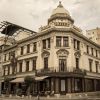
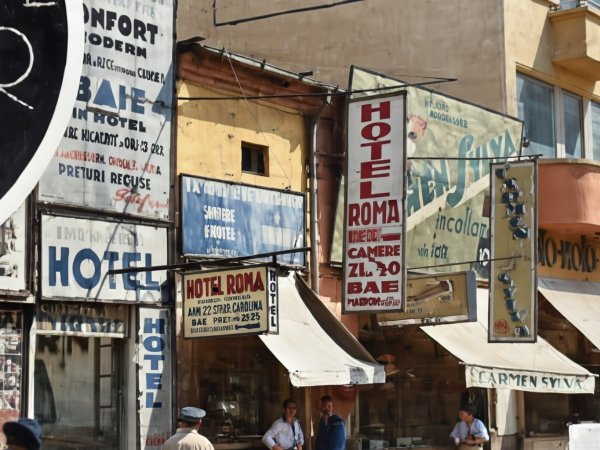
At number 110 on Calea Griviței stood Hotel Roma, one of the reference points of the area during the interwar period. The building, easily recognizable through the three decorative circles on the façade, was a typical example of a construction intended for commercial activities and accommodation.
The hotel appears documented in the 1920s, being mentioned in the Socec Yearbook from the period 1923–1924, in the section dedicated to hotels. The operation was attributed to Stutzer Ghedale, which confirms the existence of a business organized and integrated into the network of urban services of the period. In a city in continuous expansion, presence in such a yearbook represented a form of commercial legitimacy and visibility.
Hotel Roma was intended especially for travelers in transit. The proximity to the North Railway Station made it a convenient option for those who arrived late in the city or departed early in the morning. The rooms were not luxurious, but they offered the minimum comfort necessary for a short stay.
The building had an interesting particularity: the sign of the hotel extended also onto the façade of the neighboring building, located at number 108. This extension of the advertisement suggests that the owner of the hotel either purchased or rented the adjacent building, or obtained the right to use its surface for promotion. The practice was not unusual in crowded commercial areas, where visibility was essential.
The presence of an extensive advertisement indicated the importance of competition between hotels. Near the railway station there were numerous similar establishments, and each tried to attract customers through visible displays and easily remembered names. The name “Roma” suggested elegance and cosmopolitanism, qualities appreciated in a city that aspired to be perceived as a modern capital.
Cinema Roma and the transformation into Cinema Diana
Hotel Roma was not only a place of accommodation, but also a space of entertainment. Inside the building there functioned a cinema hall initially known under the name Cinema Roma. This association between hotel and cinema was characteristic of transit areas, where travelers needed quick ways of spending their free time.
Cinema Roma functioned, with some interruptions, until December 1934. At that moment, the hall was renamed Cinema Diana, a name under which it continued to exist until June 1948. The change of name probably reflected a commercial strategy meant to refresh the image of the establishment and to attract a new public.
The hall had a modest capacity: approximately 150 seats and another ten benches. The relatively small dimensions suggest a neighborhood cinema intended for a varied public. Here came not only the clients of the hotel, but also the inhabitants of the surroundings or the travelers waiting for the train.
The program of the cinema was probably adapted to the rhythm of the area. Evening screenings attracted the local public, while daytime shows were attended by those in transit. The cinema offered an accessible and rapid experience, suitable for people who did not have much free time.
The closing of Cinema Diana in 1948 was connected with the process of nationalization that radically changed the structure of urban property. Many private businesses disappeared then, and small cinemas were reorganized or abolished.
Advertising and the image of the city
The façade of Hotel Roma represented an important element of the urban landscape. The advertisements of the hotel and of the cinema occupied a visible surface not only on the main building, but also on the neighboring property. In an era in which street advertising was becoming increasingly important, these inscriptions contributed to the visual identity of the street.
Calea Griviței was a place where the gaze of the traveler quickly encountered names of hotels, restaurants, or shops. Large and visible inscriptions had the role of orienting visitors and convincing them to stop. In the absence of modern means of promotion, the façade of the building became the main advertising instrument.
The presence of extended commercial signs also shows the pragmatic character of the area. It was not a space of monumental elegance, but one of efficiency. Buildings had to be easy to recognize and easy to use.
Hotel Roma and Cinema Diana illustrate this urban logic. They combined different functions in a relatively limited space and responded to the needs of a population in movement.
Everyday life on the boulevard
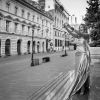
Besides hotels and cinemas, Calea Griviței was populated by diverse characters. The street was known for its lively atmosphere, in which people from different social environments met. Among them were also the elegant women who walked along the boulevard, attracting the attention of passersby.
The presence of these “ladies of the boulevard” formed part of the typical image of the area. Some were simple passersby, others were connected to the nightlife of the city. They contributed to the reputation of Calea Griviței as a lively and sometimes controversial space.
The street was not perceived exclusively as a commercial area. It was also a place where people came to look and to be looked at. Walking on the sidewalk became an urban ritual, and accidental meetings were frequent.
This social dimension completed the practical function of the street. Calea Griviței was simultaneously an artery of circulation and an urban stage on which everyday life unfolded.
After the disappearance of the cinema
After 1948, the building of the former cinema went through significant changes. Although in the 1950s the possibility of reopening the cinema hall was discussed, the plan was not realized. The economic and administrative transformations of the period led to the use of the space for other purposes.
In the 1960s, in the former cinema there functioned the Workers’ Club of the employees of Construction–Assembly Enterprise No. 4. This change reflects the orientation of the new authorities toward the use of urban buildings for collective and educational purposes.
The fate of the building illustrates the transformations of Bucharest in the second half of the twentieth century. Spaces initially intended for commercial entertainment were adapted to the new social and economic realities.
Hotel Roma and Cinema Diana thus disappeared from the landscape of the city, but their memory remains connected to the period in which Calea Griviței was one of the most animated arteries of the capital.
During the interwar period, this street was a place where travel, entertainment, and everyday life met. The hotels, cinemas, and characters who populated the boulevard formed a complex picture of a Bucharest in continuous movement. Calea Griviței was not only a street, but a space that reflected the dynamism and diversity of the interwar city.
We also recommend: The history of the grand Marmorosch Bucharest Hotel, the palace that once housed the most influential bank of 19th-century Romania