Gellu Naum started writing poetry after he lost a bet and fell in love with his wife during a hypnosis session
- Articles
- 22 DEC 25
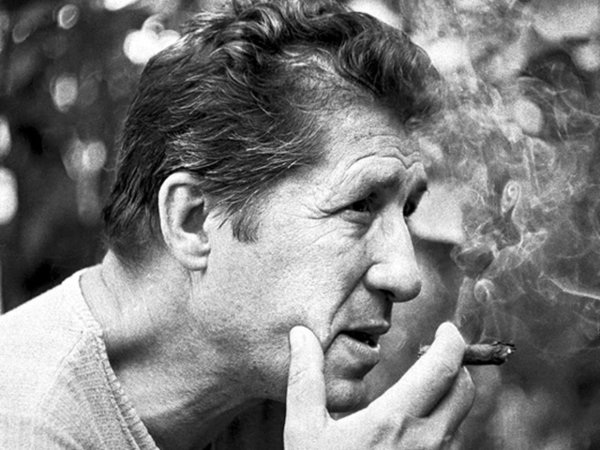
There are lives that seem to be written in advance, following an implacable logic, and others that are built from happy accidents, from apparently minor gestures that end up changing a destiny forever. The story of Gellu Naum undoubtedly belongs to the second category. Poet, prose writer, and one of the central figures of Romanian surrealism, Gellu Naum discovered poetry not as a solemn calling, but as a challenge launched in a classroom, following an adolescent bet.
A literary destiny born from play, courage, and chance
And the love of his life did not appear under the sign of a romantic lightning strike, but was built slowly, mysteriously, through a succession of unusual encounters, culminating in a hypnosis session that would unite their destinies forever.
The love story between Gellu and Lygia Naum is one of those histories that defy simple explanations. For 60 years, the two formed an almost mythical couple, bound not only by affection, but by a form of profound communion, difficult to describe in ordinary terms.
They stood by each other in moments of fulfillment, but especially in those of suffering, proving that authentic love can become a force of survival.
Childhood, school, and the beginnings of an unexpected vocation
Gellu Naum was born in Bucharest, on August 1, 1915, in a hospital ward in the Capital. He was a dark-haired child, with gentle features and dimples in his cheeks, and his parents, the writer Andrei Naum and his wife, welcomed him with natural joy. Nothing at that time foreshadowed the exceptional literary destiny that awaited him.
The years of childhood and adolescence found him passionate about words and stories. At the “Dimitrie Cantemir” National College in Bucharest, his talent for language became evident. However, poetry did not initially appear as a life ideal, but as a game.
Following a bet with his classmates, Gellu Naum began to write verses, and the exercise, started as a youthful bravado, quickly turned into a revelation. Two of his poems were published in the magazine “Cuvântul,” a moment that confirmed for him that writing could be more than a pastime.
This first validation determined him to deepen the study of philosophy at the University of Bucharest, where he formed a complex, abstract way of thinking that would decisively influence his literary work. His desire for knowledge took him, in 1938, to Paris, where he continued his studies at the Sorbonne, coming into direct contact with the great intellectual currents of the time.
War, the return home, and the encounter with love
In 1939, Gellu Naum returned to Romania, but the calm of his homecoming was short-lived. Shortly afterward, he was mobilized and sent to the Eastern Front, in the context of the Second World War. The experience of war marked him deeply, adding a grave, existential dimension to his work.
In this tense context, Lygia also appeared, the woman who would become his wife and life partner. Their first meeting was not a spectacular one, but took place at a party, following a social game. Provoked by circumstances, Gellu Naum kissed the young woman who had caught his attention, without knowing that this apparently banal gesture was opening an extraordinary love story.
Fate brought them together again in a completely unusual setting: a hypnosis session organized at the house of a mutual friend. Surprisingly, Gellu Naum was the only one capable of hypnotizing Lygia, a detail that would later acquire a profound symbolic value. It was as if their bond went beyond the rational plane and manifested itself in a subtle, hard-to-explain zone.
Love sealed in wartime
In February 1943, in the middle of the war, Lygia felt an imperative need to see Gellu again, who was in Constanța. The journey was not simple, authorizations were difficult to obtain, and conditions were hostile.
Nevertheless, on February 14, at midnight, Lygia reached the address where the poet was staying. Their meeting, which took place in the cold of a modest room, symbolically meant the reunion of two halves that had been searching for each other without knowing it.
A year later, convinced that he could not live without her, Gellu Naum asked her to marry him. His gesture was simple and direct, but charged with authentic emotion. The two married in 1946, laying the foundations of a couple that would last six decades.
A relationship beyond the ordinary limits of understanding
Their life as a couple was unconventional, built on complicity, play, and creation. Lygia learned, out of love for her husband, to draw blindfolded, accepting and exploring the surrealist universe that defined his existence. Gellu Naum, in turn, transformed her into a literary muse and dedicated to her the novel Zenobia, one of his most personal works.
The two seemed to function in a form of almost telepathic synchronization. They thought about the same things, completed each other’s sentences, and lived love as a total experience, without clear boundaries between the individual and the shared.
Sacrifice, illness, and absolute loyalty
In 1989, Gellu Naum suffered a heart attack and was hospitalized for a month. He was 74 years old, and his state of health caused fear and uncertainty. In an extreme gesture, Lygia decided to make a symbolic sacrifice: she shaved her head, as a form of offering and solidarity.
A few days after this act, the poet’s health began to improve, and the episode remains one of the most disturbing proofs of the bond between the two.
Although her hair never grew back the same way, Lygia did not regret the decision for a moment, considering it a necessary sacrifice for saving the man she loved.
The final years and the legacy of an exemplary love
Gellu Naum passed away on September 29, 2001, at the age of 86, with Lygia by his side in his final moments. Shortly after his loss, she went completely blind, and many said that grief stole the light from her eyes. Even so, at the age of 80, she continued to honor his memory, founding the Gellu Naum Foundation and the Memorial House in Comana and taking care to publish several posthumous volumes of her husband’s work.
Lygia Naum died three years later, at the age of 83, leaving behind not only an important cultural legacy, but also one of the most moving love stories in Romanian literature, proof that true love can transcend time, illness, and even death.
We also recommend: Grigore Alexandrescu, the orphaned poet who went insane four days after his own wedding, has a street named after him in Bucharest