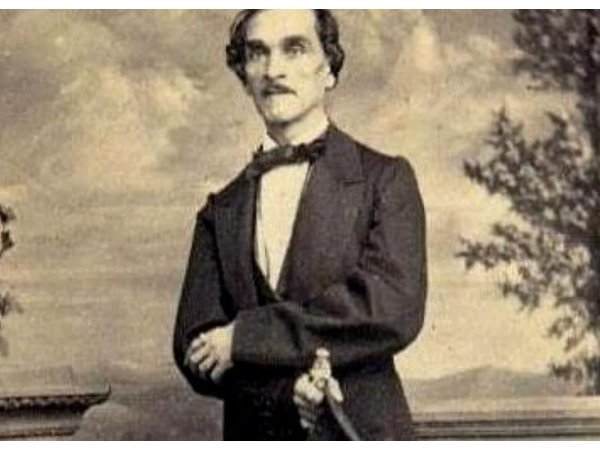
Grigore Alexandrescu, the orphaned poet who went insane four days after his own wedding, has a street named after him in Bucharest
- Articles
- 02 DEC 25
The life and destiny of Grigore Alexandrescu represent one of the most impressive and, at the same time, most dramatic stories in Romanian culture. A poet, prose writer, and enlightened spirit of his era, he moved through existence like a flame that burns intensely but extinguishes too soon. Although his name remains written in golden letters in Romanian literature, few know the magnitude of the personal tragedy that marked his fate and pushed him into a suffering that lasted a quarter of a century. Today, his memory is honored not only through the works he left behind but also through the street that bears his name in Bucharest—a symbolic gesture meant to remind passersby of his cultural legacy.
The early years and his path toward literature
Grigore Alexandrescu was born on February 22, 1810, in Brașov, into a modest family, being the fourth child of treasurer Mihai Alexandrescu and Maria Fusea. His childhood was not free of hardship, and fate had a cruel blow prepared for him early in life.
At only 17, he was left an orphan without both parents and was sent to Bucharest under the care of his uncle, Father Ieremia. This uncle, an educated man with a love for culture, was the first to notice the young man's literary sensitivity and encouraged his passion for reading and writing.
Once he arrived in the capital, young Grigore enrolled at the prestigious Saint Sava National College, where he became classmates with Ion Ghica and where he would shape his future as an intellectual. His education there opened new horizons, and access to the works of universal literature helped him develop a style that soon became recognizable.
Literary affirmation and early influences
Even in childhood, his talent began to show, and once in Bucharest he caught the attention of Ion Heliade Rădulescu, one of the central figures of Romanian culture. Under Heliade’s guidance and influence, Alexandrescu began publishing his first creations in newspapers and magazines of the time. In an era when Romanian literature was still searching for a clear identity, the young poet stood out through the sensitivity of his writing and the depth of the emotions he conveyed.
His poems were distinguished by careful observation of the inner world, melancholy, and introspection, while his prose captured the fundamental dilemmas of human existence. Grigore Alexandrescu did not shy away from tackling grave themes such as suffering, impossible love, or the fleeting nature of life. His attention to character construction established him as one of the most important writers of his generation.
The love that changed his destiny
Although his life was marked by loneliness and material hardship, the poet found, for a brief period, peace and happiness in the arms of Raluca, the woman who became his wife. Their marriage represented, for him, the beginning of a new chapter—a promise of stability and love after years of inner turmoil. However, fate, which had tested him since adolescence, proved once again to be merciless.
Only four days after the wedding, a terrible illness struck the poet, clouding his mind and altering his existence forever. The sudden psychological collapse threw him into a state of confusion and suffering that lasted for twenty-five years, until his death. Critic George Călinescu described this period as an endless oscillation “between error and lucidity, or at least between dignity and an atrocious sense of humiliation and shame.”
The tragedy of a brilliant mind
By 1860, his illness had advanced so severely that the institutions of the time could no longer maintain him in public office. On June 14, he was removed from the Central Commission for “serious illness, which renders him unable to hold this position,” being replaced by Gr. Arghiropol, as historian Horia Dumitrescu noted. This removal officially acknowledged the decline of a once-bright mind now imprisoned by suffering.
Yet despite his frail body and weakened mind, Grigore Alexandrescu did not completely abandon the written word. In his rare moments of lucidity, he continued to write, reflect, and search for meaning in the chaos surrounding him. This intellectual resistance—this struggle to remain connected to literature even in his darkest hours—remains one of the most impressive proofs of his creative strength.
His final years and the legacy he left to Romanian culture
The poet passed away at the age of 75, after prolonged suffering that kept him far from the world and from his own former glory. At his funeral, Vasile Alecsandri, his close friend and contemporary, uttered words that remain in literary memory as a warning against forgetting: “The death of poor Alexandrescu did not grieve me so much (for he had been dead for many years), but what saddened me was the indifference of the current generation toward him and the oblivion into which his once-brilliant name had fallen.”
Alecsandri’s words reflect a painful truth: society had forgotten too quickly the poet’s contribution, and his personal tragedy overshadowed public appreciation. However, time has repaired this injustice to some extent.
Today, Grigore Alexandrescu’s work is considered fundamental to the development of modern Romanian literature, and his name is honored through textbooks, critical editions, and literary studies.
Where is Grigore Alexandrescu Street located in Bucharest
At present, in Bucharest there is a street that bears his name, a symbolic homage brought to the poet who influenced generations of readers. Located in Sector 1 of the Capital, Grigore Alexandrescu Street intersects with Lascăr Catargiu Boulevard, in the immediate vicinity of Calea Victoriei, thus becoming an urban landmark filled with cultural significance.
This street is not merely a simple name, but a symbol meant to remind passersby of the sacrifice, talent, and troubled destiny of a man who loved literature until his final moment. His struggle with illness, his broken love, and his uncontested genius form a story that inspires and moves.
His work is still studied, interpreted, and admired for its sensitivity, depth, and ability to capture the essence of humanity. Through his writings, Alexandrescu intertwined the fragility of the human soul with the power of the written word, leaving a lasting mark on Romanian culture.
Thus, Grigore Alexandrescu—the orphan who found in literature his ultimate refuge and who faced a life full of trials with dignity—remains one of the brightest figures in Romanian literature.
His tragic yet uplifting destiny continues to serve as a lesson about the fragility of the human condition, the power of creation, and the resilience of the spirit in the face of suffering. In collective memory, he will forever remain the sensitive poet, the quiet visionary, and the noble soul who confronted, with stoicism, an unjustly shattered fate.
We also recommend: The most unique “Mărțișor” in Bucharest. The Tudor Arghezi Memorial House, in whose courtyard the poet’s entire family is buried