From the Bucharest slum to the stages of Japan and the USA. Romica Puceanu, the history of the queen of Romanian Gypsy music
- Articles
- 17 FEB 26
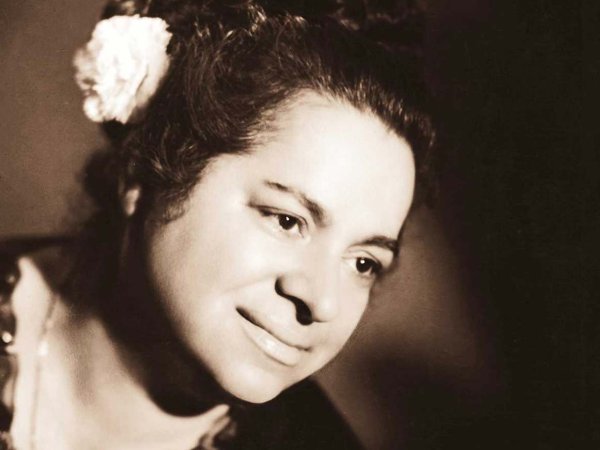
The destiny of Romica Puceanu seems taken from a dramatic novel, in which glory and suffering intertwine without mercy. Rightfully considered the queen of Romanian lăutărească music, the artist started from the slums of Bucharest and reached the great stages of the world, from Japan to the United States of America. She was an unmistakable voice, a magnetic presence, and a symbol of Roma authenticity in a period when lăutărească music was not fully accepted or promoted by the regime. Her life ended tragically, following a road accident that took place in Călărași County, while she was heading to a wedding in Constanța. Her death, which occurred only a few days after the impact, left an immense void in the souls of those who loved and admired her. But Romica Puceanu’s story is not only about an unjust end, but about an impressive ascent, about talent, dignity, and identity pride.
Childhood in the Bucharest slum and the first steps in music
Born in 1928, into a Roma family from Bucharest, Romica Puceanu grew up in an environment where music was part of everyday life. She came from a family of singers, and the sound of lăutari was familiar to her from childhood. The slum, with all its shortages and hardships, offered her something essential: direct contact with authenticity, with the pure emotion of popular song, and with the stories of simple people.
At only 14 years old, she stepped onto the stage for the first time, in various venues in the Floreasca and Herăstrău areas. She was a determined teenager, convinced that only through work and perseverance could she carve a path for herself. Her voice already had a special strength, and her interpretation was charged with a surprising maturity for her age.
Slowly but surely, she began to establish herself in the ensemble Frații Gore (Aurel and Victor), her relatives, where she performed “slum songs.” Her repertoire, built from life stories, unfulfilled loves, and deep longings, quickly reached the hearts of the audience. The road to consecration, however, was not without obstacles.
During the communist period, lăutărească music, especially that performed by Roma artists, was not encouraged to enter people’s homes. The regime favored light music and officially approved performers. Even so, Romica Puceanu’s talent was too great to be ignored.
The rise of a unique voice during the communist years
Only in the 1960s–1970s did the artist truly begin to assert herself in the guild. Her voice, deep and at the same time velvety, became unmistakable. Her first record was made in 1964, in the Electrecord studios, together with the ensemble Frații Gore. For many, this moment marked the beginning of her official recognition.
Her songs – “Şaraiman,” “Aş munci la plug şi coasă,” “Florăresele,” “Anii mei şi tinereţea,” “Ia mai dă o damigeană,” “Ileană, Ileană,” “Eu de când te-am cunoscut” – became true anthems of party music and drinking songs. In a period when lăutărească music was often marginalized, her pieces circulated secretly, were listened to in restricted circles, and were intensely appreciated.
It is said that American students were learning about her, and an anthropology professor from the USA compared her to the famous Cesaria Evora. Her album “Chansons Tziganes” reached major music stores abroad, being presented in languages such as English, French, or German. For that period, the fact that a lăutărească music artist from Romania became known in the USA or Japan was extraordinary.
She undertook tours in the USA, Japan, China, Israel (together with Doina Badea), and the GDR. She performed in prestigious Bucharest restaurants – Caraiman, Capitol, Continental, Monte Carlo in Cișmigiu, Intercontinental, Hotel Flora (today Crowne Plaza). The audience received her like a queen.
The queen of drinking songs and the magnet of Bucharest restaurants
In restaurants, the atmosphere changed radically when Romica Puceanu entered. The accordionist Viorel Fundament recounted that people became attentive, stopped eating, and watched her as at a show. It was an honor for customers if the artist came to their table to sing to them. There were evenings when, as he remembered, the mere fact that she put her hand on the microphone was enough for money to start flowing.
Even so, Romica advised her colleagues to preserve their dignity. She told them not to bend down to pick up banknotes fallen on the floor, to keep their personality. She did not boast about her earnings and did not flaunt her wealth. She was proud of her origins and of the authentic Gypsy music she promoted without compromise.
The clarinetist George Udilă remembered her generosity, especially toward the young. She had a big heart, helped without expecting anything in return, and was recognizable among a thousand women by everything she did.
On stage, she could move from heart-rending songs to melodies that brought the hall to its feet. At weddings, parties became legendary: gentlemen were left without shoes, ladies without heels, and her energy seemed inexhaustible. For the Roma community, Romica Puceanu became the equivalent of Maria Tănase – an emblem of identity and cultural pride.
Friendships, loves, and the stage of the “Constantin Tănase” Theater
Her talent also brought her to the stage of the “Constantin Tănase” Review Theater, where she shared the spotlight with great names such as Stela Popescu, Alexandru Arșinel, and Nicu Constantin. Solid friendships were formed between them, based on respect and mutual admiration.
Her sentimental life was often discussed. It is said that among her loves was Bebe Șerban, known as Bebe from Petrăchioaia. There were rumors about a closeness between her and Ion Onoriu, before he married Gabi Luncă.
The accordionist Andrei Mihalache recounted that Romica was also in love with Amza Pellea. He remembered how the artist would arrange herself emotionally when she learned that he was about to come to the venue. When the great actor appeared, they embraced and spent time together, a sign of a beautiful and respectful relationship.
In 1986, Romica Puceanu moved to New York, continuing to sing for the diaspora and for international audiences. In 1992 she returned to the country, where she was received with the same love.
The accident that ended a legend
The morning of October 24, 1996, was to be fatal. Romica Puceanu was heading from Bucharest to Constanța, where she was to sing at a wedding. In the minibus there were four other people, including two lăutari and the driver’s child. The artist was sitting on the back seat, in the middle.
Near the locality of Dragoș Vodă, in Călărași County, a Greek citizen entered head-on into the minibus. The impact was devastating. Of all the passengers, only Romica Puceanu lost her life. She was initially transported to the Municipal Hospital in Fetești, then to the Floreasca Emergency Hospital in the Capital, where doctors decided on an emergency surgery. The efforts were in vain. Two days later, the queen of party music passed away on a hospital bed.
The investigation showed that the driver responsible was traveling at approximately 48 km/h and had not consumed alcohol. A single moment was enough to break a life and close an impressive career. Just before the accident, the artist was preparing for a concert in Paris.
Romica Puceanu was buried at Izvorul Nou Cemetery, in the area known as the lăutari alley, alongside great musicians such as Nicușor Predescu, Fărâmiță Lambru, and Ion Albeșteanu. At her funeral, the ensemble led by Ion Albeșteanu sang for her, in a final tribute to a voice that marked generations.
Today, Romica Puceanu’s name is spoken with reverence by contemporary lăutari. She has remained the symbol of an authentic art, of dignity, and of a voice that transformed the slum into a world stage. Beyond the final tragedy, her musical legacy continues to live, proving that true talent knows no borders.
We also recommend: Ioana Radu, the queen of Romanian romances. Ceaușescu’s favorite loved motorcycles and reached the altar five times