Forgotten history of Bucharest: How the Customs Complex and Târgoviște Station disappeared
- Articles
- 04 DEC 25
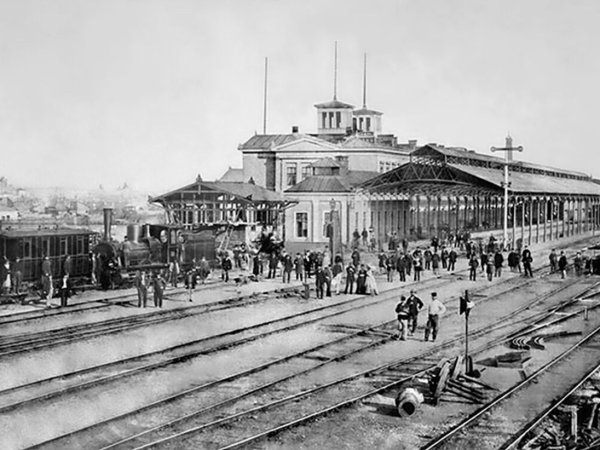
The evolution of Bucharest at the end of the nineteenth century is inseparably linked to the modernization of transport routes, and the inauguration of Târgoviște Station in 1872 was one of the decisive moments that shaped the future of the Capital. The opening of this railway gate did not represent only an engineering achievement, but also triggered an administrative reorganization of the entire surrounding area, forcing local authorities to rethink the way in which goods, people and commercial flows entered the city.
The origins of a forgotten urban transformation
Until that moment, Bucharest’s customs activity had been carried out in improvised or unsuitable spaces, such as the old customs building on Calea Moșilor or the installations located on Podul Mogoșoaiei. The emergence of the railway radically changed these practices.
Because the new train line attracted a growing volume of goods, it became imperative to move the Customs Office in order to synchronize it with the economic dynamics brought by modern transport. Thus, the appearance of Târgoviște Station led directly to the need to create a new customs point, properly organized and able to meet the new logistical requirements.
The rise of the Customs Complex at the edge of the city
The new Customs Complex was built on the land previously known as the Outer Market Field, also called the Mircea Field — an area traditionally associated with trade activities and periodic fairs. Its location was not accidental: it allowed rapid access to the railway, while offering enough space for the expansion of the necessary buildings and annexes.
The role of the customs installations was essential. They ensured the control of goods arriving on the new railway line, the calculation and collection of customs duties, and even sanitary quarantine in the case of suspicious merchandise. The complex was not limited to simple administrative offices. It represented an extensive structure which included:
– Customs Warehouses, large covered spaces intended for the unloading and inspection of goods arriving in the Capital.
– Magazines and bonded depots, secure storage areas used to hold merchandise until the completion of the customs procedure.
– Auxiliary buildings, such as inns and resting houses used by carriers, merchants and commercial agents who circulated between the country’s major economic centers.
In this way, the Customs Complex became a nodal point of Bucharest’s commercial life. It functioned as a space where the interests of the state intersected with those of major merchants, where taxes were negotiated, and where the economic pulse of the Capital could be felt in a direct and tangible way.
The decline of the Customs Office and the ambitions of a modern capital
The decline of the Customs Office near Târgoviște Station started at the beginning of the twentieth century. As railway traffic intensified and commercial flows multiplied, the existing infrastructure became insufficient. The warehouses were too small, the administrative spaces too crowded, and the older constructions no longer met the needs of a rapidly expanding city.
At the same time, the urban plans of the Capital — increasingly influenced by French cities and by the ideal of the “Little Paris” — considered that the ensemble of warehouses, depots and utilitarian buildings created a chaotic and unattractive image at the entrance to Bucharest. The authorities wanted a modern, orderly and elegant city, and the Customs Complex, with its permanent bustle, carts and merchandise, no longer fit into this vision.
Thus, between 1910 and 1930, the Customs buildings were gradually decommissioned and then demolished. What had once been one of the most important logistical points of the Capital was removed from the urban landscape. The space thus freed was used to widen the square in front of the station and to create new access boulevards, meant to give Bucharest a modern façade in line with European standards.
A sacrificed heritage and a vanished urban identity
The disappearance of the Customs Complex from the area around what is now Gara de Nord represents a classic example of urban sacrifice, in which the city’s initial economic function was subordinated to aesthetic and modernization imperatives. The utilitarian character of the place was eliminated in favor of a grand esplanade meant to elevate the prestige of the main railway terminal of Romania.
Although the old customs buildings no longer exist today, their history remains a silent testimony to a period in which Bucharest radically redefined itself. The transformation of the space reflects the way in which the Capital balanced economic needs with urban ambitions, choosing, at that time, to prioritize architectural clarity and the desire for a modern public image.
The story of the Customs Complex and Târgoviște Station is, therefore, more than a simple episode of urban reorganization. It is a chapter in the broader history of a city that has constantly sought to reinvent itself, sometimes at the cost of erasing entire pieces of its material and cultural heritage. Today, only old maps, archival documents and a few photographs remind us of the existence of this essential node of nineteenth-century commerce, swallowed by the great transformation of Bucharest into a metropolis of the twentieth century.
We also recommend: The past of Gara de Nord: from Europe’s gateway to an overburdened hub