Famous Houses of Bucharest: Monteoru House, the Architectural Jewel of Belle Époque Bucharest: From the Oil Magnate to the Writers’ Union
- Articles
- 01 OCT 26
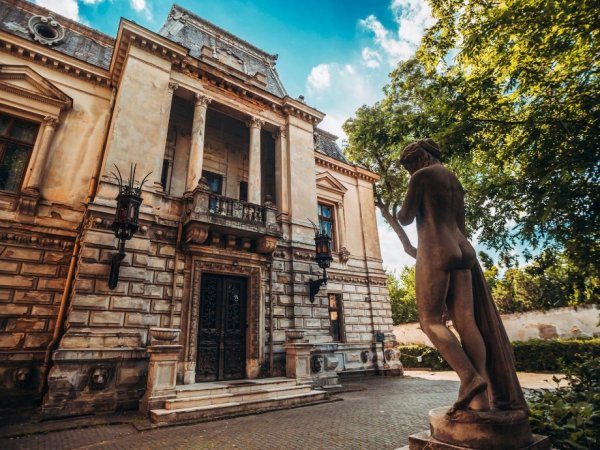
On Calea Victoriei, one of the most important historic thoroughfares of Bucharest, Casa Monteoru is today hidden behind a garden with mature trees, away from the bustle of the street. At number 115 Calea Victoriei, however, stands one of the residences that can best tell the story of the transformation of the capital into a modern, cosmopolitan and prosperous city at the end of the 19th century. The building is connected to the name of Grigore Constantinescu-Monteoru, a major landowner and industrialist associated with the development of oil exploitation in the Buzău area, but also to the architects Ion Mincu and Nicolae Cuțarida, who gave it the spectacular appearance we know today. The story of the building does not stop with the glory of the Belle Époque. After being one of the representative private residences of Bucharest’s elite, the house went through a complicated period in the years following the Second World War. It first came to be associated with ARLUS, a pro-Soviet organization, and in 1952 became the headquarters of the Writers’ Union of Romania. For decades, its salons were associated with Romanian literary life, before the property became the subject of a lengthy restitution process and was returned to the heirs.
From Alecu Niculescu to Grigore Monteoru
The history of Casa Monteoru begins before the name of the oil magnate became associated with the property. The building was erected around 1873–1874 for Alecu Niculescu, at a time when Calea Victoriei was becoming increasingly important for the aristocracy and upper bourgeoisie of the capital.
The house was to radically change its appearance and status after it was purchased, in 1883, by Grigore Constantinescu-Monteoru.
Monteoru was one of the representative figures of the rising bourgeoisie in Romania during the second half of the 19th century. Originally from a family of Greek origin, he became an important landowner in the Buzău area and became involved in the exploitation of oil resources. His name also remained connected to the resort of Sărata-Monteoru, whose development he decisively contributed to. He was also a deputy and senator and was part of the political and economic world of the period.
Once he acquired the house on Calea Victoriei, Monteoru wanted a residence worthy of his social position and accumulated wealth. In 1887, work began on transforming the building, and the project is associated with the architects Ion Mincu and Nicolae Cuțarida. The two architects significantly altered the building, giving it the appearance that has made it famous.
Therefore, Casa Monteoru was not a building erected entirely by Ion Mincu, as is sometimes claimed, but an older house that was radically transformed between 1887 and 1889. This clarification is important for understanding its architectural history.
An interior inspired by French luxury
If the exterior of the house attracts attention through its proportions and its privileged location on Calea Victoriei, the interior was designed to impress. Nicolae Cuțarida is particularly associated with arranging the interiors in the spirit of French eclecticism, one of the styles preferred by the Romanian elite at the end of the 19th century. The house thus reflects the taste of a society that looked toward Paris and Vienna and was creating its own model of urban luxury.
The salons received an elaborate decoration, in which materials and ornaments were intended to create a sumptuous atmosphere. The walls were covered with French silk, the ceilings were decorated with painted stucco, while the wooden paneling completed the ensemble. The furniture was ordered from Paris, while other elements of the interior came from the great European centers.
A special place was occupied by the monumental carved wooden staircase. It connected the representative spaces of the house and contributed to the impression of grandeur that the owners wanted to convey to their guests. Crystal mirrors, chandeliers, Meissen faience stoves and ornamented ceilings completed the decor. The house thus became more than a residence: it was a visual declaration of status, wealth and belonging to the modern world of Western Europe.
In fact, precisely this combination of architecture, decorative arts and imported objects makes the building one of the most representative Bucharest residences illustrating the taste of the Belle Époque. Although the interior is not currently a museum space permanently open to the general public, the preserved elements allow us to reconstruct the atmosphere in which part of the capital’s elite lived more than a century ago.
The garden with statues and lost stories
An important element of the ensemble is the garden in front of the house. Mature vegetation partially hides the building from the traffic on Calea Victoriei and gives it a special atmosphere, almost detached from the bustle of one of the city’s busiest historic thoroughfares.
Grigore Monteoru placed here three statues depicting female figures, brought from Greece. In 1898, the sculptural ensemble was supplemented with two other works commissioned from important Romanian sculptors of the period, Ion Georgescu and Ion Valbudea. The two representations had agriculture and Romanian industry as their themes and expressed, in an allegorical manner, the fields associated with the country’s economic development.
Their fate, however, was different from that of the Greek statues. The two sculptures created in 1898 disappeared during the First World War, in 1917. Thus, today’s garden preserves only part of the decorative program imagined for Monteoru’s residence.
The house experienced other episodes before the establishment of the communist regime. After the First World War, the building housed the Polish Legation for a period, in 1923, after which it returned to the family. Elena Lascăr Catargi, Grigore Monteoru’s daughter, remained one of the central figures in the history of the property during the interwar period.
From ARLUS to the headquarters of the Writers’ Union
The radical change in the fate of Casa Monteoru came after 1945, with the political transformations that followed the Second World War. Elena Lascăr Catargi gave up the property in the context of political pressure and the new Soviet influence. The house came to be used by ARLUS, the Romanian Association for Strengthening Relations with the Soviet Union.
In 1952, the building became the headquarters of the Writers’ Union of Romania. From that moment on, the history of the house became intertwined for several decades with the history of Romanian literature. The salons where, a few decades earlier, guests of the Monteoru family had been received became spaces for writers’ meetings, ceremonies, dinners and cultural events.
Photographer Ion Cucu, known for numerous portraits of Romanian writers, also captured in photographs the literary life that unfolded in these rooms. The house thus became not only a monument of aristocratic Bucharest, but also a landmark of Romanian literary life during the communist period and after 1989.
Among the personalities who crossed the institution’s threshold were important writers of 20th-century Romanian literature, and for entire generations of cultural figures, the address at 115 Calea Victoriei was associated with the Writers’ Union.
The restitution and a new chapter for Casa Monteoru
After 1989, the question of ownership of the building became the subject of a lengthy restitution process. The family heirs challenged the legal status of the property, and the proceedings continued for several years. In 2006, the heirs had already obtained the annulment of the document through which the property had been donated to the Romanian state, while in 2009 a restitution action mentioned in the press of the time was initiated.
The process was ultimately decided in favor of the heirs, and in 2013 the Bucharest Court of Appeal issued a final decision regarding the restitution of the property. Historical sources therefore indicate 2013 as the moment when Casa Monteoru left the institutional circuit of the Writers’ Union.
Today, Casa Monteoru remains an important architectural landmark on Calea Victoriei. Its history brings together, within a single building, several essential stages in the history of Bucharest: the rise of the upper bourgeoisie and the oil industry, the fascination with French culture, the social transformations of interwar Romania, the radical changes brought about by the communist regime and the complicated process of recovering properties after 1989.
Casa Monteoru is, essentially, a building where two apparently very different histories meet. On the one hand is the luxurious world of Grigore Constantinescu-Monteoru, with its French eclectic salons, crystal mirrors, French silk, European furniture and statues in the garden. On the other is the cultural history of communist and post-communist Romania, when the same rooms became the headquarters of one of the most important organizations representing Romanian writers.
It is precisely this succession of different destinies that makes Casa Monteoru one of the emblematic buildings of Bucharest. It is not merely a spectacular house on Calea Victoriei, but a witness to the way the city and Romanian society changed over approximately a century and a half. From the residence of an oil magnate to the headquarters of the Writers’ Union and then to the property of the heirs, Casa Monteoru has crossed eras, political regimes and generations, still preserving in its architecture traces of a vanished world.
We also recommend: Famous Houses of Bucharest: Assan House, the palace in the heart of the Capital where the first Romanian to travel around the world lived