Famous houses in Bucharest: The Villa of Colonel Cezar Golici, the Neo-Romanian jewel designed by Virginia Andreescu Haret
- Articles
- 09 MAR 26
Bucharest still preserves, behind some quiet streets or hidden by vegetation, houses that tell the story of an era in which architecture was regarded as an art. Among these buildings is also the Villa of Colonel Cezar Golici, an elegant residence built in 1928, which bears the signature of one of the most important personalities of Romanian interwar architecture: Virginia Andreescu Haret.
The most beautiful house of the Cotroceni neighborhood
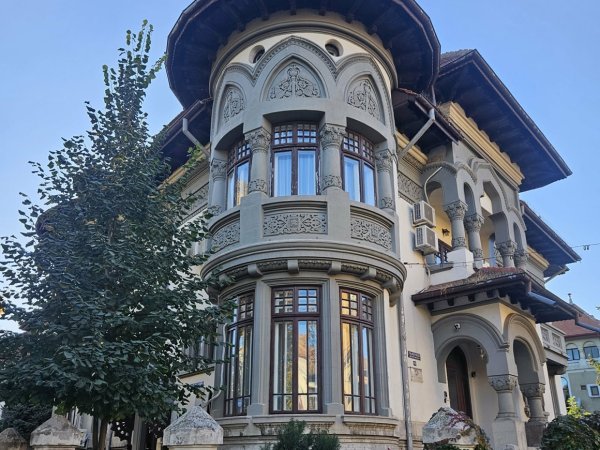
Located discreetly at the corner of Dr. Mihail Obedenaru-Gheorghiade Street and Dr. Louis Pasteur Street, the villa does not attract attention through spectacular dimensions or ostentation. On the contrary, its charm lies in balanced proportions, harmonious lines, and in the subtle way in which the Neo-Romanian style is reinterpreted. It is a house that impresses through refinement and through the attention given to details, evoking a period in which constructions were designed to last over time and to enrich the urban landscape.
In a city that has changed profoundly over the last century, the Cezar Golici Villa remains a testimony of the elegant Bucharest of the past, a place where architecture, social status, and good taste met in a natural way.
Virginia Andreescu Haret, the pioneer of Romanian architecture
The story of this villa cannot be understood without speaking about the architect who designed it. Virginia Andreescu Haret is an essential figure in the history of Romanian architecture, being the first woman in Romania who obtained a diploma in architecture.
Born into a family of intellectuals, Virginia Andreescu Haret showed from an early age a passion for drawing and constructions. She studied at the Superior School of Architecture in Bucharest, at a time when the field was dominated almost exclusively by men. Her perseverance and talent, however, made the social barriers of the era be overcome, and her name became synonymous with professionalism and innovation.
Throughout her career, Virginia Andreescu Haret designed numerous important buildings, both private residences and public edifices. Her style combined the tradition of Romanian architecture with modern influences, and her works stood out through geometric clarity, well-calculated proportions, and a special attention given to decorative details.
The Villa of Colonel Cezar Golici is an eloquent example of this architectural vision. Although it is not one of her most monumental works, the house perfectly illustrates the way in which the architect managed to transform a residence into an object of urban art.
Bucharest of the 1920s and the elegance of Neo-Romanian architecture
The interwar period represented for Bucharest an era of intense development and cultural effervescence. The city was expanding rapidly, and the new residential neighborhoods were becoming the ideal ground for architectural experiments.
In those years, the Neo-Romanian style was one of the most appreciated currents. Inspired by traditional Romanian architecture, but adapted to modern urban requirements, this style emphasized decorative elements such as arches, loggias, sculpted columns, or roofs with pronounced slopes.
The architects of the era, however, did not limit themselves to a simple copying of traditional forms. They reinterpreted these elements in a modern manner, adapting them to the urban lifestyle of the Bucharest elite. The result was an elegant, balanced architecture deeply connected to national identity.
In this context the Villa of Colonel Cezar Golici was also built. The house perfectly reflects the spirit of the time: a mixture of tradition, modernity, and refinement. It is a building that does not try to dominate the landscape, but to integrate harmoniously into it.
The Villa of Colonel Cezar Golici – discretion and refinement
Built in 1928, the villa was conceived as a residence for Colonel Cezar Golici, a representative of the military elite of the era. The choice of a prestigious architect for designing the house shows the social status of the owner, but also the desire to have an elegant and modern home.
The building stands out through a balanced composition, in which each volume is carefully proportioned. The façades are decorated discreetly, without ornamental excesses, and the Neo-Romanian elements are integrated with finesse.
One of the aspects that defines the villa is the geometric rigor of the composition. Virginia Andreescu Haret managed to create a harmony between vertical and horizontal lines, between solid spaces and open ones. This careful balancing gives the house a natural elegance, which does not need decorative artifices to impress.
Although the house is not very large in size, it conveys a sense of stability and solidity. This is due both to the well-thought proportions and to the way in which the architectural elements are arranged.
The discreet location in a quiet corner of the city
Another aspect that contributes to the charm of this residence is its location. The villa is situated at the intersection of Dr. Mihail Obedenaru-Gheorghiade Street and Dr. Louis Pasteur Street, in a quiet area of Bucharest.
This positioning gives it an almost intimate air. The house seems hidden from the agitation of the city, as if it belonged to a calmer and more elegant Bucharest, in which life unfolded at a different rhythm.
The architecture of the villa takes advantage of this placement. The street corner is used to create interesting perspectives, and the volume of the building subtly adapts to the surrounding urban space. Thus, the house becomes not only a residence, but also a discreet landmark in the landscape of the neighborhood.
For the hurried passerby, the villa may seem just one of the many interwar houses of the city. But for those who look carefully, it reveals a remarkable level of architectural refinement and balance.
A lesson in architecture and good taste
The Villa of Colonel Cezar Golici is more than just a historic residence. It represents a lesson about the way in which architecture can combine aesthetics, functionality, and respect for the urban context.
In the period in which it was built, architects placed emphasis on the harmony between the building and the surrounding environment. Houses were designed to integrate into the fabric of the city, not to dominate it. This philosophy is perfectly found in the project of Virginia Andreescu Haret.
Every detail of the villa seems carefully thought out: from the proportions of the façade to the way in which the decorative elements are integrated into the whole. The result is a balanced architecture that combines tradition with modernity in a natural way.
Today, when many of the historic buildings of Bucharest are threatened by degradation or aggressive real estate developments, such houses gain an even greater value. They are witnesses of an era in which the city was built with patience, attention, and respect for beauty.
The Cezar Golici Villa thus remains a discreet jewel of Neo-Romanian architecture, but also a proof of the talent of Virginia Andreescu Haret. In the quietness of the streets where it stands, the house continues to tell, without noise, the story of a Bucharest that knew how to build elegantly.
We also recommend: Famous houses of Bucharest: Filipescu-Cesianu House, the Most Beautiful Building in Belle Epoque Bucharest. Which Museum It Hosts Today