Did you know that... the first shopping center opened in Bucharest was the Unirea Store?
- Articles
- 20 AUG 26
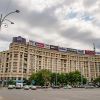
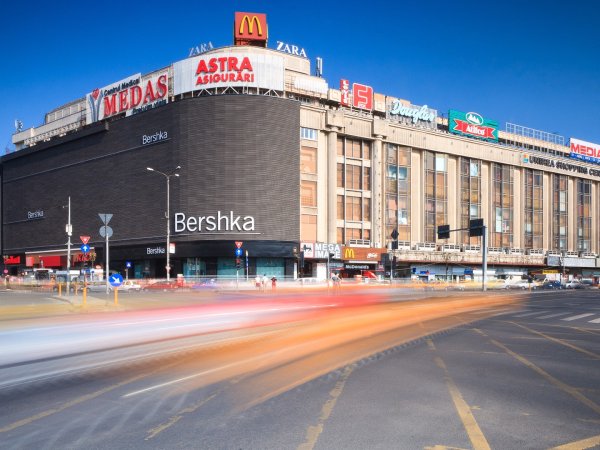
For many Bucharest residents, the Unirea Store is simply one of the iconic buildings in the city center. It is a place that has been passed through by generations of people, whether for shopping, meeting friends, taking a walk through the city center, or, later on, for the restaurants and shops that appeared inside. Few still remember, however, that today’s Unirea Shopping Center has a history of nearly five decades and that, at the time of its inauguration, it represented one of the most spectacular commercial achievements in Romania. The “Unirea” Department Store was inaugurated on September 2, 1976, in Unirii Square, and quickly became one of the most important commercial destinations in the capital, the project being designed by a team of specialists led by architect Gheorghe Leahu. In the 1970s, the building was known as a department store, not a “mall” in the contemporary sense of the word. However, its scale, the large number of departments, and the variety of products made Unirea a direct precursor of the large shopping centers that would appear after 1990. In collective memory, it has thus remained the first major modern shopping center in Bucharest.
How the Unirea Store appeared in the city center
Construction of the “Unirea” Department Store began in early 1973, during a period when Bucharest was undergoing major urban transformations. The project was coordinated by architect Gheorghe Leahu, and the new building was intended to become an important commercial hub in the city center. The choice of Unirii Square was not accidental: the area represented one of the most important urban nodes of the capital, and the store was meant to serve a very large number of shoppers.
On September 2, 1976, the building was officially inaugurated in the presence of Nicolae Ceaușescu. For its time, its dimensions were impressive. The initial structure was concentrated in the central body facing Unirii Square, and the building had eight levels, two of which were below ground. The usable commercial area was approximately 30,000 square meters.
In materials dedicated to the history of Bucharest, the store is described as the “flagship of Romanian commerce,” a phrase that illustrates the ambition of the project. It was not an ordinary neighborhood store, but a commercial complex of unusual size for Romania at that time. Its appearance also changed the way Bucharest residents perceived shopping in the city center.
A department store designed as a commercial city
Unirea was organized into levels and specialized departments, allowing shoppers to find a wide range of products within a single building. The basement housed the food section, while the other levels were dedicated to categories such as general goods, footwear, textiles, clothing for women, men, and children, and other consumer products. Documentation from the Bucharest Municipal Museum shows that the store was designed specifically to meet a very broad range of customer needs.
For a shopper in 1970s Romania, the experience was different from that offered by ordinary stores. The size of the building, the number of departments, and the multi-level organization turned a simple shopping trip into an urban experience. Unirea was a place where people could spend a long time exploring different commercial areas, even though the actual product offer was, in many periods, limited by the shortages specific to the socialist economy.
Thus, Unirea became a landmark of the city center. Its location in Unirii Square gave it extraordinary visibility, and the constant flow of people in the area contributed to its success. Later, the development of public transport and the metro network further strengthened the area’s position as one of the most important traffic hubs in Bucharest.
The 1980s expansion made the store even more impressive
The building inaugurated in 1976 was not the final form of the complex. In the 1980s, the Unirea Store was expanded with two new wings, known as the Călărași wing and the Splai wing. The expansion significantly changed the size of the complex and transformed the original structure into a much larger commercial center.
Historical and documentary sources indicate that the entire complex reached an area of approximately 84,000 square meters. Thus, Unirea became not only one of the largest department stores in Romania, but also an architectural and commercial landmark impossible to ignore in central Bucharest. Its scale must also be seen in the context of the era: major Western shopping centers already had different characteristics, but for socialist Romania such a complex was a major achievement.
The expansion consolidated the store’s role in the daily life of the capital. Unirea was no longer just a place where people went to buy products, but had become a reference point and a meeting place. For many generations, the phrase “let’s meet at Unirea” became almost synonymous with meeting in downtown Bucharest.
After the Revolution, Unirea entered a completely new world
The regime change of 1989 radically transformed Romanian commerce as well. In the 1990s, the Unirea Store shifted from a socialist department store model to a commercial center where multiple retailers and brands could operate. For the Romanian public, this was the period when store windows began to look very different, and Western brands became increasingly accessible.
Unirea greatly benefited from its central location and the notoriety it had gained during the communist period. In the years after the Revolution, the building became an important destination for international brands entering the Romanian market. Stores such as Sony, Panasonic, Adidas, and Nike were associated with this period of transformation of the commercial center.
For a generation of Bucharest residents, Unirea became one of the first places where they could see and buy products from well-known Western brands. Before modern malls appeared in the capital, going to Unirea could carry the same sense of novelty and excitement that later shopping centers built on Western models would offer.
A symbolic moment of this transformation was the opening of the first McDonald’s restaurant in Romania in 1995, at Unirea. Thus, the building became part of a much broader cultural and commercial shift: Romania’s entry into the market economy and its closer alignment with Western consumer models.
Why modern malls changed Unirea’s destiny
In the 2000s, Bucharest began to fill with shopping centers built on a completely different model. Modern malls appeared, with spacious layouts, air conditioning, parking lots, cinemas, restaurants, entertainment areas, and a carefully curated mix of brands. Competition thus became much stronger for a commercial center built in a different era.
However, Unirea had an advantage that new malls could not easily replicate: its ultra-central location. Unirii Square is one of Bucharest’s most important transport hubs, and its proximity to the Old Town, institutions, hotels, and the Palace of the Parliament keeps the area highly frequented. Colliers highlights precisely this accessibility and central position as important arguments for the future of the complex.
Nevertheless, consumer behavior has changed. People began to prefer shopping centers closer to home or work, and in Bucharest and its surroundings more than 50 shopping centers and commercial galleries have appeared in the last two decades, according to Colliers. By the end of the 1990s, Unirea had been the only major shopping center in the capital, but the market diversified rapidly afterward.
In this context, some of Unirea’s spaces began to remain vacant, and the shopping center gradually lost its status as the dominant shopping destination. The food court on the top floor remained for a long time one of the attractions that brought visitors, but even this was not enough to restore the complex to its former popularity.
What is happening today with Unirea Shopping Center
Unirea Shopping Center has not disappeared and has not closed its doors. On the contrary, the building continues to operate and host shops, restaurants, and services, but it is going through a period of transformation. In 2025, Unirea Shopping Center announced a partnership with Colliers Romania for an extensive process of repositioning and redefining its commercial spaces.
The plans aim to transform the complex into a multifunctional urban space, adapted to the way people consume, work, and spend their time today. The concept under analysis includes restaurants and cafés, entertainment and cultural areas, sports facilities, rooftop bars, co-working spaces, and even offices. The process is expected to be carried out in stages, starting with the Splai wing, continuing with the central area, and then the Călărași section.
The repositioning is all the more interesting as the Unirii Square area itself is undergoing a period of transformation and infrastructure works. For a complex that has been one of the symbols of Bucharest commerce for decades, this change may represent a new opportunity. However, the goal is no longer a return to the department store model or the classic mall model, but the creation of a space that combines retail with services, gastronomy, culture, and entertainment.
Unirea, between nostalgia and the future of Bucharest
Seen today, the Unirea Store tells the story of the last nearly five decades of Bucharest’s history. It appeared in a period when commerce was organized under a socialist system and became, for people at the time, the symbol of a modern and massive store. After 1989, the same building transformed into a space where Romanians discovered Western brands, new products, and a different shopping culture.
Then modern malls arrived, and Unirea gradually lost its dominant position. Nevertheless, the shopping center has not lost its most important quality: its place in the geography of Bucharest and in the memory of its residents. Official and historical documentation confirms that Unirea has been, since its inauguration, one of the most important commercial units in Romania, and its expansion in the 1980s further strengthened its scale and role.
We also recommend: When was the Unirea Shopping Center in Bucharest built, what is its total floor area, and why are major brands reluctant to rent retail space there?