Circului Park in Bucharest, brief history: The garbage pit, the brick factory and today’s public garden
- Articles
- 15 APR 26
The history of Circului Park in Bucharest begins long before this space became an oasis of greenery in the middle of the Capital. In the second half of the 19th century, the area had nothing of its current charm, being dominated by industrial activities and the exploitation of natural resources. In 1865, the German entrepreneur Max Tonola established here a brick factory, one of the first of this kind in the city.
From clay exploitation to the Tonola pit
For the production of bricks, clay was necessary, and it was extracted directly from that land. Over time, through continuous digging, a large pit was formed, later known as the “Tonola pit”. This cavity, resulting from intense industrial activity, was to play an essential role in the future transformation of the area.
The brick factory operated for a long time, becoming one of the most long-lived industrial units of this type in Bucharest. Its activity continued until 1935, when production was stopped, and the land was left abandoned. The former clay quarry gradually turned into an unused space which, in the absence of proper arrangement, was perceived as a degraded area, close to the image of a garbage pit.
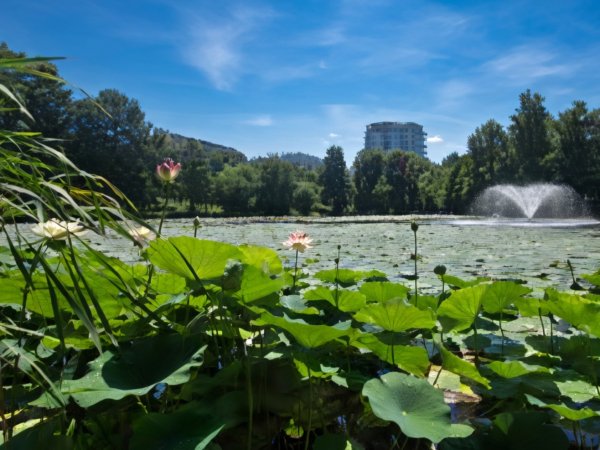
However, nature began to reclaim its place. In the depression formed, water from natural springs accumulated, giving rise to a lake. This natural element would later become the central point of one of the most beautiful parks in Bucharest.
The arrangement of the park and the vision of architect Valentin Donose
The radical transformation of the area took place during the communist period, when the authorities decided to capitalize on the land. Between 1959 and 1960, the State Circus Complex in Bucharest was built nearby, an impressive complex intended for performances, with a hall of over 2,000 seats and facilities for artists and animals.
The building was designed by a team of architects led by Nicolae Porumbescu, together with specialists such as Constantin Rulea, Nicolae Pruncu, S. Bercovici, A. Aioanei, I. Podocea and V. Donoser. The appearance of this complex also generated the need to arrange a green space around it, which would complete the urban ensemble.
Thus, in 1961, the park itself was arranged, according to the plans of landscape architect Valentin Donose. His project completely transformed the former industrial area, making use of the existing relief and the naturally formed lake. The park came to have an area of approximately 26 hectares, becoming one of the largest and most original green spaces in Bucharest.
Donose’s vision was a modern one for that time. He integrated the lake into the landscape, created winding alleys, relaxation areas and spaces planted with various species of trees and shrubs. At the same time, he emphasized plant diversity, introducing less common species for the local climate, but which adapted successfully.
The spectacular flora and the charm of the lake
One of the defining elements of Circului Park is its lake, fed by natural springs. This is not a simple ornamental lake, but a complex ecosystem, which has supported over time a remarkable biodiversity.
The best-known attraction is represented by the Egyptian lotuses (Nelumbo nucifera), a rare species in Romania, declared a natural monument. The presence of these spectacular flowers turns the lake into a unique point of attraction, especially during the blooming period, when the water surface is covered with delicate pink flowers.
Besides lotuses, the park also hosts other valuable plant species. Among them are trees such as ginkgo biloba, plane trees and bald cypresses, as well as various ornamental plants with Mediterranean influences. This diversity gives the park a special appearance, different from other green spaces in the Capital.
Inside the park can also be admired sculptures made by the artist C. Teodorescu, who transformed trunks of dried trees into works of art. These artistic interventions add originality and create an interesting dialogue between nature and human creation.
The fauna of the lake is also diverse. Here live fish, wild ducks and European pond turtles (Emys orbicularis), species that contribute to the natural balance of the area and to its charm.
Current problems of the lake and the ecosystem
Despite its beauty, Circului Park is currently facing numerous problems, which affect both the lake and the vegetation. One of the most serious situations is the decrease in the water level of the lake, a phenomenon observed in recent years.
According to the statements of the mayor Nicușor Dan, the main cause is represented by the constructions in the area, built with deep foundations, which have affected the underground springs that fed the lake. The clogging of these natural sources led to a significant reduction in water volume.
This situation has direct consequences on the ecosystem. The low water level endangers not only the Egyptian lotuses, but also the aquatic fauna. Fish, birds and turtles are affected by habitat changes, and the natural balance of the lake is threatened.
The authorities have proposed solutions to remedy the situation, including the creation of deep wells to supply the lake. These measures are essential for the conservation of this unique ecosystem and for maintaining the attractiveness of the park.
The degradation of vegetation and the lack of irrigation
Another major problem is related to the park’s irrigation system, which has not been functional for several years. Under the conditions of increasingly hot summers, the lack of water has led to the drying of a significant number of trees and shrubs.
It is estimated that approximately 250 trees have dried out, and the famous pine alley has been left without the vegetation that defined it. This degradation affects not only the appearance of the park, but also the comfort of visitors, who benefit less from the shade and coolness offered by vegetation.
The situation has drawn the attention of the local community, and civic groups have begun to actively get involved in finding solutions. The Lake Tei Civic Initiative Group has initiated petitions and discussions with local authorities, trying to draw attention to the problems and propose concrete measures.
Revitalization initiatives and future perspectives
Following the dialogue between citizens and authorities, several measures have been proposed for the revitalization of the park. Representatives of the Administration of Lakes, Parks and Recreation Bucharest, through the general director Bogdan Tănase, discussed the need to restore the irrigation system and to implement a sustainable management plan.
Among the measures already taken is the replanting of 31 trees to replace those cut recently. At the same time, new species of trees and shrubs have been introduced, such as magnolia, maple, ash, birch, red oak and cherry plum, in an attempt to restore the affected vegetation.
Another important project is the one called AWARD, which involves innovative solutions for managing water resources and protecting green spaces. The implementation of such initiatives could significantly contribute to the recovery of the park.
In the long term, the salvation of Circului Park depends on effective collaboration between authorities and the community. Investments, constant monitoring and a clear strategy are needed for the conservation of this green space.
A symbol of urban transformation
Circului Park today represents a clear example of urban transformation. From an industrial area, marked by clay exploitation and degradation, it has become a green space appreciated by the inhabitants of Bucharest.
Its history reflects the changes the city has gone through over time: industrialization, urbanization, but also concern for quality of life and environmental protection. The lake, vegetation and artistic elements create a unique landscape, combining nature with human intervention.
Even though it faces difficulties, the park remains an important place for the community. Walks along its alleys, the view of the lake and the beauty of the lotuses continue to attract visitors, offering a refuge in the hustle of the city.
In the end, the story of Circului Park is one of adaptation and rebirth. From the Tonola pit to today’s public garden, this space demonstrates that, through vision and involvement, even the most degraded places can become landmarks of the city.
We also recommend: The history of the circus in Bucharest: from acrobats, stunt performers, and entertainers to today’s Metropolitan Circus