Business visa for Bucharest. What foreigners coming for conferences, fairs or business meetings need to know
By Raluca Ogaru
- Articles
- 30 JUN 26
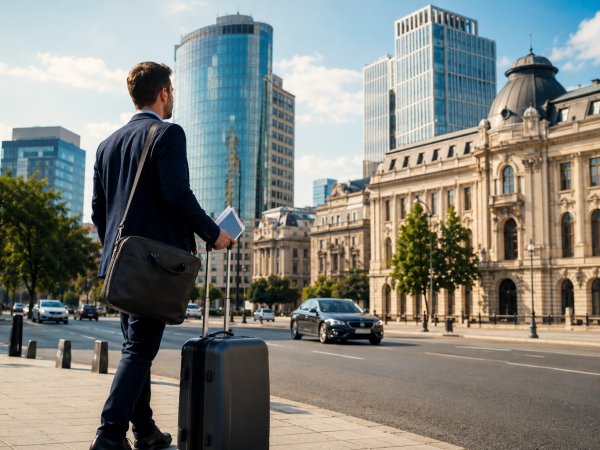
Bucharest is not only a city-break destination, but also a city where more and more foreigners arrive for conferences, fairs, corporate meetings, negotiations, networking events or short-term commercial projects. For citizens of the European Union, things are simple: they can enter Romania based on the right to free movement. For citizens from outside the EU, however, a business visit must be prepared more carefully, especially if their country of citizenship does not benefit from visa-free travel to the Schengen Area.
Since 1 January 2025, Romania has been a full member of the Schengen Area, after internal land border controls with Bulgaria and Romania were lifted, according to the decision announced by the Council of the European Union. This means that, for short stays, travel rules must be understood in the Schengen context, not only as a local Romanian regulation. For someone coming to Bucharest for business purposes, the essential question is simple: are they allowed to enter without a visa, or do they need to obtain a short-stay business visa before departure?
Who needs a business visa for Bucharest
The first thing a foreign citizen coming to Bucharest for business must check is the visa regime applicable to their nationality. Citizens of the EU, EEA and Switzerland do not need a visa to enter Romania. By contrast, third-country nationals must verify whether they benefit from visa-free entry for short stays in the Schengen Area or whether they need a visa before travelling.
The Romanian Ministry of Foreign Affairs provides the official e-Visa portal, where applicants can check whether they need a visa and can start the online visa application procedure, depending on the purpose of travel. For a business visit, this check should be made before buying tickets, especially if the trip is linked to a conference, fair or meeting with a fixed date.
In Romanian consular terminology, the short-stay visa for business is often marked as C/A. Romanian consular pages describe it as a visa granted to third-country nationals travelling to Romania for economic or commercial purposes. This is the category that may be relevant for someone coming to Bucharest for negotiations, meetings with partners, business conferences, fairs or short-term commercial activities.
It is important for the purpose of travel to be clear from the application stage. A business visit is not the same as employment in Romania. If the person is coming to work effectively for a Romanian employer or to stay long term, the legal regime is different. The European Commission explains, in its guide for non-EU workers in Romania, that employment requires a work authorisation and a long-stay visa for employment, while stays longer than 90 days also require a temporary residence permit.
What you can do with a short-stay business visa
A business visa is designed for short-term activities, not for settling in Romania. In practice, it can cover participation in a conference, congress, trade fair, meetings with business partners, negotiations or discussions related to contracts. For Bucharest, this is especially relevant in areas where corporate events are concentrated: Romexpo, large hotels in the centre and north of the city, coworking hubs, and the Pipera, Floreasca, Barbu Văcărescu, Victoriei or Universitate areas.
For the visitor, the difference should be understood simply: you may come for meetings, presentations, business discussions, event participation or specific commercial activities, but you should not treat a business visa as a solution for actual employment in Romania. If the activity involves employment, a local salary, a work contract or a longer-term presence, the work and residence regime must be checked, not only the visit regime.
Short stays in the Schengen Area are generally limited to 90 days in any 180-day period. For those who travel frequently in Europe for business, this rule matters a lot, because days spent in other Schengen countries are added together. A person coming to Bucharest after repeated visits to Germany, France, Italy or Austria must calculate the total time spent in the Schengen Area, not only the days spent in Romania.
For event organisers in Bucharest, this information is just as important. If you invite speakers, consultants, partners or participants from third countries, it is useful to send them in advance the documents that justify the purpose of travel: invitation, event programme, organiser details, venue address and contact information.
Documents and steps: what to check before applying
The exact list of documents may vary depending on the consulate, the applicant’s nationality, the type of visa and the specific situation. However, for a business visit, the documents generally aim to establish the same things: who the applicant is, why they are coming to Bucharest, where they will stay, how they will cover their expenses, whether they have medical insurance and whether there are clear reasons for them to return to their country of departure.
Romanian consular pages indicate, for the C/A visa, documents such as a valid passport, completed application form, recent photographs, documents proving the purpose of travel, return ticket, travel medical insurance and, where applicable, an invitation or documents from the company or institution justifying the trip. In some cases, the invitation must be approved by the General Inspectorate for Immigration, and the Ministry of Foreign Affairs states that an invitation is required for certain types of short-stay visas, including business.
For someone coming to a conference, the invitation should be as clear as possible: the participant’s full name, the period, the purpose of travel, the name of the event, the address of the venue, the organiser’s details and, if applicable, who covers the costs. For a business meeting, the Romanian company can provide a letter explaining the commercial relationship, the purpose of the visit and the estimated duration.
The application can be initiated through the e-Visa portal of the Ministry of Foreign Affairs, which allows online application and checking the status of the request. However, the online application does not automatically mean that the entire process is completed digitally. In many cases, the applicant must appear at the competent diplomatic mission or consular office for the verification of original documents, an interview or final formalities.
How long it can take and how much a business visa can cost
For a useful article on București.ro, the most accurate wording is that the processing time must be checked with the competent consulate, because it can vary depending on the country from which the application is submitted, the season, the complexity of the file and possible additional checks. In practice, for business trips, applying at the last minute is one of the biggest mistakes.
Visa fees are published by the Ministry of Foreign Affairs on the page dedicated to processing fees. Because values and exceptions may change, the applicant should always check the current fee directly on the official website or with the Romanian diplomatic mission responsible for their file.
In addition to the visa fee, the real costs of the trip must also be taken into account: plane ticket, accommodation in Bucharest, local transport, medical insurance, possible translations, legalisations or administrative costs for documents. If the trip is paid for by the inviting company, this should be clearly mentioned in the submitted documents.
For companies in Bucharest inviting foreign partners, preparing documents in advance can make a major difference. An invitation sent late, without clear details or without justification of the business purpose, can delay the process. In the case of large events, organisers are advised to include on their website a section for international participants, with information about visas, the airport, transport and accommodation.
What visitors should know after arriving in Bucharest
Once in Bucharest, the business visitor should organise their time very practically. Henri Coandă International Airport is the main air gateway to the capital, and the connection to the city can be made by train, bus, authorised taxi or ride-sharing. For meetings in the northern part of the city, areas such as Aviației, Pipera, Floreasca and Barbu Văcărescu may be more convenient than the Old Town.
For conferences at Romexpo, accommodation in the Piața Presei Libere, Expoziției, 1 Mai, Domenii or northern Bucharest areas can reduce time lost in traffic. For events in the centre, areas such as Universitate, Piața Victoriei, Calea Victoriei, Piața Romană or Amzei provide good access to hotels, restaurants, cafés and cultural institutions.
Bucharest can be a difficult city during rush hours. A trip that looks short on the map can take much longer in traffic, especially in the morning and evening. For important meetings, the metro is often the most predictable option, especially on routes connecting the centre with the north, west or south of the city.
For visitors staying only two or three days, the programme should be organised by areas, not by addresses scattered across the city. One day for meetings in the north, one day for the centre and one evening for networking or dinner are often more efficient than repeated trips between opposite ends of the capital.
Common mistakes that can complicate a business visit
The first mistake is confusing a business visit with the right to work. A person coming to a conference or negotiation is not in the same situation as someone who is going to be employed in Romania. For employment, the procedure involves different documents, authorisations and, usually, a long-stay visa for work.
The second mistake is applying too late. Business events have fixed dates, and flights and hotels become more expensive as the date approaches. If the visa is delayed, the entire trip may be compromised. That is why the visa regime should be checked immediately after receiving the invitation.
The third mistake is an unclear file. A vague invitation, an unconfirmed hotel booking, the lack of proof of the purpose of travel or inconsistencies between the event period and the visa period requested can create problems. For business travel, the documents must form a coherent picture: who is inviting the visitor, why, for how long and who is paying.
The fourth mistake is ignoring the 90/180-day rule. Because Romania is part of Schengen, a visitor who travels frequently in Europe must calculate their days of stay across the entire Schengen Area. Bucharest may be only one stop, but the rule applies to the total number of short-stay trips.
Why Bucharest is worth a business visit
Bucharest is a good city for business meetings precisely because it has a useful combination: an international airport, large hotels, conference spaces, office areas, restaurants, coworking hubs and a growing tech scene. For a foreign participant, the capital can work both as a practical destination and as an urban experience.
Outside the official programme, the city offers enough options for a few free hours: a walk on Calea Victoriei, dinner in the Amzei area, a quick visit to the Romanian Athenaeum, the National Museum of Art, the Village Museum or the Old Town. For those coming to Romania for the first time, these stops can turn a strictly professional trip into a good introduction to the city.
READ ALSO:
Business etiquette guide for expats: how to better understand Bucharest's business culture
For local organisers, the visa part is increasingly important. An international conference does not mean only speakers and a venue, but also clear information for non-EU participants: what documents may be necessary, when to apply, what address the event has, which hotels are recommended and which contacts can help in case of administrative questions.
In the end, the business visa for Bucharest should not be seen as an obstacle, but as a planning stage. If the documents are prepared correctly, the purpose of the visit is clear and the application is submitted in time, a few days in the capital can be enough for productive meetings, networking and a good first experience of the city.