Bucharest's Lost Open-Air Pools: How the City Cooled Off 50 to 100 Years Ago, at Tei and Floreasca
- Articles
- 17 JUN 26
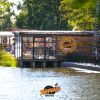
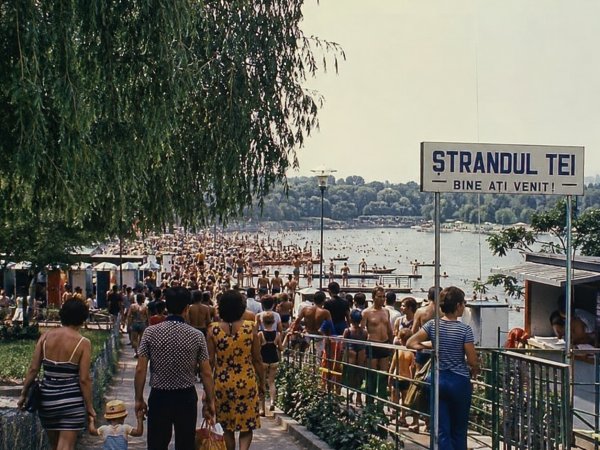
Of the open-air pools that once lined the shores of Lake Tei, almost nothing remains standing today — only ruins overrun by vegetation, in a place where, a generation or two ago, thousands of Bucharest residents spent every summer Sunday. One of several pools that operated along the lake's shore — sources vary, putting the number at six, seven, or eight — stayed open until sometime in the '90s, drawing tens of thousands of Bucharest residents who had no real chance of getting a train ticket to the seaside.
Before the Pools: Heat Waves and Swimming Wherever You Could
Until the late 1920s, Bucharest had no modern pool facility with purpose-built basins — though that doesn't mean people didn't cool off at all. The Dâmbovița River was informally turned into a swimming spot by less particular Bucharest residents, while those with more means preferred older bathing establishments, such as the "Apele Minerale" baths in the south of the city. It was only toward the end of the '20s and the beginning of the '30s that the idea of a proper "ștrand" (the local term for an outdoor pool complex) became a heated subject of public debate. Period press accounts suggest that even Nicolae Iorga had reservations about such a project for the capital — at least according to a polemical 1929 piece in the magazine "Vremea," which ironically paraphrased his position as suggesting the city needed public baths and libraries first. The dispute died down, according to 1930 press reports, with the opening of a pool at Șosea, praised at the time as the city's "very first" and described as an unexpectedly big success.
Four Pools for an Entire City
Things moved forward after that, but not fast enough. By 1936, Bucharest had only four pools: Kiseleff, Tirul, Obor, and Lido. The last one, located on Magheru Boulevard, was described by the interwar press as a kind of elegant little jewel tucked between buildings and traffic, with a blue mosaic pool and shaded tables where cold syrups were served — a place for youth and high society, accessible more through appearance than through the price of admission. A year later, the summer of 1937 brought a heat wave that the press described in almost apocalyptic terms: sidewalks that, according to the newspapers of the day, reached 60 degrees Celsius — a figure modern historians view with skepticism, given the measurement methods available at the time. The boulevards emptied out, the trams ran nearly empty, and thousands of people sought refuge at the pools — including those who, on any other day, would have considered swimming beneath their station.
Floreasca, the City's Lakeside Beach
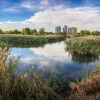
For those living in the north-eastern part of the capital, the summer refuge was Lake Floreasca. There, in Bordei Park, laid out — according to the press — in 1936 right on the water's edge, Bucharest residents sunbathed directly on the grass or on makeshift pontoons and swam in designated areas of the lake. It wasn't a pool with concrete basins, but rather an urban beach, with lake water standing in for the sea — enough, on scorching days, to draw crowds to the shore.
Tei, the People's Pool of the Communist Era
If the interwar period was the age of elegant pools, the communist decades turned swimming into a mass ritual. With the seaside out of reach for most people, and Sunday being the only day off for "working people," Lake Tei became one of the city's main summer refuges, alongside Floreasca and Băneasa. Shaded paths lined with willows and poplars, swimming basins, boat rides and pedal boats, chess and backgammon games set up by the water — all of it filled summer Sundays to capacity, and the trams heading to the pool were, according to some accounts, given extra cars to handle the crowds.
That same summer also took a tragic turn. On Sunday, August 6, 1967, the ferry "Haiducul," which ran daily routes between the Tei Park dock and the pool's shore, was caught in a sudden, powerful storm. Overloaded — accounts put nearly 200 people on board, against a capacity of 120 — the boat capsized. The tragedy was covered up by the communist authorities, who forbade the press from reporting on it; only the foreign press and Western diplomats reported, at the time, on a disaster on a lake on the outskirts of Bucharest, with a death toll estimated at close to 100 people — a figure that remains, to this day, officially unconfirmed.
What's Left of Them
After 1990, increasing pollution in Bucharest's lakes put an end to swimming, and the pools at Tei, Floreasca, and elsewhere in the city were abandoned one by one. Plans to redevelop the chain of lakes around the capital have, for years, gone nowhere beyond paper, and what's left of the pools today are ruins — in a place where, a generation or two ago, thousands of Bucharest residents spent every summer Sunday.
Also recommended Bucharest’s lakes: 20 aquatic landmarks with stories
Photo: AI-recreated image