Bucharest ranks 20th in the world for traffic congestion. What is the average driving speed in the city?
By Raluca Ogaru
- Articles
- 31 JUL 26
Bucharest ranks 20th in the global list of cities with the highest congestion levels, according to the 2025 edition of the TomTom Traffic Index. Romania’s capital recorded an average congestion level of 62.5%, slightly higher than in the previous year.
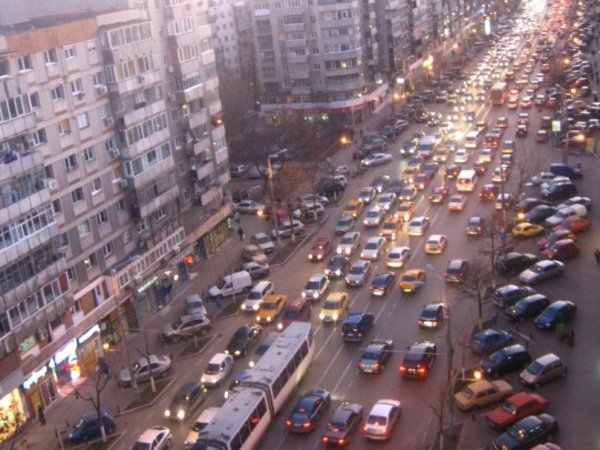
The average speed measured across the city’s road network was only 18.5 kilometres per hour, while a driver covered approximately 4.6 kilometres in 15 minutes. Conditions become even more difficult during rush hour, when the average speed falls to around 14 kilometres per hour.
The figures come from the 15th edition of the TomTom Traffic Index and are based on journeys completed throughout 2025. The company analyses anonymised GPS data from real trips to compare driving speeds, travel times and congestion levels in cities around the world.
Bucharest ranks 20th in the global congestion table
With an average congestion level of 62.5%, Bucharest occupies 20th place in TomTom’s global ranking. The figure is 0.3 percentage points higher than in 2024, indicating a slight deterioration in traffic conditions.
The top positions are occupied by Mexico City, with a congestion level of 75.9%, Bengaluru, with 74.4%, and Dublin, with 72.9%. Barranquilla ranks immediately ahead of Bucharest, with 62.8%, while Romania’s capital exceeds numerous European and international cities in terms of the additional time spent in traffic.
The 20th-place position should be understood as a ranking based on congestion levels, rather than simply average driving speed. Two cities may have similar speeds but different congestion figures, depending on their infrastructure, speed limits and the time required to travel when roads are clear.
TomTom defines the congestion level as the increase in travel time caused by additional traffic. A figure of 62.5% means that journeys through Bucharest took, on average, 62.5% longer than they would have under completely free-flowing traffic conditions.
What is the average speed in Bucharest?
In 2025, the average speed recorded across Bucharest’s road network was 18.5 km/h. During a 15-minute period, a driver covered an average of only 4.6 kilometres, approximately 200 metres less than in 2024.
The average travel time for a 10-kilometre journey was 32 minutes and 26 seconds. Compared with the previous year, drivers needed one minute and 11 seconds more to cover the same distance.
These figures represent averages calculated across the entire year, including all days and time periods analysed. They cover both congested intervals and hours when traffic was lighter.
During rush hour, the average speed drops to approximately 14 km/h, one kilometre per hour slower than in 2024. In practice, cars move at a speed similar to that of a bicycle being ridden at a moderate pace.
A 10-kilometre evening journey can take more than 45 minutes
The most serious problems occur during the evening rush hour. TomTom calculated an average travel time of 45 minutes and 7 seconds for a 10-kilometre journey. The average speed during this period falls to 13.3 km/h, while the congestion level reaches 117.7%.
In the morning, the same distance takes an average of 40 minutes and 32 seconds. The average speed is 14.8 km/h, while congestion reaches 97.5%.
A congestion level above 100% does not mean that every street is completely blocked. It indicates that the journey takes more than twice as long as it would under free-flowing traffic conditions.
The hourly traffic map shows the highest values on working days, particularly between approximately 4:00 p.m. and 7:00 p.m. Tuesday, Wednesday and Thursday stand out for heavy congestion towards the end of the working day, while Saturday and Sunday record visibly lower levels.
How much time do Bucharest drivers lose in traffic?
A driver who regularly travelled during rush hour lost approximately 171 hours in traffic over the course of 2025. This is equivalent to seven days and three hours spent behind the wheel because of congestion.
The amount of time lost increased by seven hours and 40 minutes compared with 2024. This figure does not represent the total time spent in the car, but the difference between the real journey time and the time that would have been required in free-flowing conditions.
The annual estimate is based on a standard rush-hour commuting model. Each driver’s experience may differ depending on the route, distance, schedule and number of days on which they use a car.
Someone who crosses the city every day may lose even more time. For a person who works from home, rarely uses a car or travels outside busy periods, the impact may be considerably lower.
What was the most congested day of 2025?
The most difficult day for travelling through Bucharest was Tuesday, October 7, 2025. On that day, the average congestion level reached 106%.
At 5:00 p.m., the indicator climbed to 176%, while only 2.6 kilometres could be covered in 15 minutes. This corresponds to an average speed of just over 10 km/h.
At monthly level, the highest congestion figures were recorded in October and November, both reaching an average of approximately 73%. August was the best month for drivers, with a congestion level of 44%, as holidays reduced the number of daily journeys.
The data confirms a familiar pattern in the capital: traffic improves during the summer but deteriorates rapidly once schools reopen and employees return from holiday.
How TomTom calculates its traffic data
The TomTom Traffic Index uses anonymised information about real journeys and driving speeds collected from navigation systems and connected devices. The 2025 edition is based on journeys totalling more than 3.65 trillion kilometres worldwide.
For every location, the company analyses both the central urban area, defined as “city”, and the wider metropolitan area, referred to as “metro”. The ranking in which Bucharest occupies 20th place refers to the central urban area.
Congestion is calculated by comparing real travel times with the shortest times recorded under completely free-flowing traffic conditions. The indicator therefore measures not only the number of vehicles, but also their impact on journey duration.
READ ALSO:
Education in Bucharest: How traffic and commuting time impact school performance
The conclusion for Bucharest is clear: a driver travels at an average speed of 18.5 km/h, falling towards 14 km/h during rush hour. A journey of just 10 kilometres may take more than 45 minutes, while congestion can consume the equivalent of an entire week over the course of a year.