Bucharest in 2025: a retrospective of projects launched and completed, and the visible changes across the city
By Bucharest Team
- Articles
- 27 DEC 25
How does Bucharest close out 2025? In a familiar state: a city under construction. It was not a year of grand openings or spectacular transformations, but rather a year defined by difficult interventions, unavoidable construction sites, and projects that finally moved from promises to execution. From the consolidation of the Unirii Planșeu—one of the capital’s most sensitive pieces of infrastructure—to works across the metro network and the reconfiguration of public space, 2025 brought disruption, but also laid the groundwork for changes that had long been postponed.
The Unirii Planșeu: the most serious central-city project in decades
In June 2025, reconstruction and consolidation works began on the Unirii Planșeu, a structure dating back to the 1930s that supports one of the busiest areas of Bucharest. Beneath it lie not only major utility networks, but also key metro lines.
The intervention came late, but it was unavoidable. Technical assessments pointed to real risks of structural degradation and water infiltration, and authorities framed the project as a matter of public safety rather than urban aesthetics. The works required major traffic restrictions along Splaiul Independenței and a reorganization of circulation in the area, with a direct impact on daily life in the city center.
The People’s Salvation Cathedral: a symbolic moment of completion in 2025
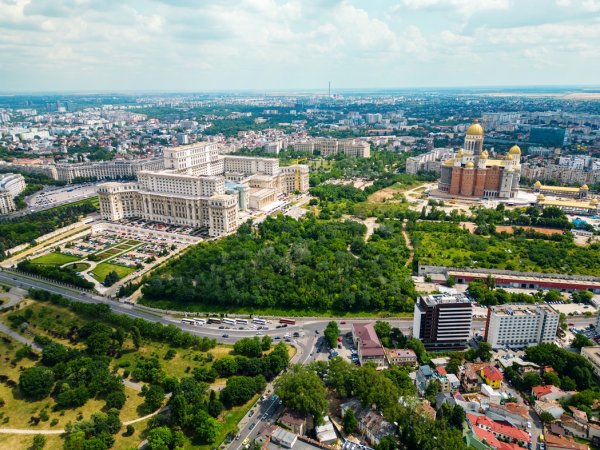
One of the few large-scale projects to reach a meaningful stage of completion in 2025 was the People’s Salvation Cathedral, which officially opened to the public in October, following the consecration of its interior iconography. While the building’s structural works and partial openings had taken place in previous years, 2025 marked the moment when the cathedral became fully functional and accessible to worshippers and visitors alike. The event carried strong symbolic weight and closed a significant chapter in a long, controversial project that has nonetheless become a defining presence in Bucharest’s urban and cultural landscape. Beyond the public debates surrounding costs and priorities, the cathedral’s opening stood out as one of the rare instances in 2025 where a major urban project reached a clear point of completion.
The metro: slow modernization and extensions that still require patience
In 2025, Metrorex continued works and procedures related to the extension of Metro Line M6 toward Henri Coandă International Airport—a project launched years ago and repeatedly pushed toward later deadlines. While no new stations were opened this year, 2025 brought contracts, preparatory works, and secured funding for sections already under construction.
At the same time, modernization continued in older stations: upgrades to installations, safety systems, and accessibility. These are changes that tend to go unnoticed, but they remain essential for a network that carries hundreds of thousands of passengers every day.
Alternative mobility: cycling starts to be taken seriously—on paper, and partly on the ground
One of the more important steps in 2025 was progress on Bucharest’s Velo Masterplan, a document outlining a coherent network of bicycle lanes connected to public transport and designed for everyday use, not decoration. The plan envisions hundreds of kilometers of cycling infrastructure to be implemented gradually over the next decade.
In practice, however, 2025 delivered adjustments and pilot projects rather than a radical shift. Fragmented routes and conflicts with car traffic remain unresolved issues, but for the first time, the direction has been clearly and officially defined.
“Străzi Deschise”: a city experienced on foot, not from behind the wheel
The “Străzi Deschise – Bucharest” program continued and expanded in 2025. Calea Victoriei once again became pedestrian-only on weekends, while cultural events spread into neighborhood streets. For many residents, this offered the most direct experience of a different kind of city—slower, more breathable, more human.
Public data shows high participation rates and generally positive public perception, even as critics continue to point to traffic-related inconveniences. The initiative remains one of the few projects that has tangibly changed how people relate to public space.
A city under construction, not a “finished” one
Beyond these major projects, 2025 also brought routine repairs, targeted upgrades, the digitalization of certain administrative services, and attempts at urban reorganization that rarely make headlines but still matter.
Bucharest did not transform radically in a single year. But it did begin—tentatively and with many setbacks—to repair what had long been ignored and to test alternatives to a city model defined by congestion and improvisation.
2025 will likely be remembered as the year Bucharest accepted that the difficult work could no longer be postponed. The real results will come later, but for now, the direction appears—at least momentarily—to be a coherent one.