Alba Iulia Square, the Great Union and the history of the Romanian Principalities. Where the name of the most well-known square in Bucharest comes from

- Articles
- 29 APR 26
Bucharest is a city in which many streets, boulevards, and squares bear names loaded with history. Some recall important personalities, others decisive moments for the destiny of the country, while others evoke cities that had a fundamental role in the formation of the modern Romanian state. Among the best-known such places is Alba Iulia Square, one of the most important urban areas of the Capital, located in Sector 3 and directly connected to one of the most spectacular road axes of Bucharest.
The history of Alba Iulia Square
For many Bucharest residents, Alba Iulia Square is known especially as an important traffic point, a modern area with restaurants, elegant buildings, and wide boulevards. However, beyond the current urban image, its name sends directly to one of the strongest symbols of Romanian national identity: the city of Alba Iulia in Transylvania.
The choice of this name is not accidental at all. Alba Iulia is the place where, on December 1, 1918, the Union of Transylvania with Romania was proclaimed, the moment that completed the formation of the unitary national Romanian state. At the same time, the city is also associated with the first great political union of the three Romanian countries, achieved by Michael the Brave in the year 1600. For this reason, Alba Iulia is known as “The Fortress of Union” and, often, as “The Other Capital of Romania.”
Thus, Alba Iulia Square in Bucharest is not only an important geographical landmark, but also a form of tribute paid to one of the most symbolic cities in the history of Romanians.
Why the square in Bucharest bears the name Alba Iulia
The name of Alba Iulia Square comes directly from the city of Alba Iulia in Alba County, one of the most important historical localities of Romania. The name was chosen to emphasize the role that this city had in the process of formation and consolidation of the Romanian state.
Alba Iulia is not only an important Transylvanian city, but a true symbol of national unity. Here took place, on December 1, 1918, the Great National Assembly that popularly legitimized the union of Transylvania and Banat with the Kingdom of Romania. This moment represented the final act of the Great Union and remained one of the most important dates in the modern history of the country.
By assigning this name to an important square in the Capital, Bucharest keeps alive the memory of that historical event and creates a symbolic connection between the political center of Romania and the city that became the emblem of national union.
Moreover, Alba Iulia was already loaded with historical significance before the year 1918. The city had been, centuries earlier, the place where Michael the Brave achieved the first political union of the three Romanian countries: Wallachia, Moldavia, and Transylvania. Even though that union was temporary, its symbolic value remained enormous.
That is why, when we speak about Alba Iulia Square in Bucharest, we actually speak about a name that concentrates centuries of history, the idea of unity, and the constant aspiration of Romanians toward a common state.
Alba Iulia, from the Roman castrum Apulum to the capital of Transylvania
The importance of the city of Alba Iulia begins as early as Antiquity. On the site of the current fortress there was the Roman castrum Apulum, one of the most important military and administrative centers of Roman Dacia.
After the conquest of Dacia by the Romans, Apulum became a major strategic point, having an essential role in controlling the province. Important troops were stationed here, and the economic and urban development of the area was remarkable for that era.
Centuries later, Alba Iulia kept its political importance. Between the years 1541 and 1711, the city was the residence of the princes of Transylvania and, practically, the political capital of the Principality of Transylvania. During this period, Alba Iulia became the center of political, administrative, and diplomatic power in the region.
The fact that the princes of Transylvania had their residence here transformed the city into a place of great influence in Central and Eastern Europe. Important decisions regarding the fate of the province were made here, and Alba Iulia had become a symbol of authority and political stability.
This historical continuity explains why the city was chosen, later, for events with strong symbolic value. Alba Iulia was not only a suitable geographical space, but a place with a deep historical memory, associated with the idea of leadership and unity.
Michael the Brave and the first union of the three Romanian countries
One of the most important pages in the history of Alba Iulia is connected to Michael the Brave and to the first political union of Moldavia, Wallachia, and Transylvania.
Between the years 1595–1596, under Sigismund Báthory, but especially between 1600–1601, under Michael the Brave, Alba Iulia became the residence of the political leader of the three Romanian countries found in personal union.
In the year 1600, Michael the Brave achieved what seemed impossible for that era: bringing under the same leadership the three great provinces inhabited mostly by Romanians. Even though this union was short-lived, it had a huge symbolic value and became a fundamental landmark in Romanian historical consciousness.
Alba Iulia was the center of this political construction and the place from which Michael the Brave exercised authority over the entire united territory. That is why the city remained associated with the idea of national unity long before the Great Union of 1918.
For the following generations, Michael the Brave became the symbol of the first attempt to unify Romanians, and Alba Iulia was seen as the natural place of this historical aspiration.
Precisely this symbolic weight made it so that, more than three centuries later, the space for proclaiming the definitive union of Transylvania with Romania was chosen here.
December 1, 1918 and the Great National Assembly
The most important moment in the modern history of the city of Alba Iulia took place on December 1, 1918, when the Great National Assembly was held here.
At the end of the First World War and in the context of the collapse of the Austro-Hungarian Empire, the Romanians from Transylvania convened in Alba Iulia a representative assembly in order to decide the future of the province. Tens of thousands of people came then to the city to participate in one of the most important moments in national history.
The Great National Assembly popularly legitimized the union of Transylvania and Banat with the Kingdom of Romania, thus confirming the formation of Greater Romania. It was the political act that completed the process of union begun in 1859 through the Union of the Principalities and continued through independence in 1877.
The importance of this moment was enormous. It was not only an administrative or diplomatic decision, but the expression of the collective will of the Romanians from Transylvania. Alba Iulia thus became the place where the ideal of national unity became reality.
That is why December 1 was later chosen as Romania’s National Day, and the city definitively received the symbolic status of “The Fortress of Union.”
Alba Iulia Square in Bucharest bears this name precisely in order to keep alive the memory of that founding moment of the modern Romanian state.
The coronation of King Ferdinand and the consolidation of the national symbol
The historical importance of the city of Alba Iulia was strengthened even more in the year 1922, when the official coronation ceremony of King Ferdinand I and Queen Maria took place here.
This event was not chosen by chance to take place in Alba Iulia. The choice of the city represented a symbolic confirmation of its role as the historical capital of Romanian unity.
Ferdinand I thus became the king of Greater Romania, and the ceremony marked not only a royal coronation, but also the official recognition of the new state resulting after the Great Union. Queen Maria, one of the most important figures of the era, was also part of this historical moment.
Through this ceremony, Alba Iulia consolidated its status as a symbolic city of national identity. It was no longer only the place of a major political act, but it became the ceremonial space of the new united Romania.
This symbolic dimension explains why Alba Iulia is often called “The Other Capital of Romania.” Even though Bucharest is the administrative and political center, Alba Iulia remains the historical and emotional capital of the idea of national unity.
Where Alba Iulia Square is located in Bucharest
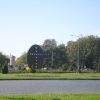
Alba Iulia Square is located in Sector 3 of Bucharest, in one of the best-known and most spectacular urban areas of the Capital. Its modern development took place especially during the communist period, in the context of the large-scale arrangement of the area adjacent to Unirii Boulevard.
The square represents an important road and urban planning hub, being designed as a central point from which three of the most important boulevards of the city start: Decebal Boulevard, Burebista Boulevard, and Unirii Boulevard.
This positioning gives it major strategic importance in Bucharest traffic and transforms it into an easily recognizable landmark for the residents of the Capital. The area is characterized by wide boulevards, modern buildings, restaurants, cafés, and appreciated residential complexes.
Alba Iulia Square is often visually compared to large Western urban squares due to its symmetry and spectacular artesian fountains, which complete the monumental image of the area.
Thus, the name Alba Iulia does not remain only a historical reference from textbooks, but becomes part of the everyday life of Bucharest residents. Every time someone crosses this square, they symbolically pass through a place that carries the memory of one of the most important pages in Romania’s history.
We also recommend: Famous boulevard names: Decebal, the last king of the Dacians, rival of Emperor Trajan, ancestor of the Romanian people