A Complete Walk Around Lacul Morii: What You'll Find on Each Shore
- Articles
- 08 JUN 26
Lacul Morii is Bucharest's largest lake — 246 hectares of water, 7 kilometres long, built in 1986 as a reservoir to protect the city from flooding. Ceaușescu ordered the construction of the Ciurel Dam, 400 homes disappeared underwater, a church was demolished, a cemetery paved over with concrete. Today, on that same ground, people with headphones jog at sunset while fishermen quietly arrange their lines.
If you've visited Lacul Morii before, you've probably only seen the embankment — the main promenade, the most visible and most visited part. But the lake has four shores that are completely different in energy, landscape and atmosphere. A full circuit covers roughly 12 to 14 kilometres and takes a few hours during which Bucharest looks like somewhere else entirely.
The eastern shore — the embankment, the promenade, the sunset
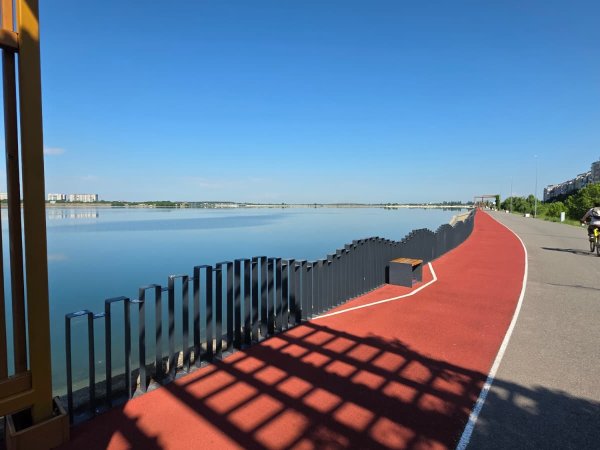
This is the Lacul Morii that everyone knows. The main embankment, facing the water, has transformed in recent years from an abandoned riverbank into one of the most popular promenades in the sixth district. The path is wide, paved and lined with wooden pergolas, benches and lamp posts — comfortable for both cyclists and runners.
In the evening, the embankment becomes one of the few places in Bucharest where the sunset opens up without obstruction. The sun drops directly over the western shore, no tower blocks in the way, and turns the water orange. It's not an exaggeration — people come specifically for this, tripods set up an hour in advance.
From the embankment you can also see the island, currently a full construction site. Insula Îngerilor — the Island of Angels — entered rehabilitation in February 2025 and is set to have a beach, floating islands, pontoons for water sports and lush vegetation, with a completion date estimated for late 2026. Once finished, access will be by jetty and the pontoons will host kayaks, paddleboards and windsurfers. For now it's an active building site, visible from the embankment, cranes and scaffolding included.
Getting there: metro to Crângași, then 10 minutes on foot through Parcul Crângași, up the steps and you're on the embankment. Alternatively, a bus to the Ciurel stop.
The northern shore — where the quiet begins
If the embankment is busy and full of people, the northern shore is something else entirely. The stretch runs from Șoseaua Virtuții toward Chiajna, passing behind the Giulești and Crângași neighbourhoods. Works on a promenade along the northern shore began recently as part of Phase II of the Lacul Morii Park project — roughly 4 kilometres of path, a cycling lane, a running track and hundreds of new trees. It's an active construction zone, but the shape of what it will become is already visible.
Until those works are complete, the northern shore remains the least visited section of the circuit. Water is visible through the trees, traffic from the road behind sounds distant, and along the bank you'll occasionally find a fisherman with a folding chair and a flask. It's the kind of quiet you don't expect to find 6 kilometres from the centre of Bucharest.
The western shore — open fields, wide sky
The western shore is the least urban of all four. Across the water, you're already outside Bucharest — at the boundary with the commune of Chiajna, the village of Roșu, flat fields and open horizon. This rural edge gives the area a texture completely unlike the rest of the circuit.
There's no paved promenade on the western shore. There's a worn dirt path, grass, occasionally mud after rain. There's also heat, because the trees are sparse and the sun hits directly. It isn't spectacular in any conventional sense — which is precisely why it's worth it. The water is a few steps away, the silence is complete, and on windy days there are small waves you wouldn't believe existed on a lake inside a capital city.
The southern shore — new, clean, with a view toward the Polytechnic
The southern shore was developed relatively recently into a promenade, accessible from Aleea Lacul Morii. It's shorter than the main embankment but quieter and neater, with a view toward the Faculty of Power Engineering at the Polytechnic University of Bucharest, which reflects in the water on calm mornings.
The area draws mostly residents from the Militari and Grozăvești neighbourhoods — families with children at weekends, students during the week. It isn't crowded, it isn't dramatic, it's simply pleasant. A place where you can sit on a bench and have nothing happen around you for fifteen minutes, which in Bucharest qualifies as a small luxury.
Practical notes for the full circuit
The complete loop around the lake is roughly 12 to 14 kilometres depending on how close to the water you walk on the wilder shores. On foot it takes 2.5 to 3 hours without stops. By bike, just over an hour.
The best starting point is Parcul Crângași — metro access 10 minutes away, toilets, water and shade before you set off. If you walk clockwise, you'll reach the western shore around sunset, exactly when the light is at its best.
The area has become one of the most popular spots in the city for jogging, cycling and evening walks, and the embankment fills up quickly on warm weekends. For quiet, come early on a weekday morning.
One final note: the lake is still changing. The Lacul Morii Park project envisions a linear park of 16.6 hectares running around the entire perimeter, with green spaces, sports facilities, cycling paths and water access on all shores. Those who visit now see a construction site and a promise. Those who come back in a few years will find something else altogether.